

Archive position — measured, not model output
0 likes on Devpost
2,263 of the 7,850 archived projects have more likes, and 5,587 share exactly 0 — so this project's #2,882 place in the like-ranked listing is a tie-break inside that group, not a ranking.
Projects (log scale)
Likes on Devpost. ▲ marks this project's group.
Show the figures
| Likes | Projects | Share of archive |
|---|---|---|
| 0 | 5,587 | 71.2% |
| 1 | 1,758 | 22.4% |
| 2 | 284 | 3.6% |
| 3–4 | 132 | 1.7% |
| 5–9 | 75 | 1.0% |
| 10+ | 14 | 0.2% |
 User Stories BotA demo video on every pull request
Get a demo video on every new feature
GitHub App that watches your pull requests and records a narrated, captioned demo.
Save time on demo prep and make informed decisions faster with a video walkthrough of every new feature.
Executive Summary
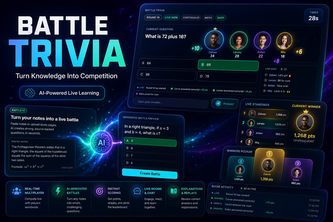
What the company appears to be: Battle Trivia is a self-reported AI-powered learning platform that allows users to turn study notes or images into live multiplayer trivia battles using GPT-5.6. It includes features like real-time multiplayer gameplay, question review, source proof, and leaderboards.
What changed: During OpenAI Build Week, the author added "Battle It" — a new feature enabling AI-generated trivia from user content, with human review and editing capabilities.
Single most important open question: Is there any evidence of user adoption, revenue, or customer traction beyond the author's self-description?
Analysis basis: This report is based entirely on the self-reported project description provided by the author. No external verification or historical data are available. All claims are treated as stated by the author and not independently confirmed.
What The Product Actually Is
The description states that Battle Trivia is:
- An AI-powered real-time multiplayer learning platform.
- It supports three main experiences:
- Battle Trivia: Continuous live trivia rooms with scoring, chat, leaderboards.
- Word Scramble: A word unscrambling game.
- Battle It: AI-generated trivia from user notes or images.
The system uses GPT-5.6 to generate questions and explanations from user input, which must be reviewed before use in a private multiplayer lobby.
Inference: The platform appears designed for educational or personal learning use, with competitive elements to increase engagement.
Positioning & Claim Evolution
The author states that Battle Trivia started from the idea that “learning becomes more memorable when it feels competitive, social, and rewarding.” This suggests a positioning around gamified learning and social interaction.
During Build Week, the platform evolved to include:
- AI-generated content (Battle It)
- Human review of generated questions
- Source-backed explanations
- Private multiplayer lobbies
Claim: The author positions Battle Trivia as a tool that combines AI with human oversight for effective learning.
Inference: The evolution from a basic trivia platform to one incorporating AI-generated content indicates an attempt to innovate in the educational space.
Target Customer & ICP
The description does not explicitly define target customers or ideal customer profiles (ICP). However, it implies:
- Users who study or prepare for exams.
- Individuals or groups looking to make learning more engaging through competition.
- Educators or students using collaborative tools.
Claim: The platform targets learners seeking interactive and competitive study methods.
Inference: The inclusion of teacher controls and classroom features in future plans suggests an intent to serve educational institutions, though this is not yet evidenced.
Business Model & Pricing Evidence
There is no evidence of pricing or business model in the description. The author does not mention monetization strategies, subscriptions, or paid features.
Claim: No commercial structure is described.
Inference: If the platform is intended for educational use, it may be free-to-use or supported via institutional licensing — but this is speculative without further data.
Technical & Delivery Signals
The project uses:
- Frontend: React, Vite, JavaScript, Tailwind CSS
- Backend: ASP.NET Core .NET 8, C#, PostgreSQL, Dapper, Npgsql
- Real-time communication: SignalR
- AI: GPT-5.6 (via OpenAI API)
- Deployment: Docker containers behind Caddy
Key technical decisions include:
- Mandatory human review of AI-generated content.
- Rate limiting to prevent abuse.
- Separation of AI-generated lifecycle from existing features.
- Use of structured output validation for AI responses.
Claim: The system is built with modern tech stacks and includes safeguards for responsible AI use.
Inference: The architecture shows an attempt to integrate AI into an existing platform while maintaining control over quality and safety.
Traction & Maturity Signals
There is no evidence of user traction, revenue, or customer adoption. The description mentions:
- A single developer (Zakhele Khawula)
- No mention of users, customers, or usage metrics
- No funding rounds or valuation mentioned
Claim: No data on product maturity or market traction.
Inference: The project appears to be a prototype or early-stage development effort.
Competitive Context
The description does not reference competitors. However, it implies a space that includes:
- Educational platforms with gamification
- AI-powered learning tools
- Multiplayer trivia apps
Claim: No competitive landscape is described.
Inference: The platform likely competes in the broader educational technology and AI-assisted learning market — but no specific competitors are named.
Open Questions & Risks
Key risks identified from the description:
- No traction or revenue evidence – The platform appears unproven in the market.
- Single-person team – Limited capacity for scaling or development.
- AI dependency without clear safeguards – While human review is included, it's unclear how scalable this process is.
- Unverified AI output quality – No data on accuracy or reliability of GPT-5.6-generated content.
- No monetization strategy – Unclear path to profitability.
Inference: The lack of any commercial or user metrics raises concerns about viability and scalability.
Questions the description leaves open
- What is the current user base, if any?
- Are there any early adopters or pilot users?
- How do you plan to monetize this platform?
- What are your plans for scaling beyond a single developer?
- How do you ensure consistent quality in AI-generated content?
- Have you considered privacy implications of handling personal study materials?
- What is the long-term vision for the product beyond Build Week?
Overall Assessment
There is no evidence to support commercial viability, traction, or scalability.
Assessment: Not evidenced.
Inference: This appears to be an early-stage prototype or hackathon project with limited commercial potential at this time. Further due diligence would require evidence of user engagement, revenue, or product-market fit.
User Stories BotA demo video on every pull request
Get a demo video on every new feature
GitHub App that watches your pull requests and records a narrated, captioned demo.
Save time on demo prep and make informed decisions faster with a video walkthrough of every new feature.
Source
Submitted to the OpenAI 2026 hackathon on Devpost. Project home on Devpost. Back to the full gallery on Devpost.
This competitive analysis was produced by top-founders.com (opens in a new tab)
Generated by a language model from this project's public Devpost page — its tagline, the author's own write-up and any built-with tags listed there — as captured in August 2026. Short quotations are the author's words. It is an opinion on the idea as a business, not on the people behind it, and it reflects the description as published then. If the project has moved on, request a correction below. The analysis is not independent research and contains no verified traction, revenue or customer data.
An independent guide by KFG International LLC — not affiliated with, endorsed by, or connected to Devpost or OpenAI.