

Archive position — measured, not model output
0 likes on Devpost
2,263 of the 7,850 archived projects have more likes, and 5,587 share exactly 0 — so this project's #6,808 place in the like-ranked listing is a tie-break inside that group, not a ranking.
Projects (log scale)
Likes on Devpost. ▲ marks this project's group.
Show the figures
| Likes | Projects | Share of archive |
|---|---|---|
| 0 | 5,587 | 71.2% |
| 1 | 1,758 | 22.4% |
| 2 | 284 | 3.6% |
| 3–4 | 132 | 1.7% |
| 5–9 | 75 | 1.0% |
| 10+ | 14 | 0.2% |
 User Stories BotA demo video on every pull request
Get a demo video on every new feature
GitHub App that watches your pull requests and records a narrated, captioned demo.
Save time on demo prep and make informed decisions faster with a video walkthrough of every new feature.
Executive Summary
What the company appears to be
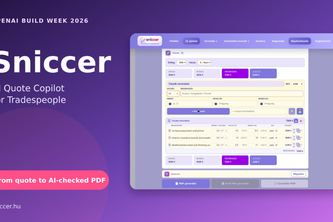
Sniccer is a self-reported web application built by one developer (Dénes B.) for tradespeople. It helps users create professional quotes using structured input and an AI review feature powered by OpenAI's GPT-5.6. The product is described as a mobile-friendly tool that integrates with WordPress, PHP, JavaScript, and PDF generation components.
What changed
The author states that Sniccer began as a personal solution to a problem identified through their son’s experience in construction. It evolved from an idea into a working prototype during a hackathon (OpenAI 2026), using AI tools like Codex and GPT-5.6 for development and refinement.
Single most important open question
Is there any evidence of actual user adoption, revenue or customer feedback beyond the author’s self-reported description?
Note: This analysis is based entirely on the self-reported project description provided by the caller. No external verification, traction data, or third-party sources are available. All claims are attributed to the author and labeled as such.
What The Product Actually Is
The description states that Sniccer is a mobile-friendly web application designed for tradespeople and small businesses to generate professional quotes. It allows users to:
- Enter customer and contractor details;
- Organize work into groups;
- Add material costs, labor fees, VAT, deposits, and totals;
- Generate a professional PDF quote;
- Save and reuse previous quotes.
The core functionality includes an AI Quote Review, which uses GPT-5.6 via the OpenAI API to analyze structured quotes for:
- Missing or inconsistent information;
- Spelling/wording issues;
- Unusually priced items;
- Forgotten work phases;
- Missing line items;
- Unclear sections.
Each AI suggestion is displayed separately and must be manually accepted or rejected by the user, ensuring control remains with the professional.
Claim: Sniccer is a quote generator with an AI review feature.
Evidence: Author's own write-up.
Positioning & Claim Evolution
The author positions Sniccer as a solution to a common problem in tradespeople’s quoting workflows—the lack of accessible, affordable tools that avoid complexity and repetition. The product is framed not as a revolutionary tech innovation but as a practical tool built from listening to real-world needs.
Key positioning elements include:
- A focus on simplicity and usability, especially for non-technical users.
- Emphasis on AI as a second pair of eyes, not an authoritative replacement.
- Use of AI to reduce mistakes and administrative burden without increasing complexity.
Claim: Sniccer aims to simplify quoting for tradespeople using AI assistance.
Evidence: Author's own write-up.
Target Customer & ICP
The target customer is described as:
- Tradespeople and small businesses, particularly those who do not want to use spreadsheets or complicated office software.
- Users who are highly skilled in their profession but lack time or technical knowledge for business administration tasks.
There is no explicit segmentation beyond this general group. The author does not describe specific industries, regions, or customer personas.
Claim: Sniccer targets independent tradespeople and small businesses needing simple quote creation.
Evidence: Author's own write-up.
Business Model & Pricing Evidence
No information is provided about pricing models, monetization strategies, or business model assumptions. The author does not mention whether the tool will be free, subscription-based, or sold as a one-time purchase.
Claim: Not evidenced.
Evidence: No mention of pricing or business model in the description.
Technical & Delivery Signals
The application is built using:
- WordPress
- PHP
- JavaScript
- AJAX
- PDF generation components
It integrates with OpenAI API and uses Codex for development assistance. The AI review process involves structured model responses to ensure suggestions are tied to specific quote fields.
Claim: Sniccer is a web-based tool built on WordPress and PHP, integrated with OpenAI.
Evidence: Author's own write-up.
Traction & Maturity Signals
There is no evidence of any traction, revenue, or customer usage beyond the author’s personal experience. The project was submitted to a hackathon and has not yet launched publicly or gathered users.
Claim: No traction or maturity signals.
Evidence: Author's own write-up.
Competitive Context
The description does not reference existing competitors or market players. It only mentions that free tools were too limited and paid systems were overly complex.
Claim: Not evidenced.
Evidence: No mention of competitive landscape in the description.
Open Questions & Risks
- Single-founder development: The entire project is attributed to one person (Dénes B.), raising questions about scalability, long-term maintenance, and team structure.
- Unverified AI integration: While GPT-5.6 is mentioned, there’s no demonstration of how the AI actually functions or its accuracy in real-world use cases.
- No commercial viability evidence: No revenue, pricing, or user feedback is reported.
- Lack of product-market fit validation: The tool has not been tested with actual users beyond the author's son.
Inference: The lack of traction and commercial data raises concerns about whether Sniccer will gain adoption or generate value at scale.
Evidence: Author’s own write-up.
Questions the description leaves open
- How many tradespeople have you tested this with, and what was their feedback?
- What is your plan for monetization and scaling beyond the current prototype?
- Can you demonstrate how the AI review process works in practice?
- Are there any specific industries or professions where the tool performs better than others?
- How do you intend to support multilingual functionality and profession-specific rules going forward?
Inference: These questions aim to uncover whether the product has moved beyond concept into real-world testing.
Evidence: Author’s own write-up.
Overall Assessment
At this stage, Sniccer is a conceptual prototype developed during a hackathon. There is no evidence of revenue, customers, or traction. The author describes the tool as useful for solving a real-world problem but does not provide any data to validate that hypothesis.
Inference: This is an early-stage idea with potential but requires further validation and development before considering investment or partnership.
Evidence: Author’s own write-up.
User Stories BotA demo video on every pull request
Get a demo video on every new feature
GitHub App that watches your pull requests and records a narrated, captioned demo.
Save time on demo prep and make informed decisions faster with a video walkthrough of every new feature.
Source
Submitted to the OpenAI 2026 hackathon on Devpost. Project home on Devpost. Back to the full gallery on Devpost.
This competitive analysis was produced by top-founders.com (opens in a new tab)
Generated by a language model from this project's public Devpost page — its tagline, the author's own write-up and any built-with tags listed there — as captured in August 2026. Short quotations are the author's words. It is an opinion on the idea as a business, not on the people behind it, and it reflects the description as published then. If the project has moved on, request a correction below. The analysis is not independent research and contains no verified traction, revenue or customer data.
An independent guide by KFG International LLC — not affiliated with, endorsed by, or connected to Devpost or OpenAI.