

Archive position — measured, not model output
1 like on Devpost
505 of the 7,850 archived projects have more likes, and 1,758 share exactly 1 — so this project's #920 place in the like-ranked listing is a tie-break inside that group, not a ranking.
Projects (log scale)
Likes on Devpost. ▲ marks this project's group.
Show the figures
| Likes | Projects | Share of archive |
|---|---|---|
| 0 | 5,587 | 71.2% |
| 1 | 1,758 | 22.4% |
| 2 | 284 | 3.6% |
| 3–4 | 132 | 1.7% |
| 5–9 | 75 | 1.0% |
| 10+ | 14 | 0.2% |
 User Stories BotA demo video on every pull request
Get a demo video on every new feature
GitHub App that watches your pull requests and records a narrated, captioned demo.
Save time on demo prep and make informed decisions faster with a video walkthrough of every new feature.
Executive Summary
What the company appears to be
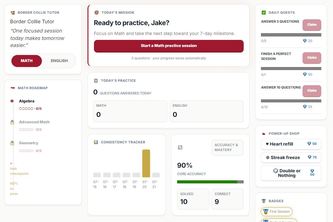
Daily1600 is a self-reported SAT prep app built as a hackathon project by two founders (Kevin Lee and Jake Lee). It claims to use AI-powered Socratic tutoring, gamification mechanics (streaks, hearts, gems), and a parent insight portal to make SAT preparation engaging and habit-forming. The product is described as a single-page web application with no backend dependencies, using local storage for student progress and OpenAI's GPT-5.6 for tutoring and diagnostics.
What changed
The project was submitted to the OpenAI 2026 hackathon. It is a self-reported prototype built in a short timeframe, not yet deployed or monetized.
Single most important open question
Is there evidence of real student usage, traction, or revenue that would indicate whether this product has moved beyond a proof-of-concept?
What The Product Actually Is
The description states that Daily1600 is a single-page web application built with React + TypeScript and styled with Tailwind CSS. It uses:
- Browser-based local storage for all student data (no backend required)
- OpenAI’s GPT-5.6 API to power:
- The “Border Collie Tutor” — a Socratic AI tutor that guides students through incorrect answers
- Parent diagnostics dashboard powered by GPT-5.6
- A gamification engine including:
- Daily streaks
- Heart system (limited lives)
- Gem economy
- Power-up shop
- Double-or-nothing wagering mode
The app is described as a Digital SAT prep tool, with features tailored to Math and English/Reading & Writing tracks.
Not evidenced
- No mention of actual users, customers, or revenue.
- No evidence of monetization or pricing model.
- No indication that the product has been released beyond the hackathon.
Positioning & Claim Evolution
The description states that Daily1600 aims to make SAT prep addictive by applying gamification and AI tutoring principles from successful habit-forming apps (e.g., language learning tools). It positions itself as an alternative to expensive private tutoring or passive prep methods.
Key claims:
- The app uses a Socratic pedagogy to guide students toward their own answers, not just provide them.
- It builds strong study habits through streaks and reward loops.
- It offers a parent insight portal for family engagement.
- The goal is to make achieving a perfect 1600 score feel earnable, not just purchasable.
Inference The positioning reflects an attempt to reframe SAT prep as a personalized, gamified learning experience, leveraging behavioral design and AI to improve retention and motivation.
Target Customer & ICP
The description states that the app is built for:
- Students preparing for the Digital SAT
- Specifically, those who are disengaged with traditional prep methods
- Parents who want to stay involved in their child’s academic progress
It also mentions that it was co-designed and tested by a 15-year-old student (Jake Lee), who is preparing for his own SATs.
Not evidenced
- No data on actual target demographic size or adoption.
- No evidence of broader market segmentation beyond the parent-student dyad.
- No indication of whether the app targets other test types or age groups.
Business Model & Pricing Evidence
The description does not state:
- Any pricing model
- Revenue streams
- Monetization strategy
- Subscription plans or one-time purchases
It mentions that the app uses GPT-5.6, which implies potential cost considerations, but no financial details are shared.
Inference Given its hackathon origin and lack of commercial details, it is unclear whether this project intends to become a paid product or if it's currently in prototype form.
Technical & Delivery Signals
The app is built as:
- A single-page application
- Using React + TypeScript, bundled with Vite
- Styled with Tailwind CSS v4
- Persisting data via localStorage
- Powered by OpenAI’s GPT-5.6 API
Key technical features include:
- Dual-engine fallback for AI tutor (local response when no API key is present)
- Prompt engineering architecture designed to enforce Socratic pedagogy
- Codex used for development acceleration
Not evidenced
- No mention of scalability, infrastructure, or deployment strategy.
- No evidence of performance metrics or user experience testing beyond the co-designer.
Traction & Maturity Signals
The description states:
- The app was built in a hackathon
- It is used daily by the co-founder (Jake Lee)
- It includes “real student” feedback and validation
However, there is no evidence of:
- External users or customer base
- Revenue or monetization
- Product adoption beyond the founder’s own use
- Any formal launch or marketing efforts
Inference The product appears to be in a pre-commercial prototype phase, with limited external traction.
Competitive Context
The description does not provide:
- Names of competitors
- Market size or share data
- Competitive positioning relative to existing SAT prep tools (e.g., Khan Academy, Kaplan, etc.)
It implies that the app is different due to its use of AI Socratic tutoring, gamification, and parental engagement features.
Inference The competitive landscape likely includes traditional SAT prep platforms and newer edtech apps using gamification or AI. However, no direct comparison or differentiation strategy is stated.
Open Questions & Risks
- No revenue or monetization model — the app is described as a prototype with no commercial intent.
- Unverified claims — all features are self-reported and untested in real-world conditions.
- Limited scalability — reliance on localStorage and browser-based architecture may not support large-scale use.
- Dependency on GPT-5.6 API — without clear pricing or infrastructure, long-term viability is uncertain.
- Founder co-designer is also the user — raises questions about objectivity and generalizability of feedback.
Questions the description leaves open
- What is your plan for monetization?
- How do you intend to scale beyond a single student’s use case?
- Have you validated the Socratic tutor with other students, or just Jake?
- Are there any plans to integrate with schools or educational institutions?
- What are the technical limitations of using localStorage for all data storage at scale?
- How will you handle API costs and access to GPT-5.6 in a production environment?
- Is there any plan for offline functionality beyond what is described?
Overall Assessment
Not evidenced.
There is no evidence of:
- Revenue or financial performance
- Customer acquisition or retention metrics
- Product-market fit beyond the founder’s own use
- Any formal business model or traction
This project appears to be a pre-commercial prototype, likely intended for demonstration or further development rather than immediate investment or partnership.
Confidence level Low. The description is self-reported and lacks any verifiable commercial data, user metrics, or product deployment details.
User Stories BotA demo video on every pull request
Get a demo video on every new feature
GitHub App that watches your pull requests and records a narrated, captioned demo.
Save time on demo prep and make informed decisions faster with a video walkthrough of every new feature.
Source
Submitted to the OpenAI 2026 hackathon on Devpost. Project home on Devpost. Back to the full gallery on Devpost.
This competitive analysis was produced by top-founders.com (opens in a new tab)
Generated by a language model from this project's public Devpost page — its tagline, the author's own write-up and any built-with tags listed there — as captured in August 2026. Short quotations are the author's words. It is an opinion on the idea as a business, not on the people behind it, and it reflects the description as published then. If the project has moved on, request a correction below. The analysis is not independent research and contains no verified traction, revenue or customer data.
An independent guide by KFG International LLC — not affiliated with, endorsed by, or connected to Devpost or OpenAI.