

Archive position — measured, not model output
0 likes on Devpost
2,263 of the 7,850 archived projects have more likes, and 5,587 share exactly 0 — so this project's #3,607 place in the like-ranked listing is a tie-break inside that group, not a ranking.
Projects (log scale)
Likes on Devpost. ▲ marks this project's group.
Show the figures
| Likes | Projects | Share of archive |
|---|---|---|
| 0 | 5,587 | 71.2% |
| 1 | 1,758 | 22.4% |
| 2 | 284 | 3.6% |
| 3–4 | 132 | 1.7% |
| 5–9 | 75 | 1.0% |
| 10+ | 14 | 0.2% |
 User Stories BotA demo video on every pull request
Get a demo video on every new feature
GitHub App that watches your pull requests and records a narrated, captioned demo.
Save time on demo prep and make informed decisions faster with a video walkthrough of every new feature.
Executive Summary
What the company appears to be
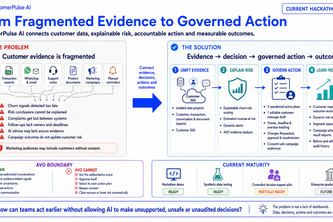
CustomerPulse AI is a self-reported B2B SaaS product designed as a governed workspace for customer retention and marketing. It claims to help teams manage customer evidence across multiple sources (spreadsheets, emails, WhatsApp) by importing and normalizing data into isolated projects. The system calculates an operational churn-risk index and supports explainable AVO (AI-validated observation) analysis of conversations, linking findings to specific evidence. It enforces human ownership for actions and outcomes, and includes governance features such as consent handling, campaign audience calculation, and audit trails.
What changed
The project description indicates a shift from generic AI tools that produce summaries or recommendations to a system where AI supports decision-making but does not replace human judgment. The key change is the emphasis on “Evidence before intervention,” which implies a move toward operational accountability in customer-facing workflows.
Single most important open question
Is there any evidence of actual usage, adoption, or traction beyond the developer’s own demonstration? The description states that the application can be used without login and includes mock data; however, it does not provide any indication of real-world deployment or customer engagement.
What The Product Actually Is
The description states that CustomerPulse AI is a governed customer-retention and marketing workspace. It allows users to:
- Create isolated projects
- Import various types of customer data:
- Records
- Transactions
- Authorized conversations
- Catalogues
- Guidelines
- Policies
- Campaign results
It then normalizes this data before updating the selected project, ensuring that all elements (customers, conversations, documents, alerts, actions, campaigns, analytics, audit history) remain isolated between projects.
The system calculates a churn-risk index using behavioral components like purchase recency, frequency, and spending trends. It also estimates revenue at risk based on this index.
It supports an AVO analysis of authorized customer conversations, returning:
- Evidence-linked summaries
- Sentiment and intent
- Complaints and unresolved issues
- Cancellation indicators
- Competitor mentions
- Price objections
- Missed commitments
- Confidence and uncertainty levels
- Three operational action plans
- One editable draft message
The system enforces that:
- AVO does not set the authoritative risk index
- AVO does not select its own action plan
- AVO does not approve its own recommendation
- It bypasses customer consent
- It does not claim an intervention succeeded
- It does not automatically reduce customer risk
It also includes a governed retention workflow that continues beyond recommendation generation, involving:
- Evidence validation
- Dynamic alerting
- Human review
- Owner and deadline assignment
- Execution
- Customer response
- Supported outcome
- Risk recalculation
- Audit and analytics
Additionally, it supports marketing intelligence, including:
- Segmentation by region and industry
- Triggered marketing opportunities
- Campaign audience calculation based on consent and contact availability
- Campaign results that update analytics or recalculate individual customer risk
The system is built using Next.js, React, TypeScript, and integrates with OpenAI-compatible APIs (e.g., Xiaomi MiMo), as well as Supabase for persistence.
Positioning & Claim Evolution
The description states that the company was inspired by the lack of connection between different sources of customer evidence (spreadsheets, WhatsApp, emails) and the absence of accountability in AI-assisted workflows. This led to a core principle: "Evidence before intervention."
This positioning reflects a shift from tools that generate AI summaries or recommendations to systems where:
- AI supports understanding
- Human ownership is enforced for actions
- Outcomes are tracked and fed back into operational records
The claim evolution shows a focus on governance, explainability, and human-in-the-loop decision-making rather than automation or unaccountable AI outputs.
Target Customer & ICP
The description states that the product is intended for Malaysian B2B and MSME customer-facing teams who manage relationships across multiple platforms like spreadsheets, transaction exports, WhatsApp, email, support notes, and manual reminders.
These users are described as managing fragmented customer evidence and seeking a way to connect signals before acting on them.
There is no explicit mention of other verticals or geographies beyond Malaysia, nor any indication of whether the product targets larger enterprises or only small businesses.
Business Model & Pricing Evidence
Not evidenced.
The description does not contain any information about pricing models, monetization strategies, or business model assumptions. No details are provided on how the product would be sold or who pays for it.
Technical & Delivery Signals
The system is built as a Next.js App Router application using React and strict TypeScript. It uses:
- ESLint
- TypeScript
- Unit tests (136 of 136 passed)
- Playwright workflows (49 of 49 passed)
- Vercel production deployment
- IndexedDB for browser storage
- Supabase for persistence
- OpenAI-compatible API integration (Xiaomi MiMo)
- GitHub and Vercel for deployment
It separates responsibilities into domain modules:
- Import validation and normalization
- Project and workspace isolation
- Customer tier calculation
- Churn-risk calculation
- AVO provider integration
- Evidence validation
- Approval and action-state transitions
- Marketing opportunity detection
- Consent-safe audience calculation
- Campaign lifecycle management
- Analytics and audit aggregation
The public walkthrough uses versioned browser storage and IndexedDB, allowing judges to create projects, upload files, switch projects, refresh the application, and inspect imported records without creating an account.
It includes:
- Demo Publisher for internal scheduling records
- A credential-gated Buffer adapter (not yet live)
- Deterministic fallbacks for AVO analysis
The final verified engineering baseline included:
- ESLint: passed
- TypeScript: passed
- Unit tests: 136 of 136 passed
- Playwright workflows: 49 of 49 passed
- Production build: passed
- Vercel production deployment: verified
Traction & Maturity Signals
Not evidenced.
There is no evidence of revenue, customers, or adoption beyond the authors’ own demonstration. The product is described as a hackathon submission and includes a public no-login walkthrough using mock data. No real-world usage or performance metrics are provided.
Competitive Context
Not evidenced.
The description does not mention any competitors or how CustomerPulse AI compares to existing solutions in the market for customer retention, marketing intelligence, or AI-driven CRM tools.
Open Questions & Risks
- No traction or revenue: The product is described as a hackathon submission with no evidence of real-world usage or monetization.
- Unverified claims: All claims are self-reported and unverified; there is no independent validation of the system’s functionality or effectiveness.
- Limited scope: The system appears to be built for a specific use case (Malaysian B2B/MSME teams) with no indication of scalability or broader applicability.
- Demo-only features: Some components like Buffer publishing are described as not yet live and require credential configuration.
- No customer feedback loop: There is no evidence that the product has been tested with actual users or that feedback has informed development.
Questions the description leaves open
- What is the actual user base for this tool? Has it been deployed in any real-world settings?
- How does the system handle data privacy and compliance (e.g., GDPR, local Malaysian regulations)?
- Are there plans to integrate with existing CRM or ERP systems?
- What are the key assumptions behind the churn-risk index model? Is it validated against historical data?
- How do you plan to monetize this product? What pricing model is being considered?
- What is the roadmap for moving from demo mode to full production deployment?
- How does the system ensure consistency and accuracy when importing data from various sources?
Overall Assessment
Not evidenced.
There is no evidence of any investment or partnership activity related to CustomerPulse AI beyond its submission to a hackathon. No funding rounds, investors, or strategic partners are mentioned in the description. The product remains at the prototype stage with no indication of commercial viability or traction.
User Stories BotA demo video on every pull request
Get a demo video on every new feature
GitHub App that watches your pull requests and records a narrated, captioned demo.
Save time on demo prep and make informed decisions faster with a video walkthrough of every new feature.
Source
Submitted to the OpenAI 2026 hackathon on Devpost. Project home on Devpost. Back to the full gallery on Devpost.
This competitive analysis was produced by top-founders.com (opens in a new tab)
Generated by a language model from this project's public Devpost page — its tagline, the author's own write-up and any built-with tags listed there — as captured in August 2026. Short quotations are the author's words. It is an opinion on the idea as a business, not on the people behind it, and it reflects the description as published then. If the project has moved on, request a correction below. The analysis is not independent research and contains no verified traction, revenue or customer data.
An independent guide by KFG International LLC — not affiliated with, endorsed by, or connected to Devpost or OpenAI.