

Archive position — measured, not model output
0 likes on Devpost
2,263 of the 7,850 archived projects have more likes, and 5,587 share exactly 0 — so this project's #3,599 place in the like-ranked listing is a tie-break inside that group, not a ranking.
Projects (log scale)
Likes on Devpost. ▲ marks this project's group.
Show the figures
| Likes | Projects | Share of archive |
|---|---|---|
| 0 | 5,587 | 71.2% |
| 1 | 1,758 | 22.4% |
| 2 | 284 | 3.6% |
| 3–4 | 132 | 1.7% |
| 5–9 | 75 | 1.0% |
| 10+ | 14 | 0.2% |
 User Stories BotA demo video on every pull request
Get a demo video on every new feature
GitHub App that watches your pull requests and records a narrated, captioned demo.
Save time on demo prep and make informed decisions faster with a video walkthrough of every new feature.
Executive Summary
What the company appears to be
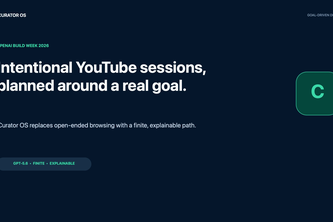
Curator OS is a self-reported YouTube curation tool built by one developer (Weifeng Jiang) that uses GPT-5.6 for goal-driven session planning and deterministic code for safety, relevance, and recall. It allows users to describe a learning or exploration goal, then generates a finite, explainable video queue based on that intent.
What changed
The project evolved from an existing system with explicit preferences, evidence-aware analysis, and deterministic scoring into a goal-driven discovery flow during a hackathon. It added GPT-5.6 session planning, visible thesis and query reasons, multilingual support (English and Simplified Chinese), and bounded recall for niche searches.
The single most important open question
Is there any evidence of user adoption, revenue, or traction beyond the author's own dogfooding and testing?
What The Product Actually Is
The description states that Curator OS is a YouTube curation tool designed to turn a real goal into an intentional viewing session instead of optimizing for infinite feed engagement. It uses GPT-5.6 for structured session planning and deterministic code for safety, relevance, and recall.
It allows users to describe what they want to learn or explore, then chooses a mode, language, recency window, and time budget. GPT-5.6 generates a concise session thesis and bounded set of search queries, each with a visible reason.
The system sanitizes queries, reapplies hard exclusions, down-ranks fatigued topics, limits recall, rejects irrelevant candidates before saving, and stops honestly when bounded search cannot find a good result.
It preserves the original discovery flow with no planner call if the goal is left blank.
Evidence The author states this functionality exists. No independent verification or user data provided.
Positioning & Claim Evolution
The project positions itself as a tool that turns YouTube's infinite feed into finite, explainable sessions planned by GPT-5.6 and bounded by deterministic safety, relevance, and recall.
It claims to be different from typical video feeds that optimize for one more click, instead focusing on limited time and attention.
Evidence The author states this is the intent and approach. No evidence of market positioning or competitive differentiation beyond self-description.
Target Customer & ICP
The description does not explicitly state a target customer or ideal customer profile (ICP). It describes a user who wants to learn or explore something specific, but does not define the persona or segment.
Evidence Not evidenced. The author only describes the use case of someone with a learning or exploration goal.
Business Model & Pricing Evidence
There is no evidence in the description of a business model or pricing structure. The project is described as a hackathon submission with no mention of monetization, subscriptions, or paid features.
Evidence Not evidenced.
Technical & Delivery Signals
The system uses Next.js, React, TypeScript, Zod, Prisma, PostgreSQL, Tailwind CSS, and the YouTube Data API. A dedicated OpenAI Responses API call uses GPT-5.6 for structured session planning, while GPT-5.6 Terra handles evidence-aware video analysis.
Safety, relevance, ranking, duplicate suppression, and fallback behavior remain code-owned. The author used Codex through Raft.build to audit the system, implement extensions in gated slices, generate regression coverage, compare models, inspect failure paths, and support QA.
The app includes 364 automated tests, TypeScript checks, Prisma validation, and a 22-route production build. It has responsive mobile QA, explainable query reasons, deterministic safety boundaries, and a public MIT-licensed repository.
Evidence The author states these technical details exist. No evidence of deployment, usage, or performance metrics beyond self-reported testing.
Traction & Maturity Signals
There is no evidence of user traction, revenue, customers, or adoption beyond the author's own dogfooding and testing. The project is described as a hackathon submission with no mention of users, downloads, or market engagement.
Evidence Not evidenced.
Competitive Context
The description does not provide any information about competitive landscape, existing solutions, or how Curator OS compares to other YouTube curation tools or AI-powered content discovery platforms.
Evidence Not evidenced.
Open Questions & Risks
- Single-person development: The project is built by one developer (Weifeng Jiang), which raises questions about scalability and long-term maintenance.
- No user data or traction: There is no evidence of users, customers, or adoption beyond the author’s own testing.
- Unverified technology claims: The description refers to GPT-5.6, which is not a publicly confirmed model version; this may be speculative or self-reported.
- No commercialization path: No mention of monetization, pricing, or business model.
Evidence These are inferences based on the lack of evidence for user adoption, team size, and commercial viability.
Questions the description leaves open
- What specific learning or exploration goals do users have that Curator OS addresses?
- How many people have actually used this tool beyond your own testing?
- What is the actual business model you plan to pursue?
- Can you demonstrate any user feedback or early adoption data?
- Are there any known technical limitations or edge cases in how GPT-5.6 interacts with YouTube content?
- How do you intend to scale beyond a single developer?
Overall Assessment
There is no evidence of revenue, customers, traction, or commercial viability beyond the author's own development and testing. The project appears to be a hackathon submission with no demonstrated market demand or product-market fit.
Confidence Low — based entirely on self-reported claims without any external validation or user data.
Assessment Not ready for investment or partnership consideration at this stage. Further evidence of traction, adoption, or commercialization is required before evaluating potential value or risk.
User Stories BotA demo video on every pull request
Get a demo video on every new feature
GitHub App that watches your pull requests and records a narrated, captioned demo.
Save time on demo prep and make informed decisions faster with a video walkthrough of every new feature.
Source
Submitted to the OpenAI 2026 hackathon on Devpost. Project home on Devpost. Back to the full gallery on Devpost.
This competitive analysis was produced by top-founders.com (opens in a new tab)
Generated by a language model from this project's public Devpost page — its tagline, the author's own write-up and any built-with tags listed there — as captured in August 2026. Short quotations are the author's words. It is an opinion on the idea as a business, not on the people behind it, and it reflects the description as published then. If the project has moved on, request a correction below. The analysis is not independent research and contains no verified traction, revenue or customer data.
An independent guide by KFG International LLC — not affiliated with, endorsed by, or connected to Devpost or OpenAI.