

Archive position — measured, not model output
1 like on Devpost
505 of the 7,850 archived projects have more likes, and 1,758 share exactly 1 — so this project's #911 place in the like-ranked listing is a tie-break inside that group, not a ranking.
Projects (log scale)
Likes on Devpost. ▲ marks this project's group.
Show the figures
| Likes | Projects | Share of archive |
|---|---|---|
| 0 | 5,587 | 71.2% |
| 1 | 1,758 | 22.4% |
| 2 | 284 | 3.6% |
| 3–4 | 132 | 1.7% |
| 5–9 | 75 | 1.0% |
| 10+ | 14 | 0.2% |
 User Stories BotA demo video on every pull request
Get a demo video on every new feature
GitHub App that watches your pull requests and records a narrated, captioned demo.
Save time on demo prep and make informed decisions faster with a video walkthrough of every new feature.
Executive Summary
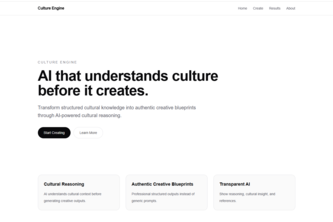
The company appears to be a solo project named "Culture Engine", self-described as an AI tool aimed at improving cultural authenticity in creative outputs by structuring cultural knowledge before AI generation. The author states the goal is to help AI begin with research so creators can spend more time creating and less correcting.
What changed
The author reports building an MVP focused on Pashtun culture in Pakistan, using a reasoning pipeline that separates knowledge from content generation. This represents a shift from generic prompts toward structured cultural reasoning.
The single most important open question
Is there evidence of traction or customer feedback beyond the author's own experience and stated vision?
Analysis basis
The entire analysis is based on the self-reported project description provided by the caller, including the name, tagline, author's write-up, and technology stack. No external verification or historical data is available.
What The Product Actually Is
- The description states that Culture Engine helps AI understand culture before generating creative content.
- It uses structured cultural knowledge together with AI reasoning to build a "cultural blueprint" before generation.
- The current MVP focuses on Pashtun (Pakistan) cultural knowledge.
- It follows a reasoning pipeline: Knowledge Layer → Reasoning Layer → Blueprint Layer → OpenAI Responses API.
- Built using Next.js, TypeScript, Tailwind CSS, OpenAI API, Vercel, and GitHub.
Inference The product is described as an AI tool that structures cultural understanding to improve creative outputs. It is not a marketplace, SaaS platform, or commercial product — it's a prototype built for a hackathon.
Positioning & Claim Evolution
- The author states the goal was not to replace cultural research but to help AI begin with that research.
- It positions itself as an alternative to generic prompts by introducing structured reasoning.
- The author claims that better understanding, not better prompts, leads to more meaningful and respectful results.
- Future vision includes expanding support to many cultures across Pakistan and eventually globally.
Inference The positioning has evolved from a personal problem-solving tool (designer using AI) to a broader vision of culturally authentic AI. The claim is that structured cultural knowledge improves AI outputs.
Target Customer & ICP
- The description states the author is a designer who uses AI daily.
- It targets creators working with AI for creative content generation.
- The MVP focuses on Pashtun culture, suggesting an initial audience of designers or artists interested in culturally specific content.
- No explicit customer segmentation beyond "creators" or "designers" is provided.
Inference The target customer appears to be individual creators (especially designers) who use AI tools and seek cultural authenticity. No evidence of a defined ICP beyond this.
Business Model & Pricing Evidence
- Not evidenced.
- No mention of pricing, monetization strategy, or business model in the description.
Finding
There is no evidence of any business model or pricing structure.
Technical & Delivery Signals
- Built with Next.js, TypeScript, Tailwind CSS, OpenAI API, Vercel, and GitHub.
- Follows a reasoning pipeline architecture: Knowledge Layer → Reasoning Layer → Blueprint Layer → OpenAI Responses API.
- The system separates cultural understanding from content generation to make it easier to improve and expand.
Inference The technical approach suggests a modular, scalable architecture. However, no evidence of production deployment or delivery mechanisms beyond the MVP.
Traction & Maturity Signals
- Not evidenced.
- No mention of users, customers, revenue, adoption, or usage metrics.
- The project is described as an MVP built for a hackathon.
- No evidence of product-market fit or user feedback.
Finding
There is no evidence of traction or maturity beyond the initial prototype.
Competitive Context
- Not evidenced.
- No mention of competitors or existing solutions in the space.
- No indication of market analysis or differentiation strategy.
Finding
No competitive context is provided in the description.
Open Questions & Risks
- Solo team (1 member) with no evidence of additional contributors or support.
- MVP built for a hackathon — no indication of long-term development or commercial viability.
- No evidence of traction, customers, or revenue.
- The author’s own experience is the only data point; no external validation or feedback.
- Risk of over-engineering or misalignment with actual user needs without real-world testing.
Inference The main risk is that this remains a personal project with limited commercial potential unless further developed and validated.
Questions the description leaves open
- What specific cultural knowledge structures were used in the MVP? How are they defined?
- Have you tested the system with other creators or designers beyond yourself?
- What is your roadmap for expanding to more cultures?
- Are there any plans to monetize this tool, and if so, how?
- How do you plan to validate that structured cultural knowledge improves AI outputs in practice?
Inference These questions aim to probe the technical depth, user validation, scalability, and commercial viability of the concept.
Overall Assessment
- Not evidenced.
- No evidence of revenue, customers, or traction to support investment or partnership decisions.
- The project is described as a solo hackathon effort with no indication of market readiness or business model.
Finding
There is insufficient evidence to assess whether this project warrants investment or partnership. It appears to be an early-stage idea with no demonstrated commercial potential.
User Stories BotA demo video on every pull request
Get a demo video on every new feature
GitHub App that watches your pull requests and records a narrated, captioned demo.
Save time on demo prep and make informed decisions faster with a video walkthrough of every new feature.
Source
Submitted to the OpenAI 2026 hackathon on Devpost. Project home on Devpost. Back to the full gallery on Devpost.
This competitive analysis was produced by top-founders.com (opens in a new tab)
Generated by a language model from this project's public Devpost page — its tagline, the author's own write-up and any built-with tags listed there — as captured in August 2026. Short quotations are the author's words. It is an opinion on the idea as a business, not on the people behind it, and it reflects the description as published then. If the project has moved on, request a correction below. The analysis is not independent research and contains no verified traction, revenue or customer data.
An independent guide by KFG International LLC — not affiliated with, endorsed by, or connected to Devpost or OpenAI.