

Archive position — measured, not model output
0 likes on Devpost
2,263 of the 7,850 archived projects have more likes, and 5,587 share exactly 0 — so this project's #4,837 place in the like-ranked listing is a tie-break inside that group, not a ranking.
Projects (log scale)
Likes on Devpost. ▲ marks this project's group.
Show the figures
| Likes | Projects | Share of archive |
|---|---|---|
| 0 | 5,587 | 71.2% |
| 1 | 1,758 | 22.4% |
| 2 | 284 | 3.6% |
| 3–4 | 132 | 1.7% |
| 5–9 | 75 | 1.0% |
| 10+ | 14 | 0.2% |
 User Stories BotA demo video on every pull request
Get a demo video on every new feature
GitHub App that watches your pull requests and records a narrated, captioned demo.
Save time on demo prep and make informed decisions faster with a video walkthrough of every new feature.
Executive Summary
What the company appears to be
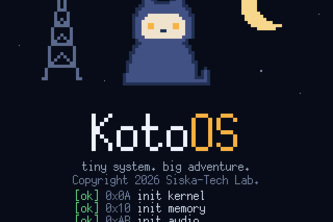
KotoOS is a self-reported embedded operating system project built for the ClockworkPi PicoCalc, a small keyboard-equipped computer based on Raspberry Pi RP2040/RP2350 microcontrollers. It includes a custom virtual machine (VM), application language, GUI framework, audio and graphics systems, Japanese input support, and Wi-Fi networking capabilities. The project was developed primarily in Rust using no_std embedded architecture.
What changed
The author reports that KotoOS evolved from an initial version (0.1) supporting only RP2040 to version 0.2 adding RP2350A support with audio streaming, and then to v0.3 introducing KotoUI, multilingual support, and Wi-Fi networking. The development process involved extensive use of AI tools like GPT-5.6 and Codex across firmware, hardware drivers, compiler, VM, UI systems, performance optimization, and real microcontroller hardware.
Single most important open question
Is there any evidence of actual user adoption or commercial traction beyond the author’s own development work?
Note: This analysis is based entirely on the self-reported project description provided by the caller. No external verification, revenue data, customer names, or independent sources are available. All claims are treated as stated by the author and not independently confirmed.
What The Product Actually Is
The description states that KotoOS is a custom embedded operating system designed for the ClockworkPi PicoCalc device. It includes:
- A custom application runtime and virtual machine (VM)
- A KotoOS application language
- A bytecode-based application package format
- A retained-mode GUI framework called KotoUI
- Support for keyboard-first interaction, Japanese text input with SKK, SD card storage, audio streaming, and graphics rendering
- Applications are compiled into bytecode and run inside a bounded VM
- The system supports RP2040 and RP2350A hardware profiles
- It includes Wi-Fi networking, SNTP time synchronization, and experimental TLS 1.3 communication
The author describes KotoOS as a project built primarily in Rust using a no_std embedded architecture, with subsystems such as koto-vm, koto-gfx, koto-audio, koto-ime, etc.
Claim: The system is designed specifically for constrained hardware environments
Evidence: Author states that the target device has limited memory and no conventional OS underneath; they chose to make constraints part of the design rather than treat them as limitations.
Claim: KotoOS uses a custom VM with fixed resource limits
Evidence: Applications run inside a bounded VM with deterministic instruction budgets, bounded heap usage, and no general-purpose allocator.
Claim: The system supports AI-assisted development
Evidence: Author reports extensive use of GPT-5.6 and Codex for architectural reasoning, debugging, API design, performance analysis, refactoring, and implementation across multiple modules.
Positioning & Claim Evolution
The author positions KotoOS as a modern embedded computing platform that turns a small, constrained device into a programmable handheld computer. The core idea is to build something inspired by compact personal computers but using modern embedded technologies instead of recreating an existing platform.
Key claims include:
- A tiny programmable computer with sandboxed apps
- A Rust-based development stack
- Support for Japanese input, games, audio, and Wi-Fi networking
- An experiment in AI collaboration across an entire embedded computing stack
The project evolved from a simple idea to a more complex system over the course of OpenAI Build Week, with incremental additions including:
- v0.1: Initial release supporting RP2040
- v0.2: Added RP2350A support and audio streaming
- v0.3: Introduced KotoUI, multilingual support, and Wi-Fi networking
Claim: The project is a “system-level” engineering experiment
Evidence: Author describes it as an experiment in how far AI can collaborate with a single developer across firmware, hardware drivers, compiler, VM, UI systems, performance optimization, and real microcontroller hardware.
Claim: KotoOS aims to be a modern embedded OS for small devices
Evidence: The author explicitly says they wanted to build something inspired by compact personal computers but using modern embedded technologies instead of recreating an existing platform.
Target Customer & ICP
The description does not clearly identify specific customer segments or personas. However, the target device is identified as:
- ClockworkPi PicoCalc, a small keyboard-equipped computer built around Raspberry Pi Pico family (RP2040/RP2350A)
It appears to be aimed at developers and hobbyists interested in embedded systems, particularly those working with constrained hardware.
Claim: The target audience is likely embedded developers or hobbyists
Inference from evidence: The project is built for a specific embedded device (PicoCalc), uses Rust, no_std, and supports development workflows like VS Code-based tooling. These are typical signals for developer-focused embedded projects.
Claim: There is no clear indication of end-users beyond the developer
Evidence: No mention of consumers, commercial customers, or user personas in the description.
Business Model & Pricing Evidence
There is no evidence provided regarding a business model or pricing strategy. The project appears to be an open-source development effort with no stated monetization plans.
Claim: No business model or pricing information available
Evidence: The author does not describe any revenue streams, paid features, or commercial offerings.
Technical & Delivery Signals
The technical architecture is described as:
- Built primarily in Rust using a no_std embedded architecture
- Uses Embassy for asynchronous execution
- Supports RP2040 and RP2350A-class microcontrollers
- Includes subsystems such as:
- koto-vm (application VM)
- koto-gfx (graphics and compositing)
- koto-audio (audio playback)
- koto-ime (Japanese input)
- koto-input (keyboard handling)
- koto-storage (storage access)
- koto-runtime (application runtime services)
Applications are compiled into Koto bytecode, run in a bounded VM, and use statically allocated records to manage memory efficiently.
Claim: The system is built for performance on constrained hardware
Evidence: Author mentions tight resource limits, minimal free SRAM (~4.4 KiB), and challenges with PSRAM performance, display rendering, and networking under memory pressure.
Claim: The system uses AI tools extensively during development
Evidence: Author reports using GPT-5.6 and Codex for architectural reasoning, debugging strategies, API design, performance analysis, refactoring, and implementation across multiple modules.
Traction & Maturity Signals
There is no evidence of traction or adoption beyond the author’s own development work. The project was publicly released as version 0.1 on July 13, followed by v0.2 and v0.3 during OpenAI Build Week. No data is provided about:
- Number of users
- Customer base
- Revenue
- Market penetration
- Adoption metrics
Claim: No traction or adoption data available
Evidence: The description contains no references to customers, sales, or usage statistics.
Claim: The project is in early development stages
Inference from evidence: The author describes a rapid iteration process over a short time period (Build Week), and the system has only reached version 0.3 at the time of submission.
Competitive Context
The description does not provide any information about competitors or market positioning beyond what is implied by the project’s goals — building an embedded OS for small devices like the PicoCalc.
Claim: No competitive landscape described
Evidence: The author does not mention existing products, platforms, or competitors in the embedded or handheld computing space.
Open Questions & Risks
Several potential risks and open questions are evident from the description:
- Lack of commercial traction or user base – No evidence of adoption beyond the developer’s own use
- Highly specialized niche – Targeting a specific, limited hardware platform (PicoCalc)
- Development complexity – The system is described as being built for extremely constrained environments, which increases risk and development difficulty
- Unproven scalability or long-term viability – No indication of plans to expand beyond current scope or support additional platforms
- AI dependency – Heavy reliance on AI tools during development may not be sustainable or replicable in a commercial context
Claim: Lack of traction raises questions about commercial viability
Inference from evidence: The project is described as an experiment and has no reported users, customers, or revenue.
Claim: Risk of over-engineering for a niche market
Inference from evidence: The system is tailored specifically to the PicoCalc hardware with no indication of broader applicability.
Questions the description leaves open
- What are your plans for expanding beyond the current hardware platform (PicoCalc)?
- Are there any commercial or strategic partners involved in the project?
- How do you plan to monetize or scale this effort if at all?
- Can you provide more details on how the AI tools were used and whether they can be replicated or maintained independently?
- What is your roadmap for future releases beyond v0.3?
- Have you considered integrating with other embedded ecosystems or platforms?
Overall Assessment
Not evidenced
There is insufficient evidence to assess whether this project warrants investment or partnership interest. The description lacks any indication of commercial traction, customer base, revenue, or scalability potential.
Claim: No basis for investment or partnership decision
Evidence: No financial data, user metrics, or market positioning provided.
Claim: Project appears experimental and not yet commercially viable
Inference from evidence: The project is described as a development experiment with no reported users, customers, or monetization strategy.
User Stories BotA demo video on every pull request
Get a demo video on every new feature
GitHub App that watches your pull requests and records a narrated, captioned demo.
Save time on demo prep and make informed decisions faster with a video walkthrough of every new feature.
Source
Submitted to the OpenAI 2026 hackathon on Devpost. Project home on Devpost. Back to the full gallery on Devpost.
This competitive analysis was produced by top-founders.com (opens in a new tab)
Generated by a language model from this project's public Devpost page — its tagline, the author's own write-up and any built-with tags listed there — as captured in August 2026. Short quotations are the author's words. It is an opinion on the idea as a business, not on the people behind it, and it reflects the description as published then. If the project has moved on, request a correction below. The analysis is not independent research and contains no verified traction, revenue or customer data.
An independent guide by KFG International LLC — not affiliated with, endorsed by, or connected to Devpost or OpenAI.