

Archive position — measured, not model output
0 likes on Devpost
2,263 of the 7,850 archived projects have more likes, and 5,587 share exactly 0 — so this project's #3,577 place in the like-ranked listing is a tie-break inside that group, not a ranking.
Projects (log scale)
Likes on Devpost. ▲ marks this project's group.
Show the figures
| Likes | Projects | Share of archive |
|---|---|---|
| 0 | 5,587 | 71.2% |
| 1 | 1,758 | 22.4% |
| 2 | 284 | 3.6% |
| 3–4 | 132 | 1.7% |
| 5–9 | 75 | 1.0% |
| 10+ | 14 | 0.2% |
 User Stories BotA demo video on every pull request
Get a demo video on every new feature
GitHub App that watches your pull requests and records a narrated, captioned demo.
Save time on demo prep and make informed decisions faster with a video walkthrough of every new feature.
Executive Summary
What the company appears to be
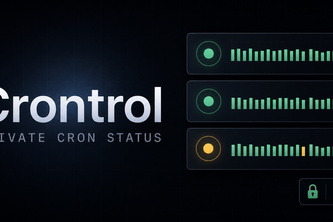
Crontrol is a self-reported local-first supervisor for headless automation jobs (cron-launched AI agents, scrapers, backups, pipelines) that monitors, diagnoses and optionally auto-applies fixes using GPT-5.6. It claims to do the legwork so users stay in Crontrol.
What changed
The project was built during a 2026 OpenAI hackathon as a proof-of-concept with a single developer (Jamie Hughes). It uses Codex to build itself, and includes a CLI, dashboard, SQLite storage, and GPT-based diagnosis/repair logic. The author states it can diagnose failures, propose fixes, and optionally apply them after human approval or in auto-fix mode.
Single most important open question
Does Crontrol actually work as described in practice, or is this a demo that only functions in controlled conditions?
What The Product Actually Is
The description states that Crontrol is:
- A local-first supervisor for cron jobs and headless AI agents
- A tool that wraps existing cron jobs with monitoring via
ct run - A system that records exit codes, durations, and redacted logs in local SQLite
- A dashboard with watchdog that detects failed, late, stale, or flapping jobs
- A system that sends failure evidence to GPT-5.6 for diagnosis
- A system that proposes typed patches/config changes/commands with risk/confidence
- A system that can optionally apply fixes after human approval or in auto-fix mode
- A system that generates ready-to-copy Codex prompts for scheduler-level changes
The product is built as a TypeScript monorepo with CLI, Fastify server, React dashboard, and shared Zod schemas. It uses SQLite in WAL mode, server-sent events for live updates, and structured outputs for GPT responses.
Inference The system appears to be a hybrid local-monitoring + AI diagnosis tool that aims to reduce manual intervention in cron job failures.
Positioning & Claim Evolution
The author states Crontrol is:
- A "local-first supervisor" for headless automation
- Designed to monitor and self-heal cron-launched AI agents
- A tool that does the legwork so users stay in Crontrol
- Built from scratch during Build Week, inspired by personal failure experiences with cron jobs
Inference The positioning evolved from a personal problem (cron job failures) into a solution that claims to automate diagnosis and repair of such failures using AI.
Target Customer & ICP
The description states:
- Semi-technical users who are not used to installing many packages
- Users running cron jobs, scrapers, backups, pipelines
- Users who want to monitor headless AI agents
- Teams that want remote visibility into job health via a dashboard
Inference The target is likely developers or system administrators with cron-based automation workloads who want to reduce manual intervention and improve uptime.
Business Model & Pricing Evidence
Not evidenced. The description does not state anything about pricing, monetization, or business model.
Technical & Delivery Signals
The description states:
- Built using Codex (GPT-5.6) with a spec-first approach
- Uses TypeScript monorepo with CLI, Fastify server, React dashboard
- SQLite in WAL mode for local storage
- Server-sent events for live updates
- Structured outputs for GPT calls to ensure typed responses
- Self-explanatory agent instructions for onboarding
- A "seeded demo job" that was initially broken but fixed
Inference The technical approach is a hybrid of local execution with AI-assisted diagnosis and repair, using modern tooling and AI for automation.
Traction & Maturity Signals
Not evidenced. No data on users, customers, revenue, usage, or adoption is provided.
Competitive Context
Not evidenced. No mention of competitors or market context beyond the author's personal experience with cron jobs.
Open Questions & Risks
- The system is described as a hackathon project built by one person
- It uses GPT-5.6 and Codex for development, which may not be production-ready
- The description states that fixes cannot be applied to scheduler-level changes without a "guarded Codex handoff"
- The author notes that the demo job initially referenced a non-existent script and that fixes were initially treated as actionable even when unchanged
- No evidence of real-world testing or deployment beyond the demo
Inference The product is experimental, not proven in production, and may have significant limitations in real-world use.
Questions the description leaves open
- What are the actual failure rates and diagnosis accuracy of Crontrol in real-world usage?
- How does Crontrol handle edge cases or complex failures that aren't covered by the demo?
- Has the system been tested with more than one cron job or in a multi-user environment?
- What is the current state of the product beyond the hackathon prototype?
- Are there any known limitations or blind spots in how Crontrol diagnoses or fixes issues?
- How does Crontrol handle sensitive data, especially when it needs to send logs to GPT models?
Overall Assessment
Not evidenced. No information is provided about funding, valuation, or investment interest.
User Stories BotA demo video on every pull request
Get a demo video on every new feature
GitHub App that watches your pull requests and records a narrated, captioned demo.
Save time on demo prep and make informed decisions faster with a video walkthrough of every new feature.
Source
Submitted to the OpenAI 2026 hackathon on Devpost. Project home on Devpost. Back to the full gallery on Devpost.
This competitive analysis was produced by top-founders.com (opens in a new tab)
Generated by a language model from this project's public Devpost page — its tagline, the author's own write-up and any built-with tags listed there — as captured in August 2026. Short quotations are the author's words. It is an opinion on the idea as a business, not on the people behind it, and it reflects the description as published then. If the project has moved on, request a correction below. The analysis is not independent research and contains no verified traction, revenue or customer data.
An independent guide by KFG International LLC — not affiliated with, endorsed by, or connected to Devpost or OpenAI.