

Archive position — measured, not model output
1 like on Devpost
505 of the 7,850 archived projects have more likes, and 1,758 share exactly 1 — so this project's #900 place in the like-ranked listing is a tie-break inside that group, not a ranking.
Projects (log scale)
Likes on Devpost. ▲ marks this project's group.
Show the figures
| Likes | Projects | Share of archive |
|---|---|---|
| 0 | 5,587 | 71.2% |
| 1 | 1,758 | 22.4% |
| 2 | 284 | 3.6% |
| 3–4 | 132 | 1.7% |
| 5–9 | 75 | 1.0% |
| 10+ | 14 | 0.2% |
 User Stories BotA demo video on every pull request
Get a demo video on every new feature
GitHub App that watches your pull requests and records a narrated, captioned demo.
Save time on demo prep and make informed decisions faster with a video walkthrough of every new feature.
Executive Summary
What the company appears to be
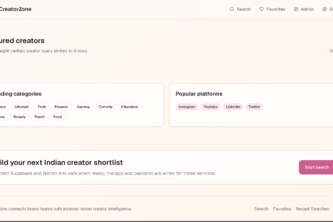
CreatorZone is a creator-discovery application for Indian influencer workflows. The description states it is built to scale from India's creator economy and integrates with Notion as the source of truth for creator data, syncing that into a searchable database.
What changed
This is a hackathon project submitted to the OpenAI 2026 hackathon. It was built in a short timeframe using free-tier infrastructure and represents an early-stage prototype with no commercial traction or revenue evidence.
Single most important open question
Does CreatorZone have a viable path to product-market fit in influencer discovery, or is it a proof-of-concept that lacks the depth of functionality needed for real adoption?
What The Product Actually Is
The description states that CreatorZone is a creator-discovery app for Indian influencer workflows. It syncs data from Notion into a database and makes it searchable through a web UI.
- Frontend: Built with Next.js (App Router), TypeScript, Tailwind, TanStack Query, backed by Supabase Postgres.
- Backend: FastAPI with Celery for background jobs.
- Ingestion: Notion sync module that respects rate limits and maps Notion properties to schema.
- Search infrastructure: Meilisearch for keyword search; Qdrant wired in for semantic search (not yet implemented).
- Deployment: Local Docker Compose setup with mocked APIs for CI.
Evidence The author's own write-up describes the architecture and components. No evidence of actual product usage or customer adoption.
Positioning & Claim Evolution
The description states that CreatorZone aims to turn influencer discovery from a manual grind into a searchable, data-backed workflow — starting in India's creator economy, built to scale.
- The app positions itself as an enhancement to existing Notion-based workflows.
- It claims to respect how teams already work (using Notion) while adding search capabilities.
- The author notes that most internal creator databases live in Notion but lack discovery features.
Evidence Self-reported claims about workflow and positioning. No evidence of market validation or competitive differentiation beyond the stated intent.
Target Customer & ICP
The description states that CreatorZone targets:
- Startup founders
- Small agencies
- Solo brand managers
These users are said to currently find creators by scrolling Instagram, screenshotting profiles into spreadsheets, and DM'ing people cold — indicating a pain point in manual discovery workflows.
Evidence Self-reported user personas. No evidence of actual customers or usage data.
Business Model & Pricing Evidence
The description does not provide any information about pricing models, monetization strategies, or business model details.
Evidence Not evidenced.
Technical & Delivery Signals
- Built with Next.js (App Router), TypeScript, Tailwind, TanStack Query
- Backend built with FastAPI and Celery
- Ingestion respects Notion API rate limits with retry logic
- Uses Meilisearch for keyword search; Qdrant for semantic search (not yet implemented)
- Designed to run on free-tier infrastructure (Supabase, Docker, mocked APIs)
- CI runs against mocked API responses
- PII is encrypted or stripped before reaching indexes
Evidence Author's own technical write-up. No evidence of production deployment or performance metrics.
Traction & Maturity Signals
The project was built for a hackathon and submitted to the OpenAI 2026 hackathon on Devpost.
- Team size: 4
- Built in a short timeframe (weekend)
- Uses free-tier infrastructure
- No evidence of revenue, customers, or user adoption
Evidence Self-reported project timeline and constraints. No traction data.
Competitive Context
The description does not mention any competitors or competitive landscape.
Evidence Not evidenced.
Open Questions & Risks
- Product-Market Fit Uncertainty: The app is built as a hackathon prototype with no evidence of real adoption or user feedback.
- Scalability Concerns: Built on free-tier infrastructure, which may not support growth.
- Technical Debt Risk: The architecture was designed around constraints (e.g., rate limits) rather than scalability.
- Lack of Monetization Strategy: No mention of pricing or revenue model.
- Limited Scope: Semantic search is configured but not yet implemented; many features are described as "next steps."
Evidence Self-reported limitations and design decisions. No independent validation.
Questions the description leaves open
- What specific problems do you observe in current influencer discovery workflows?
- Have you validated your assumptions with actual users or potential customers?
- How do you plan to monetize this product?
- What is the timeline for implementing semantic search and other next steps?
- Are there any existing partnerships or integrations with Notion or Instagram that could help accelerate adoption?
- How will you handle data privacy and compliance as you scale?
Overall Assessment
The project is a hackathon prototype with no evidence of traction, revenue, or customer validation. It shows early technical design thinking around integration with Notion and search infrastructure but lacks commercial viability indicators.
Confidence Level Low
Assessment Not ready for investment or partnership consideration without further development, user feedback, and market validation. The description reflects a self-reported idea rather than an established product or business.
User Stories BotA demo video on every pull request
Get a demo video on every new feature
GitHub App that watches your pull requests and records a narrated, captioned demo.
Save time on demo prep and make informed decisions faster with a video walkthrough of every new feature.
Source
Submitted to the OpenAI 2026 hackathon on Devpost. Project home on Devpost. Back to the full gallery on Devpost.
This competitive analysis was produced by top-founders.com (opens in a new tab)
Generated by a language model from this project's public Devpost page — its tagline, the author's own write-up and any built-with tags listed there — as captured in August 2026. Short quotations are the author's words. It is an opinion on the idea as a business, not on the people behind it, and it reflects the description as published then. If the project has moved on, request a correction below. The analysis is not independent research and contains no verified traction, revenue or customer data.
An independent guide by KFG International LLC — not affiliated with, endorsed by, or connected to Devpost or OpenAI.