

Archive position — measured, not model output
0 likes on Devpost
2,263 of the 7,850 archived projects have more likes, and 5,587 share exactly 0 — so this project's #3,523 place in the like-ranked listing is a tie-break inside that group, not a ranking.
Projects (log scale)
Likes on Devpost. ▲ marks this project's group.
Show the figures
| Likes | Projects | Share of archive |
|---|---|---|
| 0 | 5,587 | 71.2% |
| 1 | 1,758 | 22.4% |
| 2 | 284 | 3.6% |
| 3–4 | 132 | 1.7% |
| 5–9 | 75 | 1.0% |
| 10+ | 14 | 0.2% |
 User Stories BotA demo video on every pull request
Get a demo video on every new feature
GitHub App that watches your pull requests and records a narrated, captioned demo.
Save time on demo prep and make informed decisions faster with a video walkthrough of every new feature.
Executive Summary
What the company appears to be
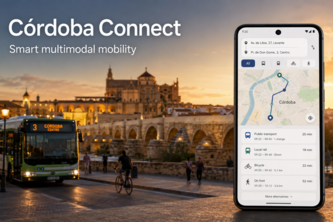
Córdoba Connect is a self-reported Android mobility app designed for users in Córdoba, Spain. It enables users to plan multimodal journeys combining AUCORSA buses, Renfe Proximidad rail services, walking, and cycling. The app provides door-to-door trip planning with detailed timing, transfers, and fare information, using OpenTripPlanner as its routing engine.
What changed
The project was submitted as a hackathon entry to the OpenAI 2026 hackathon. It is described as a working prototype built over a short timeframe, incorporating AI assistance (Codex + GPT-5.6) in engineering and deployment processes.
Single most important open question
Is Córdoba Connect intended to be a standalone product or part of a larger mobility ecosystem? The description does not clarify whether this is a one-off prototype or a scalable service with future commercial ambitions.
What The Product Actually Is
The description states that Córdoba Connect is an Android app built in Kotlin using Jetpack Compose and Material 3. It compares AUCORSA buses, Renfe Proximidad rail services, walking, and cycling for door-to-door journeys.
It uses:
- Google Maps and Places for location search.
- FastAPI as a backend API layer between the Android app and OpenTripPlanner.
- OpenTripPlanner with an OpenStreetMap extract of Córdoba and GTFS datasets from AUCORSA and Renfe.
- Firebase for optional cloud synchronization (anonymous authentication, Firestore).
- Local storage using Room and SQLCipher with encryption via Android Keystore.
The app supports:
- Address-based origin/destination selection.
- Time-based journey planning (now or specific time).
- Visualized routes with distinct styling per transport mode.
- Fare notices for separate tickets or transfers.
- Saved commutes stored locally and optionally synced to Firebase.
- Bilingual interface in English and Spanish.
Not evidenced No revenue, customer base, pricing model, or user adoption data is provided. The app is described as a prototype built during a hackathon.
Positioning & Claim Evolution
The author positions Córdoba Connect as:
- A bilingual Android companion for navigating Córdoba.
- A tool that brings together multiple transport modes in one interface.
- An alternative to Google Maps, which the author claims sometimes misses AUCORSA connections due to misconfigurations.
Key claims include:
- It offers door-to-door experience designed specifically for Córdoba.
- It helps users avoid checking several apps or memorizing timetables.
- It provides practical journey alternatives, including walking/cycling recommendations when competitive with public transport.
The app is described as a “coherent, working product”, not just a demonstration. The author emphasizes that it treats data quality as part of the user experience — clearly indicating scheduled data rather than real-time.
Inferred The positioning suggests a local-first mobility solution aimed at improving urban navigation for residents and commuters in Córdoba.
Target Customer & ICP
The description states:
- The app is built specifically for Córdoba, targeting users who travel within the city.
- It caters to recurring journeys such as commuting to work or university.
- Users can save frequently used routes as workday or weekend commutes.
Inferred
Primary users are likely:
- Commuters in Córdoba.
- Residents seeking efficient, multimodal travel options.
- People who use public transport but also walk or cycle.
Not evidenced No explicit segmentation beyond “users of Córdoba’s transport system.” No demographic data, usage frequency, or geographic scope beyond Córdoba is stated.
Business Model & Pricing Evidence
The description does not provide any information about:
- Revenue streams.
- Pricing models.
- Monetization strategy.
- Subscription plans or in-app purchases.
Not evidenced There is no indication of how the app would generate income, if at all. The project is described as a hackathon prototype with no mention of commercial viability or business model.
Technical & Delivery Signals
The author reports:
- The app is built using Kotlin, Jetpack Compose, and Material 3.
- Backend uses FastAPI to interface with OpenTripPlanner.
- Routing engine powered by OpenTripPlanner, using GTFS and OpenStreetMap data.
- Data persistence handled via Room + SQLCipher, with encryption via Android Keystore.
- Optional cloud sync through Firebase Anonymous Authentication and Firestore.
- Infrastructure is containerized using Docker.
- CI/CD pipelines include validation for both Android and Python code.
Inferred The technical stack suggests a modern, scalable architecture that supports local-first design, secure data handling, and reproducible builds. The use of AI tools (Codex + GPT-5.6) indicates an engineering process focused on rapid iteration and problem-solving across layers.
Traction & Maturity Signals
The description states:
- This is a hackathon submission.
- It is described as a working prototype, not a production-ready product.
- The app includes encrypted local storage, optional cloud sync, and bilingual support.
- It has been tested in CI/CD environments and supports automated validation.
Not evidenced
No data on:
- User adoption or retention.
- Number of active users.
- App downloads or installations.
- Feedback from early users.
- Market traction beyond the hackathon.
Competitive Context
The description does not mention:
- Direct competitors.
- Existing mobility apps in Córdoba.
- How this differs from Google Maps, Citymapper, or other transit planners.
Not evidenced No competitive analysis is provided. The author only claims that Google Maps sometimes misses AUCORSA connections — no comparison with other tools or market positioning.
Open Questions & Risks
Key risks inferred from the description:
- Data dependency on outdated GTFS feeds: The app uses an expired AUCORSA snapshot and relies on a projected calendar, which may not reflect real-time service changes.
- Limited scope: The app is built for Córdoba only; no indication of expansion plans or multi-city support.
- Prototype nature: It’s described as a hackathon prototype with no commercial traction or monetization strategy.
- No user feedback loop: No mention of user testing, surveys, or iterative improvements beyond the hackathon phase.
- AI dependency: While GPT-5.6 was used for engineering, there is no indication that AI will be used at runtime in the app.
Questions the description leaves open
- Is Córdoba Connect intended to evolve into a commercial product or remain a local prototype?
- What are the plans for updating and maintaining the GTFS data feed from AUCORSA?
- Are there any partnerships or agreements with local transport providers (AUCORSA, Renfe)?
- How does the app handle disruptions or delays in real-time, if at all?
- Has there been any user testing beyond the hackathon environment?
- What is the long-term vision for expanding to other cities or regions?
- Are there any plans for monetization or revenue generation?
Overall Assessment
Not evidenced No financials, traction metrics, or commercial strategy are provided. The project is described as a hackathon prototype with no indication of scalability or business model.
Confidence level Low — the description is self-reported and unverified, offering only a technical and conceptual overview without any evidence of market validation, revenue, or customer adoption.
Assessment Córdoba Connect appears to be a proof-of-concept mobility app built for Córdoba with strong engineering execution. However, it lacks commercial traction, user data, or clear monetization plans. It is not yet ready for investment or partnership consideration unless further development and market validation are demonstrated.
User Stories BotA demo video on every pull request
Get a demo video on every new feature
GitHub App that watches your pull requests and records a narrated, captioned demo.
Save time on demo prep and make informed decisions faster with a video walkthrough of every new feature.
Source
Submitted to the OpenAI 2026 hackathon on Devpost. Project home on Devpost. Back to the full gallery on Devpost.
This competitive analysis was produced by top-founders.com (opens in a new tab)
Generated by a language model from this project's public Devpost page — its tagline, the author's own write-up and any built-with tags listed there — as captured in August 2026. Short quotations are the author's words. It is an opinion on the idea as a business, not on the people behind it, and it reflects the description as published then. If the project has moved on, request a correction below. The analysis is not independent research and contains no verified traction, revenue or customer data.
An independent guide by KFG International LLC — not affiliated with, endorsed by, or connected to Devpost or OpenAI.