

Archive position — measured, not model output
1 like on Devpost
505 of the 7,850 archived projects have more likes, and 1,758 share exactly 1 — so this project's #879 place in the like-ranked listing is a tie-break inside that group, not a ranking.
Projects (log scale)
Likes on Devpost. ▲ marks this project's group.
Show the figures
| Likes | Projects | Share of archive |
|---|---|---|
| 0 | 5,587 | 71.2% |
| 1 | 1,758 | 22.4% |
| 2 | 284 | 3.6% |
| 3–4 | 132 | 1.7% |
| 5–9 | 75 | 1.0% |
| 10+ | 14 | 0.2% |
 User Stories BotA demo video on every pull request
Get a demo video on every new feature
GitHub App that watches your pull requests and records a narrated, captioned demo.
Save time on demo prep and make informed decisions faster with a video walkthrough of every new feature.
Executive Summary
What the company appears to be
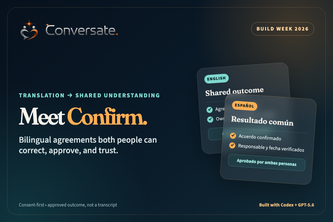
Conversate Confirm is a product extension for multilingual conversation tools that introduces an optional "bilingual agreement" outcome layer. It allows two participants in a conversation to jointly approve a structured summary of commitments, action items, and deadlines derived from their live, translated conversation.
What changed
The project extends an existing tool (Conversate) with a new feature ("Confirm") that adds consent-based capture, AI-generated bilingual schema output, dual approval, correction history, and limited persistence of approved versions. It was built during the OpenAI Build Week hackathon.
Single most important open question — commercial due-diligence read
Is there evidence of real-world demand or user validation for this specific outcome layer in multilingual business contexts? The description does not indicate any actual customers, revenue, or usage beyond a demo and sandbox test.
What The Product Actually Is
The description states that Conversate Confirm is an optional extension to a multilingual conversation tool. It turns conversations into bilingual agreements through the following process:
- Before speaking, both participants separately opt-in to enable Confirm.
- If both opt in, bounded source-turn text is temporarily captured.
- GPT-5.6 generates a strict-schema bilingual card containing:
- Agreements
- Action items
- Owners
- Deadlines
- Unresolved questions
- Details needing confirmation
- The generated card is not treated as truth; either participant can correct it.
- Corrections reset both approvals.
- Only the version approved by both participants is retained.
- Retention ends after 30 days or upon deletion by the authenticated room owner.
The system uses:
- OpenAI’s Realtime API for transcription
- OpenAI Responses API for structured outputs
- Fastify API service
- React UI
- PostgreSQL for persistence
- Google Cloud Run and Secret Manager
Inference This is a product designed to reduce misalignment in multilingual communication by creating shared, editable outcomes from live conversations.
Positioning & Claim Evolution
The author claims that translation alone does not ensure understanding or commitment. They state:
- Translation can cross language gaps but not commitment.
- This leads to missed work, repeated calls, and damaged trust.
- Conversate Confirm aims to bridge this gap by turning conversations into bilingual agreements both people can verify.
They also distinguish Confirm from:
- Meeting notes (unilateral memory aids)
- E-signatures (start with a prepared document)
Inference The positioning is that of a tool for trust-building in multilingual collaboration, not just translation or transcription.
Target Customer & ICP
The description states that the problem affects:
- Multilingual small businesses
- Service providers
- Remote teams
- Customers
It also notes that the feature is intended for use in contexts where commitment and clarity are critical, such as business negotiations or service agreements.
Inference The target ICP appears to be small-to-medium enterprises (SMEs) or remote teams working across languages, particularly those needing structured outcomes from conversations.
Business Model & Pricing Evidence
There is no evidence in the description of a pricing model, monetization strategy, or business model. The project is presented as a hackathon submission with no indication of revenue streams or customer acquisition plans.
Not evidenced
Technical & Delivery Signals
The system includes:
- Shared TypeScript schemas
- Fastify API service
- React participant UI
- PostgreSQL for approved-card persistence
- OpenAI Responses API and Realtime API integration
- Google Cloud Run judge sandbox with isolated service, database, and secret bindings
- Bounded transient capture
- Mutation deduplication and versioning logic
- Fail-closed behavior
Codex (GPT-5.6) was used for:
- Mapping repository structure
- Implementing schema and API
- Hardening safety boundaries
- Accelerating adversarial review, test generation, and deployment diagnosis
Inference The technical architecture shows a deliberate focus on privacy, concurrency control, and deterministic behavior, especially around consent, approval, and data retention.
Traction & Maturity Signals
There is no evidence of:
- Customers
- Revenue
- Usage metrics
- Product-market fit validation
- Real-world adoption or feedback
The description mentions:
- A complete two-participant product flow
- 571-test demo head count (at V6)
- Repository-wide Vitest suite with 578 tests
- Playwright matrix with 114 tests including 21 Confirm-specific flows
- Live sandbox that passed end-to-end testing
However, these are all internal development artifacts and not indicators of traction.
Not evidenced
Competitive Context
The description does not mention any direct competitors. It positions the product as distinct from:
- Meeting notes (e.g., Notion, Google Docs)
- E-signature tools (e.g., DocuSign, PandaDoc)
It also implies that existing translation tools do not provide this kind of outcome layer.
Inference
The competitive landscape is unclear, but it likely includes a mix of:
- Translation services
- Collaboration platforms
- Meeting summarization tools
- Legal document automation tools
Open Questions & Risks
- No traction or customer validation: The product exists only as a demo and sandbox test.
- Unproven demand: There is no evidence that multilingual businesses actually need this specific outcome layer.
- High technical complexity without real-world use case: Features like dual approval, versioning, and sandbox isolation are complex but may not be necessary if the core problem isn’t validated.
- Unclear monetization path: No pricing or business model is described.
- Single-person team: The project has only one member (Brian Smith), which raises questions about scalability and execution capacity.
Questions the description leaves open
- What specific pain points in multilingual business communication are you trying to solve?
- Have you spoken with any actual users or potential customers yet?
- How do you plan to validate whether people want this kind of outcome layer?
- Is there a roadmap for moving from the current sandboxed prototype to production-ready use?
- What is your go-to-market strategy, and how will you acquire early adopters?
- Are you planning to charge for this feature, and if so, what pricing model are you considering?
Overall Assessment
The description presents a conceptual product with strong engineering rigor, but lacks any evidence of traction, revenue, or customer validation.
Confidence level Low This is a self-reported, unverified account of a hackathon project. There is no indication that the product has moved beyond prototyping or received real-world feedback.
Assessment Not ready for investment or partnership consideration without further proof of demand, user engagement, or commercial viability. The engineering work is impressive, but it does not yet demonstrate a viable business model or market need.
User Stories BotA demo video on every pull request
Get a demo video on every new feature
GitHub App that watches your pull requests and records a narrated, captioned demo.
Save time on demo prep and make informed decisions faster with a video walkthrough of every new feature.
Source
Submitted to the OpenAI 2026 hackathon on Devpost. Project home on Devpost. Back to the full gallery on Devpost.
This competitive analysis was produced by top-founders.com (opens in a new tab)
Generated by a language model from this project's public Devpost page — its tagline, the author's own write-up and any built-with tags listed there — as captured in August 2026. Short quotations are the author's words. It is an opinion on the idea as a business, not on the people behind it, and it reflects the description as published then. If the project has moved on, request a correction below. The analysis is not independent research and contains no verified traction, revenue or customer data.
An independent guide by KFG International LLC — not affiliated with, endorsed by, or connected to Devpost or OpenAI.