

Archive position — measured, not model output
0 likes on Devpost
2,263 of the 7,850 archived projects have more likes, and 5,587 share exactly 0 — so this project's #4,805 place in the like-ranked listing is a tie-break inside that group, not a ranking.
Projects (log scale)
Likes on Devpost. ▲ marks this project's group.
Show the figures
| Likes | Projects | Share of archive |
|---|---|---|
| 0 | 5,587 | 71.2% |
| 1 | 1,758 | 22.4% |
| 2 | 284 | 3.6% |
| 3–4 | 132 | 1.7% |
| 5–9 | 75 | 1.0% |
| 10+ | 14 | 0.2% |
 User Stories BotA demo video on every pull request
Get a demo video on every new feature
GitHub App that watches your pull requests and records a narrated, captioned demo.
Save time on demo prep and make informed decisions faster with a video walkthrough of every new feature.
Executive Summary
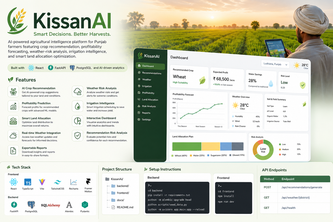
KissanAi is an AI-powered agricultural intelligence platform described by its authors as a tool to help farmers optimize crop selection, profitability, irrigation, and weather-aware decision-making. The platform is presented as a unified system combining multiple agricultural analytics capabilities into one interactive dashboard.
The project was built as part of the OpenAI 2026 hackathon and is self-reported as an end-to-end AI application with frontend and backend components. It uses technologies such as React, FastAPI, PostgreSQL, and machine learning for its core functionality.
Key commercial due-diligence read: The description states that KissanAi aims to empower farmers with data-driven insights but provides no evidence of actual users, revenue, or adoption. The platform appears to be a proof-of-concept or prototype built in a hackathon setting, with no demonstrated traction or business model beyond the authors' own claims.
Most important open question: Is there any evidence that KissanAi has moved beyond a hackathon prototype to serve real farmers or agricultural stakeholders?
What The Product Actually Is
The description states that KissanAi is an AI-powered agricultural intelligence platform. It recommends suitable crops based on environmental conditions, forecasts expected profitability, analyzes weather-related risks, provides irrigation recommendations, and optimizes land allocation for maximum returns.
It presents these insights through an interactive dashboard with visualizations and exportable reports. The authors describe it as a system that brings together multiple agricultural intelligence capabilities into one application.
The platform is built using:
- Frontend: React, TypeScript, Vite, Tailwind CSS, Recharts, Framer Motion
- Backend: FastAPI, PostgreSQL, SQLAlchemy, Alembic, Pydantic
- AI/ML components: data, machine learning, natural language processing, OpenAI integration
Inference: The platform appears to be a full-stack application designed to deliver actionable agricultural insights via an interface. However, there is no evidence of actual deployment or user interaction beyond the authors' own account.
Positioning & Claim Evolution
The description states that KissanAi was built to demonstrate how modern AI can empower farmers with data-driven insights that improve productivity while reducing risk. It positions itself as a comprehensive decision-support tool for farmers, integrating multiple aspects of agricultural planning.
It claims to simplify complex farming decisions by combining weather intelligence, profitability analysis, and optimization into a single platform. The authors also note they are proud of building an end-to-end system rather than solving a single problem.
Inference: The positioning reflects a vision of AI as a democratizing force in agriculture, aimed at farmers who may lack access to sophisticated tools or information. However, this is a stated intent, not evidence of traction or adoption.
Target Customer & ICP
The description states that KissanAi is intended for farmers in Pakistan, where agriculture is described as the backbone of the economy. The platform aims to help farmers make informed decisions about crop selection, irrigation, and resource allocation.
It also mentions that it plans to incorporate multilingual support for regional farmers, suggesting an intention to serve diverse linguistic groups within agricultural communities.
Inference: The target customer appears to be smallholder or subsistence farmers in Pakistan who rely on intuition or fragmented information. However, there is no evidence of actual customers or market validation beyond the authors' own claims.
Business Model & Pricing Evidence
The description does not provide any information about pricing, monetization strategies, or business model. It only states that the platform helps farmers make better decisions and provides a dashboard with visualizations and reports.
Not evidenced: No evidence of revenue streams, subscription models, licensing fees, or any commercial structure beyond the authors' own account.
Technical & Delivery Signals
The description indicates that KissanAi was built as part of a hackathon. The technical stack includes:
- Frontend: React, TypeScript, Vite, Tailwind CSS, Recharts, Framer Motion
- Backend: FastAPI, PostgreSQL, SQLAlchemy, Alembic, Pydantic
- AI/ML: data, machine learning, natural language processing, OpenAI integration
The authors mention challenges in designing a recommendation system that balances multiple factors and in presenting complex analytics simply. They also note accomplishments in building an end-to-end platform with full-stack AI capabilities.
Inference: The technical architecture suggests a scalable approach to building an AI-driven application, but there is no evidence of production deployment or performance metrics beyond the authors' own claims.
Traction & Maturity Signals
The description states that KissanAi was built for the OpenAI 2026 hackathon and is described as a prototype. It includes a roadmap with future features such as satellite imagery integration, yield forecasting, GIS-enabled visualization, multilingual support, seasonal forecasting, market price prediction, and mobile app development.
There is no evidence of actual users, customer feedback, or adoption beyond the authors' own account. The project is presented as a demonstration rather than a deployed product.
Not evidenced: No evidence of revenue, customers, user engagement, or any form of traction beyond the authors’ own description.
Competitive Context
The description does not provide any information about competitors or competitive landscape. It only describes KissanAi’s functionality without comparing it to existing solutions in the agricultural intelligence space.
Not evidenced: No evidence of market analysis, competitor identification, or differentiation strategy beyond the authors' own claims.
Open Questions & Risks
- Prototype vs. Product: The platform is described as a hackathon project with no evidence of real-world deployment or user adoption.
- Lack of Traction: There is no evidence of revenue, customers, or usage metrics.
- Unverified Claims: All claims are self-reported and unverified; there is no third-party validation.
- Technical Feasibility: While the tech stack suggests scalability, there is no evidence that it has been tested in real-world conditions.
- Market Fit Uncertainty: No evidence of customer validation or understanding of actual farmer needs beyond the authors’ assumptions.
Inference: The risk of misalignment between stated goals and real-world utility is high due to lack of evidence of adoption or impact.
Questions the description leaves open
- What specific data sources does KissanAi use for its recommendations?
- Has the platform been tested with actual farmers or agricultural stakeholders?
- Are there any partnerships or pilot programs with agricultural organizations or government bodies?
- How does KissanAi plan to monetize its service once beyond the prototype stage?
- What are the key assumptions underlying the AI models used in the platform?
- Have you conducted any user research or usability testing with farmers?
- What is the timeline for moving from prototype to production-ready product?
Overall Assessment
The description states that KissanAi was built as a hackathon project and does not provide evidence of traction, revenue, or customer adoption. It is described as an end-to-end AI application with a clear vision but no demonstrated commercial viability.
Not evidenced: No evidence of business model, financials, or market validation exists beyond the authors' own claims.
Assessment: At this stage, KissanAi appears to be a conceptual prototype with potential for further development. However, without evidence of real-world usage, customer feedback, or revenue generation, it does not meet the criteria for investment or partnership consideration at this time.
User Stories BotA demo video on every pull request
Get a demo video on every new feature
GitHub App that watches your pull requests and records a narrated, captioned demo.
Save time on demo prep and make informed decisions faster with a video walkthrough of every new feature.
Source
Submitted to the OpenAI 2026 hackathon on Devpost. Project home on Devpost. Back to the full gallery on Devpost.
This competitive analysis was produced by top-founders.com (opens in a new tab)
Generated by a language model from this project's public Devpost page — its tagline, the author's own write-up and any built-with tags listed there — as captured in August 2026. Short quotations are the author's words. It is an opinion on the idea as a business, not on the people behind it, and it reflects the description as published then. If the project has moved on, request a correction below. The analysis is not independent research and contains no verified traction, revenue or customer data.
An independent guide by KFG International LLC — not affiliated with, endorsed by, or connected to Devpost or OpenAI.