

Archive position — measured, not model output
1 like on Devpost
505 of the 7,850 archived projects have more likes, and 1,758 share exactly 1 — so this project's #880 place in the like-ranked listing is a tie-break inside that group, not a ranking.
Projects (log scale)
Likes on Devpost. ▲ marks this project's group.
Show the figures
| Likes | Projects | Share of archive |
|---|---|---|
| 0 | 5,587 | 71.2% |
| 1 | 1,758 | 22.4% |
| 2 | 284 | 3.6% |
| 3–4 | 132 | 1.7% |
| 5–9 | 75 | 1.0% |
| 10+ | 14 | 0.2% |
 User Stories BotA demo video on every pull request
Get a demo video on every new feature
GitHub App that watches your pull requests and records a narrated, captioned demo.
Save time on demo prep and make informed decisions faster with a video walkthrough of every new feature.
Executive Summary
Company: Convointel
Self-reported basis: The analysis is based entirely on the author's own description of Convointel, submitted as part of a Devpost entry for the OpenAI 2026 hackathon. No external verification or independent data is available.
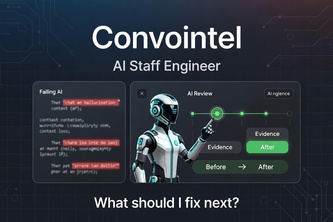
What it appears to be: Convointel is described as an automated review system for AI applications that provides actionable recommendations. It is built to work across different stacks and APIs, and uses tools like GPT-5.6, OpenAI, Pydantic, FastAPI, and SQLite.
What changed: The project started as an idea from an early-career AI engineer focused on automating post-production reviews of AI applications. It evolved into a working MVP, though the author notes it is still shaky.
Single most important open question: Is there sufficient evidence that Convointel can reliably automate meaningful reviews and recommendations for developers in real-world workflows?
What The Product Actually Is
The description states that Convointel is a system that "reviews AI applications that are already in production" and provides "actionable recommendations." It is described as a "staff that developers can employ to sit in the middle" of their development process.
It is built to be "free of any specific API provider," allowing it to integrate with different stacks. The system converts AI interactions into canonical event models, then turns them into observations, metrics, reviews, recommendations, and deployment intelligence.
Evidence:
- "It's a staff that developers can employ to sit in the middle and automatically review their applications that are already in production."
- "It starts off with converting AI interactions into canonical event models, then these are turned into observations, metrics, review, recommendations and then deployment intelligence."
Inference:
The system appears to be a post-production monitoring or auditing tool for AI apps, using LLMs (like GPT-5.6) to analyze events and generate insights.
Positioning & Claim Evolution
The author states that Convointel was inspired by the question: "What if post-production reviews of AI Applications could be automated?" This is a clear positioning statement — it targets developers who want automation in reviewing AI applications after deployment.
It claims to offer:
- Automated review of AI apps
- Actionable recommendations
- A system that can be integrated into any stack
Evidence:
- "What if post-production reviews of AI Applications could be automated"
- "makes it easy to recognize issues and tell you the next action to take"
- "free of any specific api provider, so that developers, irrespective of the stack they use can easily incorporate it in their work"
Inference:
The positioning is evolving from an idea into a tool that aims to reduce ambiguity in fixing AI application issues.
Target Customer & ICP
The description states that Convointel is intended for "developers" and is designed to be stack-agnostic, allowing integration across different tech environments. It is described as a tool that can be "employed by developers" to review their applications post-production.
Evidence:
- "It's a staff that developers can employ to sit in the middle"
- "so that developers, irrespective of the stack they use can easily incorporate it in their work"
Inference:
The target customer is likely early-career or mid-level AI engineers who are building and deploying AI applications and want automated feedback.
Business Model & Pricing Evidence
There is no mention of pricing, business model, monetization strategy, or revenue streams in the description. The project is described as a hackathon MVP with no indication of commercial viability or customer acquisition plans.
Evidence:
- No mention of pricing, subscriptions, or monetization
- "The MVP is still shaky but I'm proud it's no longer an idea but a system in motion."
Inference:
It is unclear whether Convointel intends to be a paid product or if it’s currently a demo with no commercial model.
Technical & Delivery Signals
Convointel is built using:
- Codex (GPT-5.6)
- FastAPI
- OpenAI
- Pydantic
- Python
- SQLite
- SDK
- Opentelemetry
It is described as converting AI interactions into canonical event models and then generating observations, metrics, reviews, recommendations, and deployment intelligence.
Evidence:
- "Built with (author-declared): codex, fastapi, gpt-5.6, json, openai, opentelemetry, pydantic, python, sdk, sqlite"
- "converts AI interactions into canonical event models, then these are turned into observations, metrics, review, recommendations and then deployment intelligence."
Inference:
The system is built on a Python stack with LLM integration. It appears to be a prototype or MVP, not a production-ready tool.
Traction & Maturity Signals
There is no evidence of traction, customers, revenue, or adoption in the description. The author states that the MVP is "still shaky" and that it's "no longer an idea but a system in motion." There are no mentions of users, usage metrics, or product-market fit.
Evidence:
- "The MVP is still shaky but I'm proud it's no longer an idea but a system in motion."
- No mention of customers, revenue, or usage
Inference:
Convointel is at a very early stage — likely a hackathon prototype with no demonstrated traction or market validation.
Competitive Context
There is no evidence provided about competitors or the competitive landscape. The description does not mention existing tools for AI application monitoring, review, or recommendation systems.
Evidence:
- No mention of competitors or similar products
- No indication of how Convointel compares to other tools in the space
Inference:
The competitive context is unknown, and it's unclear whether there are existing solutions addressing this problem.
Open Questions & Risks
- Unproven reliability: The system is described as an MVP that is "still shaky," suggesting it may not be reliable for real-world use.
- Lack of commercial clarity: No pricing, monetization or customer model is evident.
- No traction or adoption: There are no signs of users or product-market fit.
- Ambiguity in execution: The author notes that the first challenge was deciding what not to build — indicating a lack of focus or clarity in scope.
- Trust in recommendations: The author highlights trust as a major challenge, which is a critical barrier for any AI auditing tool.
Evidence:
- "The MVP is still shaky"
- "What if post-production reviews of AI Applications could be automated" (idea vs. execution)
- "how to ensure that the recommendations were trustworthy, the developers have to trust the system"
Questions the description leaves open
- What specific types of issues does Convointel detect in AI applications?
- How does it determine the trustworthiness of its recommendations?
- Is there a plan for how this tool will be monetized or integrated into developer workflows?
- What are the key assumptions underlying the product’s design and functionality?
- How is the system tested, and what validation has been done on its outputs?
- What are the main technical limitations of the current MVP?
Overall Assessment
Not evidenced: There is no evidence to support a commercial due-diligence conclusion about whether Convointel is a viable investment or partnership opportunity.
The project is described as a hackathon MVP with no demonstrated traction, revenue, customers, or clear business model. It is built by one person (Caleb Udeibom) and lacks any indication of scalability or market readiness.
Confidence level: Low — the description is self-reported and unverified, and contains no data on performance, adoption, or commercial viability.
Inference:
Convointel may be an interesting idea with potential, but it is not yet a product that can be evaluated for investment or partnership. It requires further development, validation, and evidence of traction before any meaningful due-diligence assessment can be made.
User Stories BotA demo video on every pull request
Get a demo video on every new feature
GitHub App that watches your pull requests and records a narrated, captioned demo.
Save time on demo prep and make informed decisions faster with a video walkthrough of every new feature.
Source
Submitted to the OpenAI 2026 hackathon on Devpost. Project home on Devpost. Back to the full gallery on Devpost.
This competitive analysis was produced by top-founders.com (opens in a new tab)
Generated by a language model from this project's public Devpost page — its tagline, the author's own write-up and any built-with tags listed there — as captured in August 2026. Short quotations are the author's words. It is an opinion on the idea as a business, not on the people behind it, and it reflects the description as published then. If the project has moved on, request a correction below. The analysis is not independent research and contains no verified traction, revenue or customer data.
An independent guide by KFG International LLC — not affiliated with, endorsed by, or connected to Devpost or OpenAI.