

Archive position — measured, not model output
0 likes on Devpost
2,263 of the 7,850 archived projects have more likes, and 5,587 share exactly 0 — so this project's #3,508 place in the like-ranked listing is a tie-break inside that group, not a ranking.
Projects (log scale)
Likes on Devpost. ▲ marks this project's group.
Show the figures
| Likes | Projects | Share of archive |
|---|---|---|
| 0 | 5,587 | 71.2% |
| 1 | 1,758 | 22.4% |
| 2 | 284 | 3.6% |
| 3–4 | 132 | 1.7% |
| 5–9 | 75 | 1.0% |
| 10+ | 14 | 0.2% |
 User Stories BotA demo video on every pull request
Get a demo video on every new feature
GitHub App that watches your pull requests and records a narrated, captioned demo.
Save time on demo prep and make informed decisions faster with a video walkthrough of every new feature.
Executive Summary
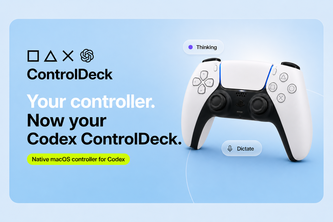
What the company appears to be: ControlDeck is a self-reported macOS application that turns a compatible game controller (primarily PS5 DualSense) into an interface for Codex and other Mac apps. The author states it enables dictation, pointer control, task navigation, and haptic/light feedback integration with Codex.
What changed: The project was submitted to the OpenAI 2026 hackathon as a self-contained proof-of-concept. No prior version or commercial history is evidenced.
Single most important open question: Is there any evidence of actual user adoption, revenue, or traction beyond the author's personal development effort?
The description states that ControlDeck is a native macOS app built with Codex and GPT-5.6, using Swift and SwiftUI. It supports DualSense controllers and integrates with Mac accessibility APIs. The author claims it enables dictation, pointer control, task navigation, and haptic/light feedback integration with Codex. However, no evidence of revenue, customers, or adoption is provided.
What The Product Actually Is
The description states that ControlDeck is a native macOS app that turns a compatible game controller (primarily PS5 DualSense) into an interface for Codex and other Mac apps. It supports dictation, pointer control, task navigation, and haptic/light feedback integration with Codex.
The author reports building it using:
- Swift and SwiftUI
- Apple's Game Controller framework
- Accessibility and Core Graphics for Mac interaction
- IOHID for DualSense-specific communication
- Core Audio with Opus decoding for wireless microphone
The app is described as supporting app-aware profiles, remapping capabilities, and an eight-slot profile wheel. It also includes a local Codex skill and constrained MCP server.
Positioning & Claim Evolution
The description states that ControlDeck was built as a personal project to explore whether DualSense hardware could become a practical interface for Codex, after the Codex Micro sold out. The author's stated goal was to "lessen the blow of missing out" on the Codex Micro.
The positioning evolved from a specific use case (Codex Micro replacement) to a general controller customization tool with app-aware profiles and support for multiple controller families. The author notes that ControlDeck "grew beyond its original Codex layout into a general controller customisation app."
Target Customer & ICP
The description states that ControlDeck targets users who:
- Use Codex or other Mac apps
- Have compatible game controllers (DualSense, DualShock, Switch Pro, etc.)
- Want physical control over their Mac interface
- Are interested in voice dictation and haptic feedback integration
The author mentions support for "browsers, terminals, communication tools, presentations, creative apps and media players" as target applications. However, no specific customer segments or personas are identified.
Business Model & Pricing Evidence
Not evidenced. The description does not contain any information about pricing models, monetization strategies, or business model details.
Technical & Delivery Signals
The description states that ControlDeck:
- Is written in Swift and SwiftUI
- Uses Apple's Game Controller framework for standard inputs
- Uses Accessibility and Core Graphics for Mac interaction
- Uses IOHID for DualSense-specific communication
- Uses Core Audio with Opus decoding for wireless microphone
- Includes a local Codex skill and constrained MCP server
- Supports app-aware profiles, remapping capabilities, and an eight-slot profile wheel
The author reports solving technical challenges including:
- Bluetooth microphone integration (71-byte Opus frames)
- Speaker audio handling
- Audio/controller state separation
- Accessibility permission loops
- Input lag issues
Traction & Maturity Signals
Not evidenced. The description contains no information about user adoption, customer base, revenue, or usage metrics.
Competitive Context
The description states that ControlDeck was built as a personal project for the OpenAI 2026 hackathon and does not mention any direct competitors or existing market players. It appears to be positioned as a novel approach to controller-based Mac interaction, particularly with Codex integration.
Open Questions & Risks
- No evidence of traction: The project is described only as a personal hackathon submission with no user adoption or revenue data
- Single-person development: Only one team member (Ian Hansel) is mentioned
- Unproven market demand: No indication that users actually want this functionality beyond the author's personal use case
- Technical complexity risks: The description mentions significant technical challenges, suggesting potential reliability issues
- Limited commercial viability: The project appears to be a proof-of-concept rather than a scalable business
Questions the description leaves open
- What specific user problems are you solving that existing solutions don't address?
- How many users have actually tried ControlDeck beyond the author's personal use?
- What is your plan for monetization and scaling beyond the hackathon prototype?
- Have you validated demand with potential customers or partners?
- What are the technical limitations of the current implementation that would need to be addressed for commercial viability?
Overall Assessment
Not evidenced. The description provides no information about financial performance, customer traction, or market validation necessary for investment or partnership decisions.
The project appears to be a personal hackathon submission with no evidence of commercial traction, revenue, or user adoption. The author's own account indicates this is a proof-of-concept rather than a scalable business. No evidence exists of any commercial activity beyond the single-person development effort.
User Stories BotA demo video on every pull request
Get a demo video on every new feature
GitHub App that watches your pull requests and records a narrated, captioned demo.
Save time on demo prep and make informed decisions faster with a video walkthrough of every new feature.
Source
Submitted to the OpenAI 2026 hackathon on Devpost. Project home on Devpost. Back to the full gallery on Devpost.
This competitive analysis was produced by top-founders.com (opens in a new tab)
Generated by a language model from this project's public Devpost page — its tagline, the author's own write-up and any built-with tags listed there — as captured in August 2026. Short quotations are the author's words. It is an opinion on the idea as a business, not on the people behind it, and it reflects the description as published then. If the project has moved on, request a correction below. The analysis is not independent research and contains no verified traction, revenue or customer data.
An independent guide by KFG International LLC — not affiliated with, endorsed by, or connected to Devpost or OpenAI.