

Archive position — measured, not model output
2 likes on Devpost
221 of the 7,850 archived projects have more likes, and 284 share exactly 2 — so this project's #299 place in the like-ranked listing is a tie-break inside that group, not a ranking.
Projects (log scale)
Likes on Devpost. ▲ marks this project's group.
Show the figures
| Likes | Projects | Share of archive |
|---|---|---|
| 0 | 5,587 | 71.2% |
| 1 | 1,758 | 22.4% |
| 2 | 284 | 3.6% |
| 3–4 | 132 | 1.7% |
| 5–9 | 75 | 1.0% |
| 10+ | 14 | 0.2% |
 User Stories BotA demo video on every pull request
Get a demo video on every new feature
GitHub App that watches your pull requests and records a narrated, captioned demo.
Save time on demo prep and make informed decisions faster with a video walkthrough of every new feature.
Executive Summary
What the company appears to be
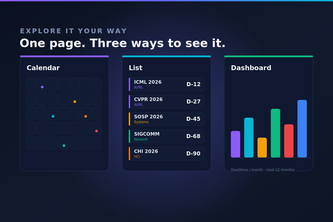
DDL Calendar (referred to as "Conference" in the description) is a self-reported tool that aggregates and displays submission deadlines for 185 top-tier academic conferences across 12 research fields, with a focus on researchers in AI, systems, and related disciplines. It presents this information via a static web interface with calendar, list, search, and dashboard views, and supports ICS subscription for syncing with Google Calendar or similar tools.
What changed
The project was submitted to the OpenAI 2026 hackathon on Devpost. The description indicates it is a self-built tool by one individual (Geunsik Lim), using an automated pipeline to collect data from community datasets and a curated CSV, generating a static site hosted on GitHub Pages.
Single most important open question
Is there any evidence of actual user adoption or engagement beyond the author’s own use case? The description states no revenue, customers, or traction data are available — only self-reported claims about functionality and design.
What The Product Actually Is
The description states that Conference is a one-stop calendar for submission deadlines of 185 top-tier venues. It offers:
- A calendar view with color-coded fields
- A list view with live countdowns
- Search & filter capabilities by acronym, name, or field
- Tier badges to indicate venue ranking
- A dashboard showing deadlines per month and acceptance trends
- An ICS subscription for calendar sync
- A dark mode option
It is built as a static site using vanilla JS + CSS, hosted on GitHub Pages. The pipeline includes:
- A Python build script that matches a curated list against the ccfddl/ccf-deadlines dataset to generate
conferences.json - A second script pulling accepted-paper counts from DBLP for dashboard charts
- A single-source-of-truth CSV (
list_conf.csv) that defines venues, fields, and tiers
The front end is described as lightweight and open-source, with no backend or database required.
Inference The tool is a data aggregation and presentation layer, not a platform for submissions or user-generated content. It is designed to surface information rather than facilitate action beyond calendar sync.
Positioning & Claim Evolution
The description states the product was built to solve the problem of researchers missing deadlines due to inconsistent, scattered, and timezone-confusing CFP announcements across 185 conferences in 12 fields.
It positions itself as:
- A single source of truth for deadlines
- A tool that helps users “sense before it’s too late”
- A trustworthy, transparent data layer, clearly distinguishing confirmed vs. predicted dates
The author emphasizes:
- Honest data: Clear labeling of confidence levels and linking to official sources
- Zero-maintenance architecture: Static site hosted on GitHub Pages
- Open-source design: Anyone can fork or self-host
Inference The positioning is focused on informational utility for researchers, not on monetization, community building, or platform services.
Target Customer & ICP
The description states that the tool targets researchers in AI, systems, and related fields, who are trying to keep track of deadlines across 185 venues.
It is implied that these users:
- Work across multiple domains (e.g., Systems, AI, Data, Networking)
- Are likely in academia or research labs
- Are concerned with submission timing for top-tier venues like ICML, CVPR, SOSP, CHI, etc.
Inference The ICP appears to be academic researchers, especially those in computer science and engineering fields, who are actively submitting to conferences and need a centralized way to track deadlines.
Business Model & Pricing Evidence
The description does not mention any pricing or business model. It states that the site is hosted on GitHub Pages for free, with no backend or database required.
Inference There is no evidence of a monetization strategy. The tool appears to be free and open-source, built by one person as a personal solution and shared publicly.
Technical & Delivery Signals
The product is described as:
- A static site built with vanilla JS + CSS
- Hosted on GitHub Pages
- Powered by an automated Python pipeline
- Uses a single-source-of-truth CSV (
list_conf.csv) - Pulls data from:
- ccfddl/ccf-deadlines dataset
- DBLP for acceptance trends
- Generates ICS feeds automatically
- Supports calendar sync via ICS
The author notes that the tool avoids backend complexity and is designed to be self-hosted or forked by anyone.
Inference The technical approach is lightweight, scalable, and low-maintenance. It reflects a data-driven, open-source mindset, not a platform or SaaS model.
Traction & Maturity Signals
The description does not provide any evidence of:
- Users
- Revenue
- Customer engagement
- Adoption metrics
- Growth trends
It states that the project was submitted to a hackathon and is hosted on GitHub Pages, but no data about usage or impact is included.
Inference There are no traction signals. The tool appears to be in an early stage of development, possibly a prototype or personal project.
Competitive Context
The description does not mention any competitors. It implies that the tool fills a gap in the market by aggregating deadlines from multiple sources and presenting them in one place.
It is implied that:
- Researchers currently manage deadlines manually (e.g., browser tabs, spreadsheets)
- Existing solutions are fragmented or inconsistent
- The tool offers a cleaner, more centralized experience
Inference The competitive landscape is not clearly defined. It appears to be a niche solution for researchers, with no known direct competitors mentioned.
Open Questions & Risks
- No evidence of traction or user base: The tool is described as self-built and hosted on GitHub Pages — no signs of adoption.
- Single-person operation: Only one team member (Geunsik Lim) is listed, which may limit scalability or long-term maintenance.
- Data reliability concerns: The tool relies on community datasets and curated CSVs. Some venues are unconfirmed, and timezones are handled manually.
- No monetization strategy: No indication of how the project might scale or generate revenue.
- Self-reported nature: All claims are from the author — no independent verification.
Inference The risk is high that this remains a personal tool with limited commercial viability, unless it gains traction or evolves into a platform.
Questions the description leaves open
- How many active users do you estimate are using the calendar?
- Have you received any feedback from researchers beyond your own use case?
- What is your plan for maintaining and updating the data over time?
- Do you have any plans to monetize or scale the product beyond its current open-source form?
- How do you handle discrepancies between community datasets and official CFPs?
- Are there any legal or licensing concerns with using the ccfddl/ccf-deadlines dataset?
Overall Assessment
Not evidenced.
The description does not provide any evidence of:
- Revenue
- Customers
- Traction
- Market validation
- Commercial strategy
It is a self-reported, open-source tool built by one person for personal use, submitted to a hackathon. There is no indication that it has evolved into a product with commercial potential or market demand.
Inference This is a preliminary project, not a mature business. It may be worth exploring if there’s interest in building a platform around it, but as of now, there is no evidence of commercial viability or investment opportunity.
User Stories BotA demo video on every pull request
Get a demo video on every new feature
GitHub App that watches your pull requests and records a narrated, captioned demo.
Save time on demo prep and make informed decisions faster with a video walkthrough of every new feature.
Source
Submitted to the OpenAI 2026 hackathon on Devpost. Project home on Devpost. Back to the full gallery on Devpost.
This competitive analysis was produced by top-founders.com (opens in a new tab)
Generated by a language model from this project's public Devpost page — its tagline, the author's own write-up and any built-with tags listed there — as captured in August 2026. Short quotations are the author's words. It is an opinion on the idea as a business, not on the people behind it, and it reflects the description as published then. If the project has moved on, request a correction below. The analysis is not independent research and contains no verified traction, revenue or customer data.
An independent guide by KFG International LLC — not affiliated with, endorsed by, or connected to Devpost or OpenAI.