

Archive position — measured, not model output
0 likes on Devpost
2,263 of the 7,850 archived projects have more likes, and 5,587 share exactly 0 — so this project's #3,389 place in the like-ranked listing is a tie-break inside that group, not a ranking.
Projects (log scale)
Likes on Devpost. ▲ marks this project's group.
Show the figures
| Likes | Projects | Share of archive |
|---|---|---|
| 0 | 5,587 | 71.2% |
| 1 | 1,758 | 22.4% |
| 2 | 284 | 3.6% |
| 3–4 | 132 | 1.7% |
| 5–9 | 75 | 1.0% |
| 10+ | 14 | 0.2% |
 User Stories BotA demo video on every pull request
Get a demo video on every new feature
GitHub App that watches your pull requests and records a narrated, captioned demo.
Save time on demo prep and make informed decisions faster with a video walkthrough of every new feature.
Executive Summary
What the company appears to be
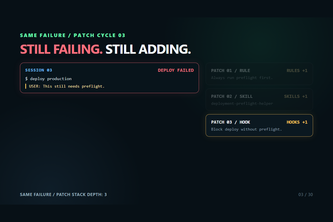
Codex Metabolism is a self-reported GPT-5.6-based Agent Skill designed to observe Codex sessions, evaluate rule bloat, and propose interventions (CREATE, PATCH, RETIRE_CANDIDATE) based on session friction. It operates with human approval and includes mechanisms for rollback, audit trails, and evidence-bound changes.
What changed
The project is described as a one-person effort built for the OpenAI 2026 hackathon. It introduces a lifecycle management layer for Codex rules and skills, aiming to close the loop on rule evolution through session analytics and human-in-the-loop decision-making.
Single most important open question
Is there evidence of real-world usage or adoption beyond the one-user case study? The description states no revenue, customers, or traction data are available.
What The Product Actually Is
The description states that Codex Metabolism is a GPT-5.6 Agent Skill that reviews recent Codex sessions and proposes interventions based on session friction. It uses:
- A GPT-5.6 model to interpret sessions, identify reusable work or friction, and author proposals.
- A Python runtime (with only standard library) to validate evidence, stream JSONL, remove duplicates, and ensure atomic writes.
- A human approval layer where changes are sealed into an approval digest; any change invalidates prior approval.
- Mechanisms for rollback, reversible changes, and audit trails.
The system is described as a zero-dependency Agent Skill, with no semantic decisions made by the model, and all actions require human authorization.
Inference: The product is not a standalone SaaS offering but a tool built for Codex environments, likely intended to be used within or alongside OpenAI’s Codex agent framework. It is not described as a commercial product or service.
Positioning & Claim Evolution
The description states that the project was inspired by:
- Hermes Agent
- Claude Code Insights
- Session analytics
It positions itself as an evidence-driven metabolism layer for Codex, aiming to close the loop on rule bloat and improve agent behavior over time.
It claims to:
- Observe → interpret → search existing capabilities → propose interventions → human approval → revisit.
- Reduce redundant rollout files from 14 to 6 in a seven-day case study.
- Preserve mixed ownership of skills, rules, hooks, and schedulers.
Claim vs. Fact: The description is self-reported and unverified. It does not state whether these claims are backed by independent validation or real-world usage beyond the one-user experiment.
Target Customer & ICP
The description does not explicitly name target customers or personas. However, it implies use within Codex agent environments, likely for developers or teams using OpenAI’s Codex framework.
It is described as a tool for:
- Managing rule bloat in agent environments.
- Observing and improving session friction.
- Supporting human-in-the-loop decision-making around agent behavior.
Inference: The ICP appears to be developers or engineers working with Codex agents, particularly those managing complex or evolving agent workflows. No explicit customer segment is named.
Business Model & Pricing Evidence
The description does not mention any pricing, monetization, or business model. It is a hackathon submission and is described as a zero-dependency Agent Skill built for internal use or demonstration.
Not evidenced: No information on revenue, pricing tiers, or commercialization strategy.
Technical & Delivery Signals
The system is built with:
- GPT-5.6 for interpretation.
- Python (standard library only) for runtime validation and evidence handling.
- A JSONL streaming pipeline to process session data.
- Mechanisms for hash-gated apply, atomic writes, and approval digest sealing.
It includes:
- A reproducible synthetic lifecycle demo
- CI support across Python 3.11/3.12 on Ubuntu and Windows
- Package builds
Inference: The technical approach is lightweight, modular, and focused on safety and auditability. It does not appear to be a commercial-grade product but a proof-of-concept or prototype.
Traction & Maturity Signals
The description states:
- A one-user, seven-day case study was conducted.
- In that case, the system reduced 14 rollout files to 6 independent sessions.
- It identified 8 fork snapshots and 210 duplicate user events.
- GPT-5.6 proposed one PATCH and one NO CHANGE / REUSE.
No further traction data is provided:
- No customers
- No revenue
- No product adoption beyond the single-user experiment
Not evidenced: No evidence of real-world usage, scaling, or product-market fit beyond a hackathon prototype.
Competitive Context
The description references:
- Hermes Agent
- Claude Code Insights
These are known tools in the agent and code-insights space. However, no competitive analysis is provided.
Inference: The project likely competes with or complements tools that help developers manage agent behavior, session analytics, and rule lifecycle management. No direct competitor names or market positioning are given.
Open Questions & Risks
- No real-world usage or adoption beyond a single-user case study.
- Self-reported only: No third-party validation or independent verification of claims.
- Hackathon project: Likely not production-ready, nor intended for commercial deployment.
- No pricing or monetization strategy described.
- Single-person team: May limit scalability and product development velocity.
Inference: The project is a prototype with no evidence of traction, revenue, or market validation. It may be more of a proof-of-concept than a viable business.
Questions the description leaves open
- What is the exact scope of the one-user case study? Was it representative?
- Are there any plans to scale beyond this single-user experiment?
- How does Codex Metabolism integrate with existing agent workflows in practice?
- Is there a plan for commercialization or productization?
- What are the long-term implications of human approval being required for every change?
- Can the system be extended to support multiple users or teams?
Overall Assessment
Not evidenced: No information is provided about revenue, customers, traction, or market readiness.
Inference: Based on the self-reported description, this appears to be a hackathon prototype with no evidence of commercial viability or product-market fit. It is not yet a viable investment or partnership opportunity without further development and validation.
User Stories BotA demo video on every pull request
Get a demo video on every new feature
GitHub App that watches your pull requests and records a narrated, captioned demo.
Save time on demo prep and make informed decisions faster with a video walkthrough of every new feature.
Source
Submitted to the OpenAI 2026 hackathon on Devpost. Project home on Devpost. Back to the full gallery on Devpost.
This competitive analysis was produced by top-founders.com (opens in a new tab)
Generated by a language model from this project's public Devpost page — its tagline, the author's own write-up and any built-with tags listed there — as captured in August 2026. Short quotations are the author's words. It is an opinion on the idea as a business, not on the people behind it, and it reflects the description as published then. If the project has moved on, request a correction below. The analysis is not independent research and contains no verified traction, revenue or customer data.
An independent guide by KFG International LLC — not affiliated with, endorsed by, or connected to Devpost or OpenAI.