

Archive position — measured, not model output
0 likes on Devpost
2,263 of the 7,850 archived projects have more likes, and 5,587 share exactly 0 — so this project's #3,384 place in the like-ranked listing is a tie-break inside that group, not a ranking.
Projects (log scale)
Likes on Devpost. ▲ marks this project's group.
Show the figures
| Likes | Projects | Share of archive |
|---|---|---|
| 0 | 5,587 | 71.2% |
| 1 | 1,758 | 22.4% |
| 2 | 284 | 3.6% |
| 3–4 | 132 | 1.7% |
| 5–9 | 75 | 1.0% |
| 10+ | 14 | 0.2% |
 User Stories BotA demo video on every pull request
Get a demo video on every new feature
GitHub App that watches your pull requests and records a narrated, captioned demo.
Save time on demo prep and make informed decisions faster with a video walkthrough of every new feature.
Executive Summary
What the company appears to be
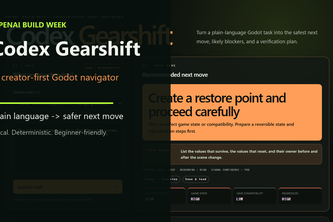
Codex Gearshift is a browser-based tool that interprets plain-language game development tasks from beginner creators and translates them into actionable Godot guidance. It operates without backend services, API keys, or external AI models at runtime, relying instead on deterministic rules and a curated set of Godot-specific blockers.
What changed
The product evolved from an experimental model-router to a creator-first navigator that hides internal routing decisions and focuses on guiding users toward the safest next move in Godot development. This shift was driven by feedback during development and GPT-5.6 Thinking for design direction, not runtime integration.
Single most important open question
Is there evidence of real-world usage or adoption from beginner game creators beyond the hackathon demo?
What The Product Actually Is
The description states that Codex Gearshift:
- Turns plain-language Godot 4.x tasks into actionable guidance.
- Provides three production guidance levels: proceed directly, proceed with checks, or create a restore point.
- Identifies relevant Godot blockers and offers verification steps.
- Generates a reusable Codex prompt bounded by safety.
- Runs entirely in the browser with no external dependencies.
It is described as a deterministic, local-first application built using Vite, TypeScript, HTML, CSS, and Vitest for testing. It uses no backend, database, authentication, or runtime AI APIs.
Inference The tool appears to be an MVP focused on educational or exploratory use within the Godot community, not yet a commercial product with customers or revenue.
Positioning & Claim Evolution
The description states:
- Initially, it was conceived as a "model-routing experiment."
- It shifted toward being a "creator-first navigator" that hides internal machinery.
- The goal is to help beginners describe problems without needing technical knowledge of Godot concepts like signal connections or collision masks.
Inference Positioning evolved from a generic AI coding assistant to a specialized, beginner-friendly tool for Godot game development. This evolution reflects an understanding of user needs and feedback during development.
Target Customer & ICP
The description states:
- The primary audience is "beginners and non-engineers."
- It aims to assist creators who struggle to articulate technical issues in Godot.
- Examples include phrases like “the button does nothing” or “coins disappear after changing scenes.”
Inference The target customer segment is likely early-stage game developers using Godot, particularly those new to game development and unfamiliar with core engine terminology.
Business Model & Pricing Evidence
Not evidenced. The description does not mention any pricing model, monetization strategy, or business model.
Technical & Delivery Signals
The description states:
- Built with Vite, TypeScript, HTML, CSS.
- Uses Vitest for deterministic regression coverage.
- Deployed as a static site via GitHub Actions and GitHub Pages.
- No backend, database, authentication, runtime AI API, or automatic code editing.
- Runs entirely in the browser with no external network requests.
Inference The technical stack supports a lightweight, local-first delivery model. The absence of runtime dependencies suggests a focus on reproducibility and transparency over scalability or automation.
Traction & Maturity Signals
Not evidenced. There is no mention of users, customers, revenue, adoption, or usage metrics beyond the hackathon submission.
Competitive Context
Not evidenced. No information about competitors or market positioning is provided in the description.
Open Questions & Risks
- No external validation: The product has not been tested or validated outside of a hackathon setting.
- Limited scope: The current version includes only 31 fixtures, 16 blockers, and 96 tests — suggesting an MVP with limited maturity.
- No commercial traction: No evidence of revenue, users, or market demand beyond the author’s own account.
- Dependency on author expertise: The tool is built by one person (コッキネア イクソラ), raising questions about scalability and long-term maintenance.
Inference The project lacks real-world usage data or commercial viability indicators. Its success depends heavily on continued founder involvement and community interest.
Questions the description leaves open
- What specific feedback did you receive from actual beginner developers during the development process?
- How do you plan to expand beyond the current 31 fixtures and 16 blockers?
- Are there any plans for monetization or commercial use cases?
- Have you considered integrating with Godot Editor or other IDEs?
- What is your roadmap for community contributions or open-source involvement?
Overall Assessment
Not evidenced. No data on valuation, funding rounds, or investment interest is available.
Inference This appears to be a hackathon prototype with no demonstrated commercial traction or investor interest. It may have potential as an educational tool or community contribution but lacks evidence of market readiness or scalability.
User Stories BotA demo video on every pull request
Get a demo video on every new feature
GitHub App that watches your pull requests and records a narrated, captioned demo.
Save time on demo prep and make informed decisions faster with a video walkthrough of every new feature.
Source
Submitted to the OpenAI 2026 hackathon on Devpost. Project home on Devpost. Back to the full gallery on Devpost.
This competitive analysis was produced by top-founders.com (opens in a new tab)
Generated by a language model from this project's public Devpost page — its tagline, the author's own write-up and any built-with tags listed there — as captured in August 2026. Short quotations are the author's words. It is an opinion on the idea as a business, not on the people behind it, and it reflects the description as published then. If the project has moved on, request a correction below. The analysis is not independent research and contains no verified traction, revenue or customer data.
An independent guide by KFG International LLC — not affiliated with, endorsed by, or connected to Devpost or OpenAI.