

Archive position — measured, not model output
0 likes on Devpost
2,263 of the 7,850 archived projects have more likes, and 5,587 share exactly 0 — so this project's #3,385 place in the like-ranked listing is a tie-break inside that group, not a ranking.
Projects (log scale)
Likes on Devpost. ▲ marks this project's group.
Show the figures
| Likes | Projects | Share of archive |
|---|---|---|
| 0 | 5,587 | 71.2% |
| 1 | 1,758 | 22.4% |
| 2 | 284 | 3.6% |
| 3–4 | 132 | 1.7% |
| 5–9 | 75 | 1.0% |
| 10+ | 14 | 0.2% |
 User Stories BotA demo video on every pull request
Get a demo video on every new feature
GitHub App that watches your pull requests and records a narrated, captioned demo.
Save time on demo prep and make informed decisions faster with a video walkthrough of every new feature.
Executive Summary
What the company appears to be
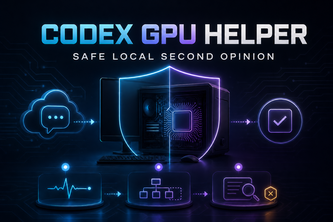
Codex GPU Helper is a self-reported Windows x64 application that integrates with Codex (an AI engineering agent) to provide optional, read-only advisory reviews using local GPU resources. It installs as an independent tool and communicates with Codex via a bounded MCP (Model Communication Protocol) interface. The helper does not modify files or execute external commands; it only offers untrusted advice that Codex independently verifies.
What changed
The project is described as a prerelease beta version (v0.1.0-beta.25), built during a hackathon, with no evidence of prior versions or commercial traction. It introduces a new integration layer between Codex and local GPU resources, focusing on safety and control over model usage.
Single most important open question
Is there any evidence that this tool has been adopted by users beyond the author’s own use case, or whether it is being used in production environments?
Note: All findings are based on self-reported information from the project description. No third-party verification, revenue data, customer names, or traction metrics are available.
What The Product Actually Is
The description states that Codex GPU Helper is:
- An independent Windows x64 app.
- A read-only stdio MCP reviewer named
local_gpu_reviewer. - Designed to run optional tasks using local GPU capacity without modifying Codex configuration.
- Not intended to replace or directly interact with Codex but to provide advisory input.
It uses:
- C#, .NET 10, Windows Forms
- Inno Setup for installation
- PowerShell automation
- GitHub Actions CI/CD pipeline
- SPDX SBOM generation
- Artifact attestations
- Exact-file registered LM Studio/GGUF routes
- Loopback Ollama integration
The tool is described as:
- Not bundling model weights.
- Using exact paths, digests, and process identity checks.
- Supporting only advisory output that Codex independently validates.
Inference: The product appears to be a proof-of-concept or early-stage prototype aimed at enabling safe local AI inference within the context of Codex workflows. It is not a commercial product as such, but rather an experimental integration tool.
Positioning & Claim Evolution
The author positions Codex GPU Helper as:
- A "safe local second opinion" for Codex.
- An optional utility that preserves existing Codex configuration and avoids accidental authority or destructive actions.
- A way to utilize spare Windows GPU capacity while maintaining control over what happens in the system.
Key claims include:
- It keeps Codex firmly in charge.
- It prevents fragile configurations, GPU contention, untrusted model identity, and destructive attempts to unload shared runtimes.
- It provides bounded advisory generation after Codex announces provider, model, and purpose.
- Output is untrusted advice that Codex independently verifies.
Inference: The positioning emphasizes safety and control over local AI usage. There is no indication of broader market positioning or branding beyond the hackathon submission.
Target Customer & ICP
The description does not clearly identify a target customer segment or ideal customer profile (ICP). However, it implies:
- Users who already use Codex as an engineering agent.
- Developers or engineers working on Windows machines with available GPU resources.
- Individuals interested in local AI inference and safety controls.
Inference: The primary audience seems to be advanced users of Codex who are interested in extending its capabilities through local hardware. There is no evidence of a defined market segment or persona beyond the author's own use case.
Business Model & Pricing Evidence
There is no evidence of any business model or pricing structure described in the project write-up. The tool is presented as an open-source, prerelease utility with no commercial offering.
Inference: No revenue model or pricing data are available; this appears to be a developer tool built for personal or internal use rather than a commercial product.
Technical & Delivery Signals
The author reports:
- Built using C#, .NET 10, Windows Forms, Inno Setup, PowerShell.
- Uses bounded MCP stdio server and supports exact-file registered LM Studio/GGUF routes.
- Implements surgical, rollback-safe Codex configuration management.
- Includes artifact attestations, SPDX SBOMs, and GitHub Actions workflows.
- Supports task-aware routing across installed models with integrity checks.
- Uses cross-process leases, fresh state hashes, and fail-closed transitions.
Inference: The technical implementation shows a strong focus on safety, control, and reliability. However, there is no evidence of scalability or production-grade infrastructure beyond the developer’s own environment.
Traction & Maturity Signals
The project is described as:
- A prerelease beta version (v0.1.0-beta.25).
- Submitted to a hackathon.
- Includes 407/407 isolated tests, full release audit, and verified checksums.
- Has undergone multiple beta iterations with fixes for signed-out beginner failures.
- Demonstrated live runtime behavior including successful cold load of Qwythos 9B through LM Studio.
Inference: The project shows technical maturity for a prototype but lacks evidence of adoption or user engagement beyond the author. No customer base, usage statistics, or product-market fit data are provided.
Competitive Context
The description does not mention any competitors or similar tools in the market. It focuses on integrating with Codex and local GPU resources without comparing itself to other solutions.
Inference: There is no competitive landscape described. The tool appears to be unique within its niche, though it may overlap conceptually with other local AI inference tools or Codex integrations.
Open Questions & Risks
Key risks identified from the self-reported description:
- No evidence of user adoption or market traction.
- Tool is limited to Windows x64 and requires existing Codex setup.
- Prerelease status implies lack of stability or long-term support.
- No commercialization strategy or monetization plan evident.
- Safety mechanisms are described but not independently validated.
Inference: The tool may be technically sound for its intended purpose, but lacks any indication of real-world utility or scalability beyond the author’s own use case.
Questions the description leaves open
- What is the actual adoption rate among users beyond the author?
- Are there plans to expand support beyond Windows x64 or Codex?
- How does this tool integrate with existing workflows in practice?
- Is there any plan for commercialization or monetization?
- Has the tool been tested in real-world environments outside of development?
- What are the long-term maintenance and update strategies?
Overall Assessment
There is no evidence of a viable business model, revenue, or customer traction. The project is described as a hackathon submission with limited commercial potential at this stage.
Inference: At present, there is insufficient evidence to recommend investment or partnership. This appears to be an experimental tool with possible future value, but it lacks the indicators of product-market fit or scalability required for commercial viability.
User Stories BotA demo video on every pull request
Get a demo video on every new feature
GitHub App that watches your pull requests and records a narrated, captioned demo.
Save time on demo prep and make informed decisions faster with a video walkthrough of every new feature.
Source
Submitted to the OpenAI 2026 hackathon on Devpost. Project home on Devpost. Back to the full gallery on Devpost.
This competitive analysis was produced by top-founders.com (opens in a new tab)
Generated by a language model from this project's public Devpost page — its tagline, the author's own write-up and any built-with tags listed there — as captured in August 2026. Short quotations are the author's words. It is an opinion on the idea as a business, not on the people behind it, and it reflects the description as published then. If the project has moved on, request a correction below. The analysis is not independent research and contains no verified traction, revenue or customer data.
An independent guide by KFG International LLC — not affiliated with, endorsed by, or connected to Devpost or OpenAI.