

Archive position — measured, not model output
0 likes on Devpost
2,263 of the 7,850 archived projects have more likes, and 5,587 share exactly 0 — so this project's #3,371 place in the like-ranked listing is a tie-break inside that group, not a ranking.
Projects (log scale)
Likes on Devpost. ▲ marks this project's group.
Show the figures
| Likes | Projects | Share of archive |
|---|---|---|
| 0 | 5,587 | 71.2% |
| 1 | 1,758 | 22.4% |
| 2 | 284 | 3.6% |
| 3–4 | 132 | 1.7% |
| 5–9 | 75 | 1.0% |
| 10+ | 14 | 0.2% |
 User Stories BotA demo video on every pull request
Get a demo video on every new feature
GitHub App that watches your pull requests and records a narrated, captioned demo.
Save time on demo prep and make informed decisions faster with a video walkthrough of every new feature.
Executive Summary
What the company appears to be
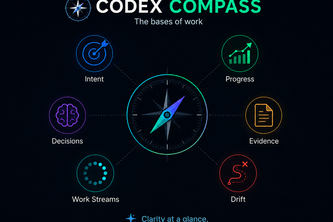
Codex Compass is a self-reported local terminal UI (TUI) tool built for developers using Codex CLI. The author states it aims to bring transparency and insight into agentic coding processes, helping developers structure and track their workstreams during agent-assisted development sessions.
What changed
The project was submitted as part of the OpenAI 2026 hackathon, indicating an experimental or early-stage effort with no known prior existence or traction.
Single most important open question — the commercial due-diligence read
Is there any evidence that Codex Compass has been adopted by developers beyond its creator's personal use, and does it have a clear path to product-market fit in agentic coding tools?
What The Product Actually Is
The description states:
- Codex Compass is a local terminal UI (TUI) tool.
- It currently supports the Codex CLI only.
- It uses hook events from the Codex CLI to trigger its activities, acting as a "hidden watcher".
- It is built using Go, with libraries like Bubble Tea and lipgloss.
- It integrates with GPT-5.6 for development tasks (build, test, review).
Inference: The tool appears to be a lightweight, developer-focused utility that tracks and structures agentic coding sessions in real time, using local CLI interaction.
Positioning & Claim Evolution
The description states:
- It is positioned as a way to keep developers engaged during agentic coding.
- It aims to bring transparency and insight into the agentic development process as it unfolds.
- The author frames it as an experimental approach to maintain developer involvement in a future where AI handles much of the coding.
Inference: The positioning is rooted in concern over the loss of analytical thinking in programming due to reliance on AI agents, and attempts to re-engage developers through structured session tracking.
Target Customer & ICP
The description states:
- It targets developers using Codex CLI.
- It is designed for those who work with agentic coding, including multiple problems or features in a single session.
Inference: The target customer is likely a subset of developers already using Codex CLI, and potentially early adopters of agentic coding workflows.
Business Model & Pricing Evidence
Not evidenced.
The description does not mention any pricing model, monetization strategy, or business model. It is described as an experimental tool built for a hackathon.
Technical & Delivery Signals
The description states:
- Built with Go, using Bubble Tea and lipgloss TUI libraries.
- Uses Codex CLI hooks to trigger functionality.
- Integrated with GPT-5.6 for development tasks (build, test, review).
- The author used GPT-5.6 Sol (medium reasoning), Luna (medium reasoning), and a Skill that snapshots the terminal UI for review.
Inference: The tool is technically lightweight, built with developer tools in mind, and uses modern CLI and AI integration patterns.
Traction & Maturity Signals
Not evidenced.
There is no mention of users, adoption, or usage beyond the author’s personal experimentation. No revenue, customers, or product traction data are provided.
Competitive Context
Not evidenced.
The description does not reference any existing tools or competitive landscape in agentic coding or developer tooling. It does not name competitors or similar products.
Open Questions & Risks
- No evidence of adoption or usage beyond the author’s personal use.
- No pricing, monetization, or business model.
- Only supports Codex CLI, limiting its applicability.
- Experimental nature — described as a hackathon project with no concrete plans for development.
- No clear path to product-market fit or scalability.
Inference: The tool is in an early experimental phase and lacks any commercial or user traction signals.
Questions the description leaves open
- Has Codex Compass been used by other developers beyond your own personal use?
- Are there any plans to support additional CLI tools or platforms beyond Codex?
- What is the intended monetization strategy, if any?
- How does it handle data persistence and session history for long-term use?
- Have you considered integrating with IDEs or other development environments beyond CLI?
Overall Assessment
Not evidenced.
There is no evidence of revenue, traction, or a clear business model to assess investment or partnership viability. The project is described as experimental and personal, with no indication of commercial potential or scalability.
User Stories BotA demo video on every pull request
Get a demo video on every new feature
GitHub App that watches your pull requests and records a narrated, captioned demo.
Save time on demo prep and make informed decisions faster with a video walkthrough of every new feature.
Source
Submitted to the OpenAI 2026 hackathon on Devpost. Project home on Devpost. Back to the full gallery on Devpost.
This competitive analysis was produced by top-founders.com (opens in a new tab)
Generated by a language model from this project's public Devpost page — its tagline, the author's own write-up and any built-with tags listed there — as captured in August 2026. Short quotations are the author's words. It is an opinion on the idea as a business, not on the people behind it, and it reflects the description as published then. If the project has moved on, request a correction below. The analysis is not independent research and contains no verified traction, revenue or customer data.
An independent guide by KFG International LLC — not affiliated with, endorsed by, or connected to Devpost or OpenAI.