

Archive position — measured, not model output
0 likes on Devpost
2,263 of the 7,850 archived projects have more likes, and 5,587 share exactly 0 — so this project's #7,297 place in the like-ranked listing is a tie-break inside that group, not a ranking.
Projects (log scale)
Likes on Devpost. ▲ marks this project's group.
Show the figures
| Likes | Projects | Share of archive |
|---|---|---|
| 0 | 5,587 | 71.2% |
| 1 | 1,758 | 22.4% |
| 2 | 284 | 3.6% |
| 3–4 | 132 | 1.7% |
| 5–9 | 75 | 1.0% |
| 10+ | 14 | 0.2% |
 User Stories BotA demo video on every pull request
Get a demo video on every new feature
GitHub App that watches your pull requests and records a narrated, captioned demo.
Save time on demo prep and make informed decisions faster with a video walkthrough of every new feature.
Executive Summary
What the company appears to be
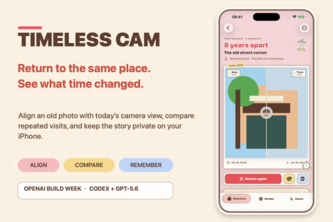
Timeless Cam is a self-reported native iOS app that enables users to align old photos with current camera views, capture present-day images from the same angle, and build a private visual timeline. It supports local-first operation, meaning no cloud backend or account is required.
What changed
During Build Week (a hackathon context), Timeless Cam was extended from a basic before-and-after camera flow into a more complete tool with post-capture editing, metadata support, search, PDF export, localization across four languages, and in-app purchase flows. The app remains local-first and does not use AI services or cloud infrastructure.
Single most important open question
Is there evidence of user adoption or engagement beyond the author’s own development and demo?
Note
This analysis is based entirely on self-reported information from the project description provided by the caller. No independent verification, traction data, revenue figures, customer names, or third-party sources are available.
What The Product Actually Is
- The description states that Timeless Cam is a native iOS app built with Swift and SwiftUI.
- It allows users to select an old photo, overlay it on the live camera view, adjust alignment (position, scale, rotation, opacity), and capture a new image from the same angle.
- Users can compare past and present views using a slider or four presentation styles.
- The app supports timeline creation, metadata editing (title, place, date), search across memories, and exporting as a searchable A4 PDF diary.
- Photos and metadata are stored locally on the device; no cloud services or accounts are used.
- It uses Core Image for image processing, Core Location for optional place metadata, PDFKit for export, and StoreKit 2 for in-app purchases.
Inference The app appears to be a personal memory tool focused on visual storytelling through repeated visits to meaningful locations.
Not evidenced No information about actual usage, user feedback, or product performance beyond the author's own account.
Positioning & Claim Evolution
- The tagline — “Return to the same place, align an old photo with today’s camera view, and turn repeated visits into a private, local-first visual timeline” — positions Timeless Cam as a tool for preserving personal memories.
- The project write-up describes it as evolving from a simple before-and-after camera experience into a more comprehensive visual-memory tool.
- It emphasizes privacy by being local-first, avoiding cloud storage or account requirements.
- The author claims that the app was extended during Build Week to include features like metadata editing, search, and PDF export.
Inference The positioning has shifted from a basic technical demo to a functional personal memory tool with enhanced usability and structure.
Not evidenced No evidence of external marketing claims, brand positioning, or user perception beyond the author’s own description.
Target Customer & ICP
- The description does not name specific customer segments.
- It implies a target audience interested in preserving personal memories through visual storytelling.
- The app is designed for individuals who value local-first privacy and want to revisit places with historical significance.
- Features like search, metadata editing, and PDF export suggest an interest in organizing and sharing these memories.
Inference The ICP likely includes tech-savvy individuals or early adopters of privacy-focused tools who are interested in personal visual history.
Not evidenced No data on actual users, personas, or segmentation beyond the author’s own assumptions.
Business Model & Pricing Evidence
- The app supports in-app purchases via StoreKit 2.
- It includes a trial and purchase flow.
- There is no mention of subscriptions, freemium tiers, or monetization beyond the trial/purchase model.
- No pricing information or revenue streams are provided.
Inference Likely a one-time purchase or freemium model with optional upgrades.
Not evidenced No evidence of pricing strategy, conversion rates, or monetization metrics.
Technical & Delivery Signals
- Built natively for iOS using Swift and SwiftUI.
- Uses Core Data (SwiftData) for local storage.
- Integrates AVFoundation, PhotosUI, Core Image, Core Location, PDFKit, and StoreKit 2.
- Supports localization in Simplified Chinese, English, Japanese, and Korean.
- The app is described as “local-first,” meaning no cloud or AI services are used at runtime.
- The author reports that Codex with GPT-5.6 helped during development by assisting with architecture review, code implementation, QA, and localization audits.
Inference The technical stack reflects a modern iOS-native approach with strong emphasis on privacy and performance.
Not evidenced No evidence of scalability, backend infrastructure, or long-term maintenance plans.
Traction & Maturity Signals
- The app was submitted to the OpenAI 2026 hackathon.
- A fresh unsigned simulator build from the repository completed successfully.
- A public demo was verified on an iPhone 17 Pro Max simulator running iOS 26.4 and passed YouTube's copyright check.
- The project includes a Git history with a baseline tag (
pre-build-week-baseline) indicating prior development.
Inference The app has been tested in a controlled environment and demonstrated functionality.
Not evidenced No evidence of user adoption, retention, or real-world usage beyond the author’s own testing.
Competitive Context
- The description does not mention direct competitors.
- It positions itself as a privacy-focused alternative to apps that rely on cloud storage or AI services for photo alignment or memory organization.
- The local-first approach and focus on visual timelines suggest it may compete with general photo-sharing or memory apps, though no specific names are given.
Inference Timeless Cam could be positioned against apps that lack strong privacy controls or fail to support repeated visual comparisons.
Not evidenced No competitive analysis, market sizing, or competitor identification provided.
Open Questions & Risks
- The app is a single-person project with no team beyond the author.
- It has not been independently verified for performance, security, or scalability.
- The lack of user data or traction raises questions about product-market fit.
- The use of Codex/GPT-5.6 during development may indicate a reliance on AI assistance rather than human-driven innovation.
- No mention of long-term roadmap, monetization strategy, or expansion plans.
Inference Risk of limited scalability and lack of real-world validation.
Not evidenced No evidence of risks beyond the author’s own account.
Questions the description leaves open
- What is the actual user feedback or engagement level beyond your own testing?
- How do you plan to scale beyond a single developer?
- Are there any plans for monetization beyond in-app purchases?
- Have you considered how users might share timelines or collaborate on memories?
- What are the long-term goals for the app, and how do they align with user needs?
- How do you intend to handle edge cases like poor lighting or misaligned photos?
- Is there any intention to expand beyond iOS or support other platforms?
Overall Assessment
- The project is a self-reported, single-developer iOS app focused on privacy and personal memory preservation.
- It shows technical capability and design maturity within its niche but lacks evidence of traction or commercial viability.
- There is no indication of revenue, customers, or market validation beyond the author’s own claims.
Assessment Not ready for investment or partnership without further evidence of user engagement, product-market fit, or scalability.
Confidence Level Low — based on thin, self-reported evidence only.
User Stories BotA demo video on every pull request
Get a demo video on every new feature
GitHub App that watches your pull requests and records a narrated, captioned demo.
Save time on demo prep and make informed decisions faster with a video walkthrough of every new feature.
Source
Submitted to the OpenAI 2026 hackathon on Devpost. Project home on Devpost. Back to the full gallery on Devpost.
This competitive analysis was produced by top-founders.com (opens in a new tab)
Generated by a language model from this project's public Devpost page — its tagline, the author's own write-up and any built-with tags listed there — as captured in August 2026. Short quotations are the author's words. It is an opinion on the idea as a business, not on the people behind it, and it reflects the description as published then. If the project has moved on, request a correction below. The analysis is not independent research and contains no verified traction, revenue or customer data.
An independent guide by KFG International LLC — not affiliated with, endorsed by, or connected to Devpost or OpenAI.