

Archive position — measured, not model output
0 likes on Devpost
2,263 of the 7,850 archived projects have more likes, and 5,587 share exactly 0 — so this project's #3,373 place in the like-ranked listing is a tie-break inside that group, not a ranking.
Projects (log scale)
Likes on Devpost. ▲ marks this project's group.
Show the figures
| Likes | Projects | Share of archive |
|---|---|---|
| 0 | 5,587 | 71.2% |
| 1 | 1,758 | 22.4% |
| 2 | 284 | 3.6% |
| 3–4 | 132 | 1.7% |
| 5–9 | 75 | 1.0% |
| 10+ | 14 | 0.2% |
 User Stories BotA demo video on every pull request
Get a demo video on every new feature
GitHub App that watches your pull requests and records a narrated, captioned demo.
Save time on demo prep and make informed decisions faster with a video walkthrough of every new feature.
Executive Summary
What the company appears to be
Codex Control Tower is a self-reported tool that adds a safety and evidence layer around AI-assisted development using Codex. It claims to separate authority between AI-generated code (Codex) and AI-based review (GPT-5.6), with a focus on preventing unauthorized actions and ensuring mission alignment through deterministic checks and human review gates.
What changed
The project description indicates an evolution from standard AI coding workflows to one that introduces structured auditing, bounded model reasoning, and preflight safety checks. The author describes building a system where GPT-5.6 operates in a "blind" mode without seeing expected answers or tools, and where local code enforces policy before any model decision.
The single most important open question
Is there evidence of real-world usage, adoption, or traction beyond the author's own controlled experiments? The description states that all outputs are from a fictional sample and that no production validation or customer outcomes are available. This raises uncertainty about whether the product has moved beyond prototype or proof-of-concept stage.
What The Product Actually Is
The description states that Codex Control Tower is a system that:
- Adds a mission-control and evidence layer around AI-assisted development.
- Records the mission, scope, forbidden actions, risks, required tests, and human approval.
- Uses local code to scan repositories and lock structural and execution facts before model review.
- Employs a "real GPT-5.6-sol" that receives neutral claims and bounded raw evidence but not expected answers.
- Requires GPT-5.6 to return SUPPORTS, CONTRADICTS, or INSUFFICIENT with citations and reasoning.
- Only allows changes after human review if there is disagreement between model and local policy.
- Includes a second safety layer that preflights destructive actions (e.g., delete commands) and blocks them if they exceed defined boundaries.
Inference The system appears to be a hybrid tool combining deterministic code governance with AI-based semantic auditing, designed to enforce controlled execution and prevent unauthorized or unsafe changes in development workflows.
Positioning & Claim Evolution
The author states:
- The product is built around the idea that "Codex writes. GPT-5.6 challenges. Control Tower locks the facts. The developer decides."
- It aims to address a broader safety problem beyond just file deletion: agent work needs bounded missions, evidence, and authority.
- The system separates deterministic code from semantic model judgment, preventing models from rewriting repository truth.
Inference The positioning evolved from a simple AI coding assistant to a more structured, safety-focused development workflow. It positions itself as a tool for managing risk in AI-assisted development by enforcing boundaries and requiring human oversight.
Target Customer & ICP
The description does not explicitly state target customers or personas. However, it implies:
- Developers working with AI tools like Codex.
- Teams seeking to manage risks in AI-assisted code generation.
- Organizations that want to maintain control over their development processes while using AI.
Inference The primary ICP likely includes developers and engineering teams who are already using or considering AI coding assistants, particularly those concerned with security, compliance, and auditability in software development.
Business Model & Pricing Evidence
There is no evidence of pricing, business model, or monetization strategy in the description. The project is presented as a hackathon submission and not as a commercial product.
Inference No clear business model or pricing information is evident. The tool appears to be experimental or prototype-level, with no indication of how it would be sold or deployed at scale.
Technical & Delivery Signals
The description states:
- Built with Node.js CLI, React, Vite, GitHub Actions, and GitHub Pages.
- Uses deterministic repository scanning and governance scoring.
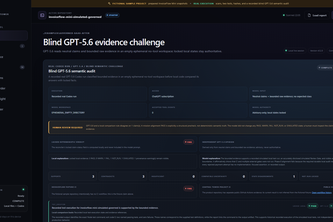
- Implements a "Blind GPT-5.6 Semantic Audit" that runs in an ephemeral, read-only workspace.
- Includes fail-closed event validation, citation allowlists, hashes, freshness checks, Git provenance.
- Has a dashboard UI built with React and Vite.
- Does not require OpenAI API keys for deterministic workflow; uses existing ChatGPT account.
Inference The technical architecture shows a strong emphasis on determinism, security, and auditability. It is designed to be self-contained and secure, with minimal reliance on external APIs for core functionality.
Traction & Maturity Signals
The description states:
- The submission contains a recorded real Codex run using pinned codex-cli 0.144.3 and exact model gpt-5.6-sol.
- It includes a controlled sample (InvoiceFlow Mini) with before-and-after snapshots.
- All outputs are from a fictional controlled sample; no customer outcomes or production validation are reported.
- No revenue, customers, or traction data is available beyond what the author states.
Inference There is no evidence of real-world adoption, usage, or market traction. The project remains in a prototype or experimental phase, with no indication of commercial deployment or user base.
Competitive Context
The description does not mention competitors directly. However, it implies:
- A space involving AI-assisted development tools.
- Tools that manage risk and enforce boundaries during code generation.
- Systems that integrate AI with deterministic checks and human review.
Inference The competitive landscape likely includes AI coding assistants (e.g., Codex, GitHub Copilot), workflow automation platforms, and security-focused development tools. The product differentiates itself through its focus on bounded AI reasoning and deterministic governance.
Open Questions & Risks
Key risks and open questions include:
- No evidence of real-world usage or customer validation.
- The system is described as a hackathon submission with no production deployment.
- No mention of scalability, performance, or integration capabilities beyond the author’s controlled example.
- The use of "GPT-5.6" is unverified; it may not exist in reality.
- The project lacks any financial or operational data.
Inference The lack of real-world validation and commercial traction raises concerns about whether the product has reached a viable or scalable stage. The experimental nature of the tool, combined with no evidence of adoption or revenue, suggests high uncertainty around its future viability.
Questions the description leaves open
- What is the actual level of integration with existing development workflows?
- How does the system handle edge cases or ambiguous inputs that may not be covered in the current example?
- Are there plans to expand beyond the current controlled sample, and what are the barriers to doing so?
- Is there any internal testing or feedback from developers using this tool?
- What is the roadmap for moving from prototype to production-ready deployment?
Overall Assessment
Not evidenced.
The description provides no information about funding rounds, valuation, team size beyond one person, or any commercial activity beyond a hackathon submission. The project appears to be an experimental prototype with no demonstrated traction, revenue, or market validation.
Inference There is insufficient evidence to support an investment or partnership decision at this time. The tool shows potential in its conceptual design but lacks real-world application or business metrics that would justify further due diligence or commitment.
User Stories BotA demo video on every pull request
Get a demo video on every new feature
GitHub App that watches your pull requests and records a narrated, captioned demo.
Save time on demo prep and make informed decisions faster with a video walkthrough of every new feature.
Source
Submitted to the OpenAI 2026 hackathon on Devpost. Project home on Devpost. Back to the full gallery on Devpost.
This competitive analysis was produced by top-founders.com (opens in a new tab)
Generated by a language model from this project's public Devpost page — its tagline, the author's own write-up and any built-with tags listed there — as captured in August 2026. Short quotations are the author's words. It is an opinion on the idea as a business, not on the people behind it, and it reflects the description as published then. If the project has moved on, request a correction below. The analysis is not independent research and contains no verified traction, revenue or customer data.
An independent guide by KFG International LLC — not affiliated with, endorsed by, or connected to Devpost or OpenAI.