

Archive position — measured, not model output
0 likes on Devpost
2,263 of the 7,850 archived projects have more likes, and 5,587 share exactly 0 — so this project's #3,375 place in the like-ranked listing is a tie-break inside that group, not a ranking.
Projects (log scale)
Likes on Devpost. ▲ marks this project's group.
Show the figures
| Likes | Projects | Share of archive |
|---|---|---|
| 0 | 5,587 | 71.2% |
| 1 | 1,758 | 22.4% |
| 2 | 284 | 3.6% |
| 3–4 | 132 | 1.7% |
| 5–9 | 75 | 1.0% |
| 10+ | 14 | 0.2% |
 User Stories BotA demo video on every pull request
Get a demo video on every new feature
GitHub App that watches your pull requests and records a narrated, captioned demo.
Save time on demo prep and make informed decisions faster with a video walkthrough of every new feature.
Executive Summary
What the company appears to be: Codex Cowork is a self-reported tool that enhances the Codex CLI by enabling delegation of tasks across three GPT-5.6 models (Sol, Terra, Luna) within a single workflow. It allows for orchestration of AI agents while preserving native Codex behavior.
What changed: The author describes an evolution from manual, single-model use of Codex to a system where different models collaborate in a structured way, with Sol as the lead agent and Luna or Terra performing specialized work under Sol’s approval.
Single most important open question: Does this tool actually improve developer productivity or reduce cost when compared to using Codex alone? The author states that early experiments failed to show improvement, but no further data on performance gains is provided.
What The Product Actually Is
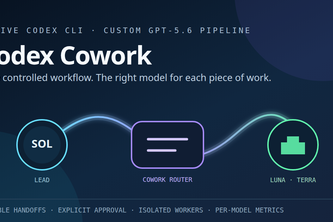
The description states that Codex Cowork turns the Codex CLI into a customizable GPT-5.6 pipeline. It delegates tasks across Sol, Terra, and Luna models while maintaining one native workflow.
It functions as a Node.js application built around the official Codex App Server protocol, using a local loopback proxy between the Codex terminal interface and the App Server.
The system includes:
- A persistent Luna watcher that observes session activity
- Isolated workers (Luna or Terra) for specific tasks
- Explicit Sol approval through a client-handled control tool
- Structured result contracts with defined scope, permissions, and acceptance criteria
Not evidenced: What the actual product does beyond this description is unknown. No screenshots, demos, or usage examples are provided.
Positioning & Claim Evolution
The author positions Codex Cowork as an enhancement to existing Codex functionality, not a replacement.
Claims:
- It "turns the Codex CLI into a customizable GPT-5.6 pipeline"
- It "seamlessly delegates each task across Sol, Terra, and Luna"
- It preserves "one native, user-controlled workflow"
Evolution:
- Started with a personal need to use Codex from mobile
- Evolved toward multi-agent orchestration
- Shifted focus from general delegation to structured ownership transfer
Not evidenced: No evidence of prior versions or claims, nor how this compares to other tools in the space.
Target Customer & ICP
The description states that the tool is designed for developers using Codex CLI for end-to-end development, particularly those who work remotely or in terminal-native environments (e.g., via Termux and DevPods).
It targets users who:
- Use Codex regularly
- Want to delegate complex tasks across different AI models
- Value control over their workflow
Not evidenced: No specific customer segments, personas, or use cases beyond the author’s own experience.
Business Model & Pricing Evidence
The description does not provide any information about pricing, monetization strategy, or business model.
Not evidenced: No indication of how this would be sold, whether it's free, paid, or part of a larger platform.
Technical & Delivery Signals
The system is built using:
- Node.js
- Codex App Server protocol
- JavaScript
- Git and GitHub integration
- WebSockets
- Zod for schema validation
- MCP (Model Control Protocol)
- GPT-5.6 models (Sol, Terra, Luna)
Key technical features include:
- Persistent semantic opportunity detection
- Explicit Sol approval mechanism
- Isolated workers with single-owner leases
- Structured trust validation
- Path-aware patch integration
- Token accounting by model and class
Not evidenced: No evidence of scalability, performance metrics, or production deployment details.
Traction & Maturity Signals
The project was submitted to the OpenAI 2026 hackathon on Devpost. The author claims:
- 79 unit tests and 7 integration tests
- Original benchmark repositories with hidden evaluators
- End-to-end build completed through Codex, including from a phone
- Honest publication of negative experimental results
Not evidenced: No revenue, customer adoption, or usage data beyond the author’s own development experience.
Competitive Context
The description does not mention any competitors or how this compares to existing tools in the AI agent orchestration space.
Not evidenced: No competitive analysis, market positioning, or differentiation from similar projects.
Open Questions & Risks
- Lack of traction: No evidence of users, customers, or revenue.
- Unproven value proposition: Early experiments showed no improvement over baseline Codex use.
- Self-reported only: All information is from the author’s own account; no third-party validation.
- Limited scope: Only one developer (the founder) is involved.
- Unclear commercial viability: No pricing, monetization, or business model described.
Inference: If early experiments failed to show value, it may be difficult to demonstrate ROI for users.
Questions the description leaves open
- What specific productivity gains have you observed in practice?
- How do you plan to validate the economic benefit of delegation over time?
- Are there any plans to expand beyond Sol/Terra/Luna models or integrate with other AI systems?
- What is your roadmap for scaling beyond a single developer?
- Have you considered how this might fit into existing development workflows or IDEs?
Overall Assessment
This is an early-stage, self-reported project submitted as a hackathon entry. There is no evidence of traction, revenue, or customer adoption.
The author describes a technical solution to a personal problem but does not provide proof that it solves a broader market need or delivers measurable value.
Assessment: Not ready for investment or partnership at this stage. Requires further demonstration of real-world utility and scalability before any serious consideration.
User Stories BotA demo video on every pull request
Get a demo video on every new feature
GitHub App that watches your pull requests and records a narrated, captioned demo.
Save time on demo prep and make informed decisions faster with a video walkthrough of every new feature.
Source
Submitted to the OpenAI 2026 hackathon on Devpost. Project home on Devpost. Back to the full gallery on Devpost.
This competitive analysis was produced by top-founders.com (opens in a new tab)
Generated by a language model from this project's public Devpost page — its tagline, the author's own write-up and any built-with tags listed there — as captured in August 2026. Short quotations are the author's words. It is an opinion on the idea as a business, not on the people behind it, and it reflects the description as published then. If the project has moved on, request a correction below. The analysis is not independent research and contains no verified traction, revenue or customer data.
An independent guide by KFG International LLC — not affiliated with, endorsed by, or connected to Devpost or OpenAI.