

Archive position — measured, not model output
0 likes on Devpost
2,263 of the 7,850 archived projects have more likes, and 5,587 share exactly 0 — so this project's #3,364 place in the like-ranked listing is a tie-break inside that group, not a ranking.
Projects (log scale)
Likes on Devpost. ▲ marks this project's group.
Show the figures
| Likes | Projects | Share of archive |
|---|---|---|
| 0 | 5,587 | 71.2% |
| 1 | 1,758 | 22.4% |
| 2 | 284 | 3.6% |
| 3–4 | 132 | 1.7% |
| 5–9 | 75 | 1.0% |
| 10+ | 14 | 0.2% |
 User Stories BotA demo video on every pull request
Get a demo video on every new feature
GitHub App that watches your pull requests and records a narrated, captioned demo.
Save time on demo prep and make informed decisions faster with a video walkthrough of every new feature.
Executive Summary
What the company appears to be
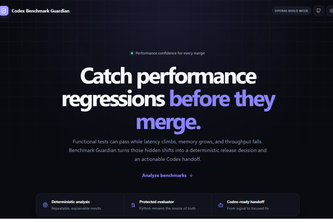
Codex Benchmark Guardian is a developer tool that detects performance regressions in code changes, creates bounded repair goals for AI agents (Codex), and verifies fixes through protected checks before merge. It is built as a self-contained system with a dashboard, CLI, API, and GitHub integration.
What changed
The author states they built this tool to address a gap in CI/CD workflows where functional tests pass but performance quietly degrades. The project introduces a "verified Codex Repair Loop" that ensures AI agents can investigate and repair regressions without controlling the benchmark policy or merging code themselves.
Single most important open question
Is there any evidence of real-world usage, adoption, or traction beyond the author’s own development and testing?
What The Product Actually Is
The description states that Codex Benchmark Guardian is a developer tool designed to detect performance regressions in software changes. It compares baseline and current benchmark data across metrics such as latency, runtime, memory usage, error rate, throughput, accuracy, recall, and success rate.
It supports both higher-is-worse and lower-is-worse metrics and generates outputs including:
- percentage changes;
- regression decisions;
- severity classifications;
- release-readiness scoring;
- triage guidance;
- Markdown and HTML reports;
- GitHub issue handoffs;
- bounded Codex repair goals;
- immutable Repair Contracts;
- CI and pull-request guardrail artifacts.
The system includes a production dashboard built with Next.js, FastAPI, and Python; a command-line interface using Typer; and a Streamlit interface. It also integrates with GitHub Actions for protected pull-request benchmark gates.
Evidence
- The author describes the tool’s functionality in detail.
- It supports multiple metric types and output formats.
- It includes integration points like GitHub Actions, FastAPI endpoints, and CLI tools.
Inference The product appears to be a workflow automation system that bridges performance testing and AI-assisted code repair within CI/CD pipelines.
Positioning & Claim Evolution
The author positions Codex Benchmark Guardian as a solution for performance regression detection in software development workflows. The core claim is that it closes the gap between benchmark alerts and actionable triage by enabling safe, bounded AI repair processes.
It emphasizes:
- That functional tests can pass while performance degrades;
- That many existing tools stop at alerting without guiding developers to fix issues;
- That AI agents should be allowed to investigate and repair but not control or approve their own work;
- That the system enforces a "verified Codex Repair Loop" that prevents self-evaluation of repair outcomes.
Evidence
- The author explicitly states these claims.
- The project is presented as solving a specific problem in CI/CD workflows.
Inference The positioning reflects an attempt to differentiate from generic benchmarking tools by introducing AI safety and bounded repair logic into the process.
Target Customer & ICP
The description indicates that Codex Benchmark Guardian targets developers working in software engineering environments where performance matters, particularly those using CI/CD pipelines with GitHub Actions or similar platforms.
It is positioned for use in:
- Code review workflows;
- Performance-sensitive applications;
- Teams using benchmarking tools and AI agents (e.g., Codex) in development processes.
Evidence
- The tool supports GitHub integration and CI/CD environments.
- It includes interfaces for developers to inspect evidence, triage regressions, and generate repair tasks.
Inference The ICP likely includes engineering teams or individuals who care about performance quality and want to automate or semi-automate regression detection and repair using AI tools.
Business Model & Pricing Evidence
There is no mention of pricing, monetization strategy, or business model in the provided description.
Evidence
- No revenue streams, subscriptions, licensing models, or pricing tiers are described.
- The project is presented as a self-contained tool built for personal or internal use.
Inference It appears to be an open-source or prototype-level tool without a clear commercialization path at this stage.
Technical & Delivery Signals
The author reports that the system uses:
- Python 3.12 for backend analysis;
- Typer for CLI;
- FastAPI for API;
- Next.js 15, TypeScript, Tailwind CSS for dashboard;
- Streamlit for local interface;
- Pytest for testing;
- Ruff for linting;
- GitHub Actions and Docker for protected evaluation;
- Deterministic generation of reports (Markdown, HTML, JSON, YAML).
It includes:
- 162 automated Python tests;
- Frontend linting, TypeScript checks, build validation;
- Protected benchmark gate using restricted containers and runners;
- Support for modern desktop/mobile browsers.
Evidence
- The author lists technologies used.
- Includes details on testing, linting, and deployment practices.
Inference The tool is built with a focus on reproducibility, security (via protected workflows), and developer experience (CLI, dashboard, GitHub integration).
Traction & Maturity Signals
There is no evidence of traction or adoption beyond the author’s own development and testing. The project was submitted to a hackathon and does not appear to have any customers, users, or revenue.
Evidence
- No customer names, logos, testimonials, or usage data are provided.
- No mention of product-market fit or real-world deployment.
- The only demonstration is a single validated pull request from the author’s own repository.
Inference The project appears to be in early-stage development or prototype form with no measurable traction.
Competitive Context
No direct competitors are named, but the description implies that existing benchmarking tools fall short in terms of guiding developers through triage and repair workflows. The tool introduces a novel concept: a “verified Codex Repair Loop” that prevents AI agents from weakening guardrails during repair.
Evidence
- The author contrasts their approach with generic benchmarking tools.
- They emphasize the need for bounded, protected repair workflows.
Inference The competitive space likely includes CI/CD platforms, performance monitoring tools, and AI agent frameworks. However, no specific competitors are identified in the description.
Open Questions & Risks
- No commercial traction or adoption: The tool is described only as a hackathon submission with no evidence of real-world usage.
- Unproven AI safety boundaries: While the system claims to enforce strict limits on Codex behavior, there’s no independent validation of these controls.
- Single-person team: With only one member listed, scalability and long-term maintenance are concerns.
- Self-reported performance data: The demonstration uses a single pull request; no broader dataset or external validation is provided.
- Unclear monetization strategy: No indication of how the tool would be sold or used commercially.
Evidence
- All risks stem from lack of evidence in the description.
Inference This is a high-risk, early-stage project with limited commercial viability unless further validated and developed.
Questions the description leaves open
- What specific performance issues have you observed in your own development workflow that led to building this tool?
- How do you plan to scale beyond a single developer’s use case?
- Have you tested the system with other teams or repositories outside of your own?
- Can you provide more details on how the “protected” evaluation works in practice? Is it truly isolated from untrusted code?
- What are the key assumptions about Codex behavior that underpin the system’s design?
- Are there any known edge cases or failure modes in the current implementation?
- How do you intend to monetize or commercialize this tool?
- What is your roadmap for future development and feature additions?
Overall Assessment
Not evidenced
There is insufficient evidence to assess whether Codex Benchmark Guardian has investment potential or would be suitable for partnership. The project appears to be a prototype or hackathon submission with no demonstrated traction, revenue, or customer base.
The author’s claims about AI safety and bounded repair are compelling but unverified without independent testing or real-world deployment data.
Confidence Level Low
Reasoning
The description is entirely self-reported and lacks any external validation, metrics, or user feedback. It does not indicate whether the tool has been adopted by others or tested in production environments.
User Stories BotA demo video on every pull request
Get a demo video on every new feature
GitHub App that watches your pull requests and records a narrated, captioned demo.
Save time on demo prep and make informed decisions faster with a video walkthrough of every new feature.
Source
Submitted to the OpenAI 2026 hackathon on Devpost. Project home on Devpost. Back to the full gallery on Devpost.
This competitive analysis was produced by top-founders.com (opens in a new tab)
Generated by a language model from this project's public Devpost page — its tagline, the author's own write-up and any built-with tags listed there — as captured in August 2026. Short quotations are the author's words. It is an opinion on the idea as a business, not on the people behind it, and it reflects the description as published then. If the project has moved on, request a correction below. The analysis is not independent research and contains no verified traction, revenue or customer data.
An independent guide by KFG International LLC — not affiliated with, endorsed by, or connected to Devpost or OpenAI.