

Archive position — measured, not model output
0 likes on Devpost
2,263 of the 7,850 archived projects have more likes, and 5,587 share exactly 0 — so this project's #7,290 place in the like-ranked listing is a tie-break inside that group, not a ranking.
Projects (log scale)
Likes on Devpost. ▲ marks this project's group.
Show the figures
| Likes | Projects | Share of archive |
|---|---|---|
| 0 | 5,587 | 71.2% |
| 1 | 1,758 | 22.4% |
| 2 | 284 | 3.6% |
| 3–4 | 132 | 1.7% |
| 5–9 | 75 | 1.0% |
| 10+ | 14 | 0.2% |
 User Stories BotA demo video on every pull request
Get a demo video on every new feature
GitHub App that watches your pull requests and records a narrated, captioned demo.
Save time on demo prep and make informed decisions faster with a video walkthrough of every new feature.
Executive Summary
What the company appears to be
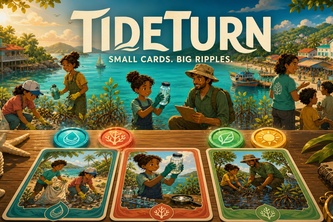
TideTurn is a single-player educational card game built as a browser-based web application. The description states it is designed to teach players about community resilience through strategic decision-making in response to interconnected environmental and social crises.
What changed
The project was submitted to the OpenAI 2026 hackathon, indicating development within a hackathon context. No evidence suggests prior existence or commercial deployment beyond this submission.
The single most important open question
Is there any evidence of traction, revenue, user adoption or market validation beyond the author's own description?
What The Product Actually Is
The description states that TideTurn is a single-player educational card game. It is built as a browser-based web application using technologies including Next.js, React, TypeScript, HTML5, CSS, and JavaScript.
Key features include:
- Procedurally generated expeditions from reusable scenario components
- A sixteen-card deck containing interventions such as community organizers, waste audits, refill station networks, environmental restoration projects, public health services, collection infrastructure, and community policies
- Resource management using a system called "Capacity"
- Four community indicators: Environment, Health, Trust, and Livelihood
- End-of-round escalating crises that add pressure
- Win condition requiring resolution of root causes, completion of community mandates, stabilization of locations and indicators, and survival through a two-round Resilience Check
The game uses localStorage for saving player collections, active decks, and progression. It includes audio feedback created with the Web Audio API, cartoon-style artwork, and animated card effects.
Not evidenced: Any revenue model, customer base, or actual gameplay data.
Positioning & Claim Evolution
The author states that TideTurn aims to demonstrate that lasting change rarely comes from one perfect solution. It is positioned as an alternative to traditional educational games that rely on quizzes or simple right-and-wrong answers.
Key claims:
- Players learn through decisions, trade-offs, and experimentation
- The game teaches systems thinking by showing how short-term actions affect long-term outcomes
- It focuses on interconnected environmental and social challenges
- The goal is to help communities become resilient
The positioning evolved from a desire to explore a different approach to educational gaming — one that avoids combat-based mechanics in favor of collectible card game elements focused on community solutions.
Not evidenced: Market positioning, competitive differentiation, or evidence of prior user feedback or testing beyond the author’s own account.
Target Customer & ICP
The description states that TideTurn is an educational card game, but does not specify a target customer segment. It is described as a single-player experience with no mention of multiplayer or collaborative features.
The stated purpose is to teach players about community resilience through strategic decision-making in response to interconnected environmental and social crises.
Not evidenced: Specific user personas, age groups, educational institutions, or target demographics.
Business Model & Pricing Evidence
There is no evidence provided regarding a business model or pricing structure. The description does not mention monetization strategies, subscriptions, sales channels, or any form of revenue generation.
Not evidenced: Any indication of how the product would be sold, licensed, or funded beyond its development as a hackathon submission.
Technical & Delivery Signals
The project was built using:
- Next.js, React, TypeScript
- HTML5, CSS, JavaScript
- localStorage for persistence
- GPT-5.6 and Codex for rapid prototyping, debugging, and iteration
- Web Audio API for audio feedback
The author notes:
- Procedural generation of expeditions from structured pools of components
- Card-preview confirmation, targeted card placement, animated effects
- Responsive layouts and cartoon-style artwork
- Automated tests for scenario generation and win/loss logic
Not evidenced: Deployment infrastructure, scalability considerations, or performance metrics.
Traction & Maturity Signals
The project was submitted to the OpenAI 2026 hackathon, indicating it is a developmental prototype. No evidence of user adoption, customer engagement, or market traction beyond this submission exists.
Not evidenced: Any data on usage, retention, user feedback, or product iteration post-hackathon.
Competitive Context
The description does not provide any information about competitors or similar products in the educational gaming space. It also lacks references to existing games or platforms that might be comparable.
Not evidenced: Market analysis, competitive landscape, or differentiation from other tools.
Open Questions & Risks
- No commercial traction: The project is described only as a hackathon submission with no evidence of real-world use.
- Unverified claims: All assertions about gameplay, learning outcomes, and design decisions are self-reported without external validation.
- Limited scope: The game is single-player and browser-based; no indication of expansion plans or broader platform strategy.
- Dependency on AI tools: Heavy reliance on GPT-5.6 and Codex raises questions about long-term sustainability and scalability if those tools change or become unavailable.
Not evidenced: Any risk mitigation strategies, user testing results, or product roadmap beyond the author’s own account.
Questions the description leaves open
- What specific educational outcomes are you trying to achieve with TideTurn?
- How did you validate the gameplay loop and mechanics with potential users?
- Are there any plans for monetization or distribution beyond the current prototype?
- Have you considered how the game might be adapted for different age groups or learning environments?
- What is your long-term vision for the product beyond this hackathon submission?
Overall Assessment
There is no evidence of revenue, customers, or traction beyond the author’s own description. The project appears to be a developmental prototype submitted to a hackathon.
The description does not indicate any commercial viability, market demand, or sustainable business model. It is unclear whether this represents a viable investment opportunity or partnership vehicle at this stage.
Confidence level: Low — based entirely on self-reported information with no external validation or evidence of impact.
User Stories BotA demo video on every pull request
Get a demo video on every new feature
GitHub App that watches your pull requests and records a narrated, captioned demo.
Save time on demo prep and make informed decisions faster with a video walkthrough of every new feature.
Source
Submitted to the OpenAI 2026 hackathon on Devpost. Project home on Devpost. Back to the full gallery on Devpost.
This competitive analysis was produced by top-founders.com (opens in a new tab)
Generated by a language model from this project's public Devpost page — its tagline, the author's own write-up and any built-with tags listed there — as captured in August 2026. Short quotations are the author's words. It is an opinion on the idea as a business, not on the people behind it, and it reflects the description as published then. If the project has moved on, request a correction below. The analysis is not independent research and contains no verified traction, revenue or customer data.
An independent guide by KFG International LLC — not affiliated with, endorsed by, or connected to Devpost or OpenAI.