

Archive position — measured, not model output
0 likes on Devpost
2,263 of the 7,850 archived projects have more likes, and 5,587 share exactly 0 — so this project's #3,362 place in the like-ranked listing is a tie-break inside that group, not a ranking.
Projects (log scale)
Likes on Devpost. ▲ marks this project's group.
Show the figures
| Likes | Projects | Share of archive |
|---|---|---|
| 0 | 5,587 | 71.2% |
| 1 | 1,758 | 22.4% |
| 2 | 284 | 3.6% |
| 3–4 | 132 | 1.7% |
| 5–9 | 75 | 1.0% |
| 10+ | 14 | 0.2% |
 User Stories BotA demo video on every pull request
Get a demo video on every new feature
GitHub App that watches your pull requests and records a narrated, captioned demo.
Save time on demo prep and make informed decisions faster with a video walkthrough of every new feature.
Executive Summary
What the company appears to be
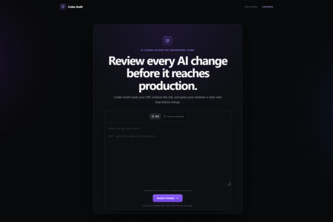
Codex Audit is a self-reported tool that claims to analyze code diffs or AI agent sessions and generate structured risk reports in plain English. It is described as a full-stack Next.js application built with GPT-5, designed for use in pull request review workflows.
What changed
The project was submitted as part of the OpenAI 2026 hackathon. The author states that it was built end-to-end using Codex and GPT-5, with a focus on improving AI-generated code review through structured outputs like risk scores, decision logs, and reviewer checklists.
Single most important open question
Is there any evidence of actual usage or adoption by developers or teams beyond the hackathon submission?
Note: This analysis is based entirely on the self-reported description provided by the author. No external verification, traction data, revenue figures, or customer information are available.
What The Product Actually Is
The description states that Codex Audit:
- Takes a code diff or an AI coding-agent session transcript
- Turns it into a structured, plain-English risk report
- Includes:
- Risk score (Low, Medium, High)
- Decision log (reconstructed explanation of major changes)
- Reviewer checklist (prioritized items for human review)
- One-click Markdown export
It is described as a full-stack Next.js application styled with Tailwind CSS and built using GPT-5.6 via a strict system prompt to return structured JSON.
Inference: The tool appears to be an AI-powered code review assistant aimed at helping developers quickly assess risks in AI-generated code before merging.
Positioning & Claim Evolution
The author positions Codex Audit as:
- A solution to the problem of scaling AI code reviews beyond manual diffs
- A way to close a gap in current review practices where humans must manually scan diffs for risk
- Not meant to replace human review, but to make it faster and more targeted
It is described as aiming to distill complex changes into readable summaries within seconds instead of minutes.
Claim: The tool aims to improve trustworthiness in AI-generated code reviews by providing structured insights.
Inference: This positioning reflects a shift from traditional code review tools toward AI-augmented workflows, though no evidence of prior adoption or market traction is provided.
Target Customer & ICP
The description implies that Codex Audit targets:
- Teams using AI coding agents (e.g., Codex, GitHub Copilot)
- Developers working in software development environments where pull requests are common
- Organizations concerned with security and compliance in code changes
No explicit segmentation or persona details are given.
Inference: The target is likely small to mid-sized engineering teams who rely on AI tools for coding and want better governance over those outputs.
Absence of evidence: No stated customer types, use cases, or personas beyond general developer workflows.
Business Model & Pricing Evidence
There is no mention of pricing, monetization strategy, or business model in the description.
Not evidenced. The author does not state whether this will be offered as a paid service, open-source, freemium, or otherwise.
Technical & Delivery Signals
The project was built with:
- Framework: Next.js
- Language: JavaScript, TypeScript
- Backend: Node.js
- AI Model: GPT-5.6 (via OpenAI API)
- UI Library: Tailwind CSS, React
- Prompt Engineering: Strict system prompts to enforce JSON output
Key technical elements include:
- Single API route handling diffs and returning structured data
- Error handling for edge cases like malformed input or empty diffs
- Markdown export functionality
- Use of Codex for scaffolding and iterative development
Inference: The tool is built with modern web stack and AI integration, suggesting a prototype-level product that could evolve into a more robust SaaS offering.
Not evidenced: No information on scalability, infrastructure, or deployment architecture beyond local builds.
Traction & Maturity Signals
The project was submitted to the OpenAI 2026 hackathon and is described as:
- Built end-to-end using Codex
- Tested with edge cases (empty input, bad formatting)
- Polished for usability and copy quality
- Not yet integrated into GitHub or other CI/CD pipelines
Not evidenced: No evidence of user adoption, customer feedback, or product usage beyond the hackathon.
Competitive Context
No mention of competitors or competitive landscape is present in the description.
Not evidenced: The author does not reference existing tools for AI code review or automated diff analysis.
Open Questions & Risks
- Unverified claims: All features and capabilities are self-reported without independent validation.
- Prototype status: The tool appears to be a hackathon submission, not yet matured into a production-ready product.
- Limited scope: No integration with CI/CD systems or team dashboards mentioned beyond future plans.
- AI dependency: Relies heavily on GPT-5.6 and prompt engineering — subject to model limitations and hallucinations.
- No commercial viability: No pricing, monetization, or customer data provided.
Inference: There is a high risk that this tool has not yet proven its utility in real-world settings or gained traction among users.
Questions the description leaves open
- What specific types of AI-generated code changes does Codex Audit currently support?
- How does the tool handle false positives or incorrect risk assessments from GPT-5.6?
- Has there been any internal testing or feedback from developers using this tool?
- Are there plans to integrate with GitHub, GitLab, or other CI/CD platforms?
- What is the current roadmap for product development beyond the hackathon version?
- How do you plan to scale beyond a single-person team (as stated in the description)?
- Is there any internal data on how often users actually use the risk scores or decision logs?
Overall Assessment
This project is currently at the prototype stage, built as a hackathon submission with no evidence of traction, revenue, or customer adoption.
Assessment: Not ready for investment or partnership. The idea shows promise in addressing a real pain point in AI-assisted code review, but lacks validation and maturity indicators. Further due diligence should focus on whether the team can build out a functional product, gain early adopters, and demonstrate commercial viability.
Confidence level: Low — based solely on self-reported project description with no external corroboration or data.
User Stories BotA demo video on every pull request
Get a demo video on every new feature
GitHub App that watches your pull requests and records a narrated, captioned demo.
Save time on demo prep and make informed decisions faster with a video walkthrough of every new feature.
Source
Submitted to the OpenAI 2026 hackathon on Devpost. Project home on Devpost. Back to the full gallery on Devpost.
This competitive analysis was produced by top-founders.com (opens in a new tab)
Generated by a language model from this project's public Devpost page — its tagline, the author's own write-up and any built-with tags listed there — as captured in August 2026. Short quotations are the author's words. It is an opinion on the idea as a business, not on the people behind it, and it reflects the description as published then. If the project has moved on, request a correction below. The analysis is not independent research and contains no verified traction, revenue or customer data.
An independent guide by KFG International LLC — not affiliated with, endorsed by, or connected to Devpost or OpenAI.