

Archive position — measured, not model output
1 like on Devpost
505 of the 7,850 archived projects have more likes, and 1,758 share exactly 1 — so this project's #841 place in the like-ranked listing is a tie-break inside that group, not a ranking.
Projects (log scale)
Likes on Devpost. ▲ marks this project's group.
Show the figures
| Likes | Projects | Share of archive |
|---|---|---|
| 0 | 5,587 | 71.2% |
| 1 | 1,758 | 22.4% |
| 2 | 284 | 3.6% |
| 3–4 | 132 | 1.7% |
| 5–9 | 75 | 1.0% |
| 10+ | 14 | 0.2% |
 User Stories BotA demo video on every pull request
Get a demo video on every new feature
GitHub App that watches your pull requests and records a narrated, captioned demo.
Save time on demo prep and make informed decisions faster with a video walkthrough of every new feature.
Executive Summary
What the company appears to be
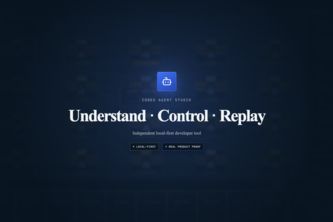
Codex Agent Studio is a self-reported local-first visual command center for multi-agent Codex workflows. The author describes it as an interactive workspace that allows developers to monitor agents, understand progress, intervene in real time, and manage complex agent-based projects.
What changed
The project was submitted to the OpenAI 2026 hackathon by a single founder (Hiếu Nguyễn Trần Hoàng), indicating a prototype or early-stage development effort. No evidence of prior traction, funding, or commercial adoption is provided.
Single most important open question
Is there any evidence that Codex Agent Studio has been used in real-world workflows beyond the hackathon context? If not, what is the path to product-market fit and scalability?
What The Product Actually Is
The description states:
- Codex Agent Studio is a local-first visual command center for multi-agent Codex workflows.
- It provides a real-time office view of active agents, including agent hierarchy, roles, teams, tasks, models, and worktrees.
- It offers unified timelines, historical session replay, and controls such as approval, steering, pause, stop, and restart.
- It includes stuck-agent detection, conflict warnings, and Kanban task management.
- It supports file activity, dependency graphs, terminal matrices, notifications, and local persistence.
The system uses a provider-adapter architecture around the Codex App Server. Events are normalized into canonical events, persisted in SQLite, projected into workspace state, and streamed to a React-based web dashboard over HTTP/WebSockets.
Inferred:
- It is built as an Electron-based desktop application with a Node.js daemon handling session logic and persistence.
- The interface uses React, TypeScript, and Vite.
- It integrates with VS Code extension APIs and Playwright for browser automation.
Not evidenced:
- Whether the product has been tested in production or used by teams beyond the developer.
- Whether it supports real-time collaboration or multi-user access.
Positioning & Claim Evolution
The author states that Codex Agent Studio was inspired by the idea of turning "invisible activity into a clear, interactive workspace." It aims to help developers understand what multiple agents are doing at once, instead of switching between terminals, logs, and conversations.
The positioning is:
- A visual command center for multi-agent workflows.
- A local-first tool that keeps telemetry on the user’s device.
- A developer tool aimed at improving observability and control in agent-based systems.
Inferred:
- The product is positioned as a debugging, monitoring, and intervention layer for Codex agents.
- It may be part of a broader trend toward agent orchestration tools, though no direct competitor comparison is made.
Not evidenced:
- Whether the tool targets enterprise or individual developers.
- How it differentiates from existing agent monitoring or IDE tools.
- Whether the author has iterated on this idea beyond the hackathon submission.
Target Customer & ICP
The description states that Codex Agent Studio is built for developers working with multi-agent Codex workflows. It aims to help users understand what agents are doing, monitor progress, and intervene when necessary.
Inferred:
- The primary user is likely a developer or engineer working in AI agent environments.
- It may appeal to teams using tools like Codex, LangChain, or LLM-based automation platforms.
Not evidenced:
- Whether the tool targets individual developers or enterprise teams.
- What specific developer personas or use cases it addresses.
- Whether there are any customer interviews or feedback loops beyond the hackathon context.
Business Model & Pricing Evidence
The description does not state anything about pricing, monetization, or business model. It is a self-reported project submitted to a hackathon.
Inferred:
- The tool is built as a local-first desktop application, suggesting it may be free or open-source in its current form.
- If commercialized, it might target developers or teams using Codex workflows, possibly through a freemium or SaaS model.
Not evidenced:
- Any pricing structure, subscription tiers, or monetization strategy.
- Whether the tool is intended for personal use or enterprise adoption.
- Any revenue streams or customer acquisition plans.
Technical & Delivery Signals
The description states that the system uses:
- A provider-adapter architecture around the Codex App Server.
- Normalized events, persisted in SQLite, projected into workspace state, and streamed via HTTP/WebSockets.
- Built with React, TypeScript, Vite, and a Node.js daemon for session handling.
- Uses VS Code extension APIs, Playwright, and git-worktrees.
- Includes deterministic mock providers and automated browser tests.
Inferred:
- The architecture supports real-time telemetry, local persistence, and reproducible development environments.
- It is designed for developer tooling, with a focus on observability and control.
Not evidenced:
- Whether the product has been tested at scale or in production.
- How it handles performance, concurrency, or large-scale agent workflows.
- Whether it supports integrations beyond Codex or VS Code.
Traction & Maturity Signals
The description states that this is a hackathon submission (OpenAI 2026). It was built by one person (Hiếu Nguyễn Trần Hoàng).
Inferred:
- The project is in an early stage, likely a prototype or proof of concept.
- No evidence of customer adoption, revenue, or user feedback beyond the author’s own description.
Not evidenced:
- Any user base, customer testimonials, or usage metrics.
- Whether the tool has been used by teams or integrated into workflows beyond the hackathon.
- Any prior versions or iterations of the product.
Competitive Context
The description does not mention any competitors or direct market context. It is a self-reported project without reference to existing tools in the agent orchestration or developer tooling space.
Inferred:
- The tool may compete with or complement tools like LangChain, CrewAI, AutoGen, or VS Code extensions for AI agents.
- It could be positioned as a local-first observability layer for multi-agent workflows.
Not evidenced:
- Any competitive analysis, market sizing, or differentiation from existing tools.
- Whether the author has benchmarked against similar products.
- Any awareness of the broader agent orchestration ecosystem.
Open Questions & Risks
- No evidence of traction or adoption: The tool is a hackathon submission with no indication of real-world usage.
- Single founder: A team size of one raises questions about scalability, product-market fit, and long-term development capacity.
- Unproven business model: No pricing, monetization, or revenue strategy is evident.
- Limited technical validation: The tool may not have been tested in production or at scale.
- Unclear positioning: Without a clear ICP or competitive differentiation, it’s hard to assess its commercial viability.
Questions the description leaves open
- What specific Codex workflows are you targeting?
- How does this tool integrate with existing agent orchestration platforms (e.g., LangChain, AutoGen)?
- Have you tested this in real-world use cases beyond the hackathon?
- What is your plan for monetization or product development beyond the prototype?
- How do you intend to scale from a single developer to a team or enterprise offering?
- What are the key technical challenges you've faced, and how have you solved them?
- Are there any users or early adopters who have provided feedback on this tool?
Overall Assessment
The project is a self-reported hackathon submission with no evidence of traction, revenue, or customer adoption. It is a prototype or proof-of-concept, built by one developer, and lacks any indication of commercial viability or scalability.
Inferred:
- This may be an early-stage idea with potential for further development, but it is not yet a product in the market.
- The tool’s positioning as a local-first, visual command center for multi-agent workflows suggests a niche that could grow, but only if validated by real users and use cases.
Not evidenced:
- Any commercial readiness or investment potential beyond the initial idea.
- Whether there is a clear path to product-market fit or user demand.
- Any strategic partnerships or early customer engagement.
Assessment: Not commercially viable at this stage. A strong candidate for early-stage investment or partnership if the founder can demonstrate traction, scalability, and a clear path forward.
User Stories BotA demo video on every pull request
Get a demo video on every new feature
GitHub App that watches your pull requests and records a narrated, captioned demo.
Save time on demo prep and make informed decisions faster with a video walkthrough of every new feature.
Source
Submitted to the OpenAI 2026 hackathon on Devpost. Project home on Devpost. Back to the full gallery on Devpost.
This competitive analysis was produced by top-founders.com (opens in a new tab)
Generated by a language model from this project's public Devpost page — its tagline, the author's own write-up and any built-with tags listed there — as captured in August 2026. Short quotations are the author's words. It is an opinion on the idea as a business, not on the people behind it, and it reflects the description as published then. If the project has moved on, request a correction below. The analysis is not independent research and contains no verified traction, revenue or customer data.
An independent guide by KFG International LLC — not affiliated with, endorsed by, or connected to Devpost or OpenAI.