

Archive position — measured, not model output
0 likes on Devpost
2,263 of the 7,850 archived projects have more likes, and 5,587 share exactly 0 — so this project's #2,804 place in the like-ranked listing is a tie-break inside that group, not a ranking.
Projects (log scale)
Likes on Devpost. ▲ marks this project's group.
Show the figures
| Likes | Projects | Share of archive |
|---|---|---|
| 0 | 5,587 | 71.2% |
| 1 | 1,758 | 22.4% |
| 2 | 284 | 3.6% |
| 3–4 | 132 | 1.7% |
| 5–9 | 75 | 1.0% |
| 10+ | 14 | 0.2% |
 User Stories BotA demo video on every pull request
Get a demo video on every new feature
GitHub App that watches your pull requests and records a narrated, captioned demo.
Save time on demo prep and make informed decisions faster with a video walkthrough of every new feature.
Executive Summary
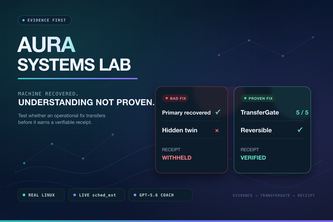
What the company appears to be: AURA Systems Lab is a self-reported evidence-first learning environment for real Linux incident response and kernel scheduling. It is described as a system that tests whether operational fixes transfer across systems and issues verifiable Intervention Receipts.
What changed: The project was submitted to the OpenAI 2026 hackathon, with the author stating it was transformed from an early CLI prototype into a full product during OpenAI Build Week. It includes a React/TypeScript web UI, FastAPI control plane, signed scenario system, isolated incident runtime, four-world TransferGate, GPT-5.6 Evidence Coach, and Judge Mode.
Single most important open question: Is there any evidence of actual adoption, revenue or traction beyond the author's own description?
Analysis basis: This report is based entirely on the self-reported project description provided by the caller — no archived history, third-party sources or independent verification. All statements are treated as claims made by the author and not proven facts.
What The Product Actually Is
The description states that AURA Systems Lab is:
- An evidence-first learning environment for real Linux incident response and kernel scheduling.
- A system that treats every operational intervention as a falsifiable claim.
- A platform with a learning loop: Observe → Predict → Inspect → Contract → Apply → ACK → Verify → TransferGate → Receipt → Reflect.
- A system that uses signed scenario families (O1, O2, K1, K2) for testing.
- A hosted capability panel that is authoritative and only clickable when real workers are available.
- A system with a GPT-5.6 Evidence Coach that provides schema-validated claims, citations, unknowns, safety notes, and suggested next probes — but cannot execute or grade.
- A system that issues downloadable Intervention Receipts binding evidence, environment fingerprint, actions, before/after facts, TransferGate assessment, rollback history, model-assistance disclosure, and SHA-256 hashes.
- A system with Judge Mode for no-login evaluation paths through real incident attempts.
Inference: The product appears to be a sandboxed, evidence-based training platform for Linux operations and kernel scheduling, using AI as an assistant rather than executor or grader. It is built around the concept of "TransferGate" which tests whether fixes transfer across systems.
Positioning & Claim Evolution
The description states that:
- Most operations labs stop when a service turns green — rewarding lucky restarts or one-host patches.
- AURA treats every operational intervention as a falsifiable claim.
- The system distinguishes between recovery and understanding.
- Recovery is useful but not proof of understanding.
- AURA's core idea is the counterexample: a bad fix can restore visibility while failing hidden same-cause worlds.
Inference: The positioning has evolved from a basic incident response tool to an evidence-based learning platform that emphasizes causality, transferability, and falsifiability in operational interventions. It positions itself as a rigorous alternative to traditional recovery-focused labs.
Target Customer & ICP
The description states:
- AURA is for learners who begin with competing hypotheses, record predictions, choose bounded probes, and receive immutable EvidenceRefs.
- The system supports instructors through cohort analytics (mentioned as future feature).
- Judge Mode allows evaluation without login or root access.
- No login or credentials are required to try the platform.
Inference: The primary customer appears to be technical learners, possibly in education or training contexts. The lack of login requirements suggests a public-facing demo or open-access model, though no evidence of specific ICP is provided.
Business Model & Pricing Evidence
The description states:
- No login or credentials are required.
- Judge Mode provides a no-login evaluation path.
- There is no mention of pricing, subscriptions, or monetization models.
- The system is described as hosted and publicly accessible.
Not evidenced: No information about business model, pricing, revenue, or monetization strategies is provided.
Technical & Delivery Signals
The description states:
- Built with: ansible, codex, ebpf, fastapi, gpt-5.6, linux, openai-responses-api, podman, postgresql, react, sched-ext, typescript.
- Uses React, TypeScript, Vite, xterm.js, ECharts for web experience.
- Python and FastAPI control plane owns attempt state machine, signed scenario registry, active diagnosis, InterventionIR validation, TransferGate orchestration, receipts, and proof projections.
- PostgreSQL stores metadata and append-only events.
- S3-compatible MinIO stores evidence, traces, and receipts.
- Incident attempts run in digest-pinned rootless Podman environments with per-attempt internal networks, private volumes, cgroup limits, seccomp, and AppArmor.
- Kernel scenarios run on a separate Linux x86_64 worker with real eBPF and sched_ext actuation.
- GPT-5.6 is called server-side through OpenAI Responses API with Structured Outputs, bounded evidence allowlist, redaction, timeout and retry controls.
Inference: The technical stack shows a sophisticated, security-conscious architecture using containerization, sandboxing, and AI integration. It emphasizes isolation, immutability, and deterministic grading.
Traction & Maturity Signals
The description states:
- The project was submitted to the OpenAI 2026 hackathon.
- It was transformed from an early CLI prototype into a complete product during OpenAI Build Week.
- It includes four signed scenario families (O1, O2, K1, K2).
- Judge Mode is available for public access without login.
- Receipts and proof artifacts are hash-bound to deployed candidates.
- The system supports more signed Linux scenario packs, cohort analytics, kernel workload families, and a scenario-authoring SDK in future steps.
Not evidenced: No information about user adoption, revenue, customer base, or usage metrics is provided. The project appears to be in early development or demo phase.
Competitive Context
The description states:
- Most operations labs stop when a service turns green.
- AURA treats every operational intervention as a falsifiable claim.
- It contrasts with traditional recovery-focused systems.
- It uses a four-world TransferGate for testing causal transfer, healthy controls, repeat worlds, and rollback verification.
Inference: The competitive context is in the space of operational training and incident response platforms. AURA differentiates itself by emphasizing falsifiability, causality, and evidence-based understanding over simple recovery.
Open Questions & Risks
The description states:
- The system explicitly refuses to issue a receipt if a fix only makes the primary system green.
- Real deployment exposed problems that portable tests could not: rootless container MAC stacking, cgroup-v2 delegation, immutable image identity, BPF reference ownership, private CNI name resolution, worker cleanup, observer lifecycle, and safe scheduler unload.
- The GPT-5.6 Evidence Coach is deliberately non-authoritative.
Open questions:
- No evidence of traction or adoption beyond the author's own description.
- The system is described as a hackathon project with no commercialization strategy.
- The use of GPT-5.6 in a constrained way may limit scalability or impact.
- The lack of login requirements and public access may indicate an open-source or demo-only model, not a commercial product.
Questions the description leaves open
- What is the current stage of development? Is this a prototype or a production-ready system?
- Are there any users or customers beyond the author’s own use cases?
- How does AURA plan to monetize its platform, if at all?
- What are the technical challenges that remain unresolved in the current implementation?
- How is the GPT-5.6 integration managed and controlled to prevent unauthorized execution or grading?
- Are there any plans for enterprise features or partnerships?
- What are the long-term goals for scaling beyond the current scenario packs?
Overall Assessment
Not evidenced: No information about funding, valuation, team size beyond one person (Frank douzi), or commercial traction is provided.
Confidence level: Low — this is a self-reported project description with no independent verification. The author states that the system is built around rigorous principles of evidence and falsifiability, but there is no data on adoption, revenue, or market validation.
Conclusion: AURA Systems Lab appears to be an experimental, hackathon-based platform focused on operational education and kernel scheduling training. It has a strong technical foundation and clear differentiation from traditional incident response tools. However, there is no evidence of traction, revenue, or commercial viability beyond the author’s own claims. The project is in early development and lacks any indication of a monetization strategy or market presence.
Final note: This analysis is based entirely on the self-reported description provided by the caller. No external data or verification sources are available.
User Stories BotA demo video on every pull request
Get a demo video on every new feature
GitHub App that watches your pull requests and records a narrated, captioned demo.
Save time on demo prep and make informed decisions faster with a video walkthrough of every new feature.
Source
Submitted to the OpenAI 2026 hackathon on Devpost. Project home on Devpost. Back to the full gallery on Devpost.
This competitive analysis was produced by top-founders.com (opens in a new tab)
Generated by a language model from this project's public Devpost page — its tagline, the author's own write-up and any built-with tags listed there — as captured in August 2026. Short quotations are the author's words. It is an opinion on the idea as a business, not on the people behind it, and it reflects the description as published then. If the project has moved on, request a correction below. The analysis is not independent research and contains no verified traction, revenue or customer data.
An independent guide by KFG International LLC — not affiliated with, endorsed by, or connected to Devpost or OpenAI.