

Archive position — measured, not model output
1 like on Devpost
505 of the 7,850 archived projects have more likes, and 1,758 share exactly 1 — so this project's #842 place in the like-ranked listing is a tie-break inside that group, not a ranking.
Projects (log scale)
Likes on Devpost. ▲ marks this project's group.
Show the figures
| Likes | Projects | Share of archive |
|---|---|---|
| 0 | 5,587 | 71.2% |
| 1 | 1,758 | 22.4% |
| 2 | 284 | 3.6% |
| 3–4 | 132 | 1.7% |
| 5–9 | 75 | 1.0% |
| 10+ | 14 | 0.2% |
 User Stories BotA demo video on every pull request
Get a demo video on every new feature
GitHub App that watches your pull requests and records a narrated, captioned demo.
Save time on demo prep and make informed decisions faster with a video walkthrough of every new feature.
Executive Summary
What the company appears to be
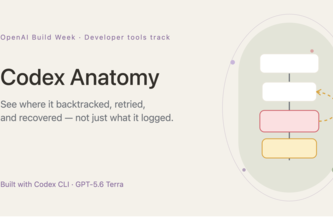
Codex Anatomy is a visual tool for debugging Codex sessions, built as a monorepo with a Python/FastAPI backend and React/Vite frontend. It parses JSONL rollout files from Codex CLI sessions and renders them as an explorable diagram showing task breakdowns and individual turns.
What changed
The project was submitted to the OpenAI 2026 hackathon by one developer who built it using real Codex session data, including the session where retry-detection logic itself was written. It is not evidenced to have any revenue, customers or traction beyond its own self-reported development and demonstration.
Single most important open question
Is there a market need for visual debugging tools that parse and display structured data from AI-powered CLI tools like Codex? The description does not indicate whether this tool has been adopted or used by others beyond the author’s own use case.
What The Product Actually Is
The description states that Codex Anatomy:
- Parses JSONL rollout files from Codex sessions.
- Breaks them into tasks and individual turns.
- Renders these as an explorable, illustrated diagram instead of flat logs.
- Is built as a monorepo with a Python/FastAPI backend and React/Vite/Tailwind frontend.
- Uses Google App Engine for backend deployment and Vercel for frontend.
It is not evidenced to be anything else — no mention of integrations, APIs, or additional features beyond the described parsing and visualization functionality.
Positioning & Claim Evolution
The author claims:
- Existing tools only show raw logs, which are hard to follow.
- Codex Anatomy offers a visual-first approach to debugging Codex sessions.
- It shows where backtracking occurred, not just what was logged.
These claims suggest the product is positioned as a developer tool for understanding AI-generated code workflows — specifically, for inspecting and analyzing the execution paths of Codex CLI sessions. The positioning appears to be niche, focused on developers working with Codex.
There is no evidence of prior versions or evolution in positioning beyond this single submission to a hackathon.
Target Customer & ICP
The description does not state who the target customer is or what the ideal customer profile (ICP) might be. It only describes that:
- The tool was built by one developer.
- It uses real Codex CLI session data.
- Sample sessions are drawn from the author's own usage.
No evidence of a broader user base, customer segment, or persona is provided.
Business Model & Pricing Evidence
There is no evidence of any business model or pricing structure. The project is described as a hackathon submission with no indication of monetization, subscriptions, or paid features.
Technical & Delivery Signals
The description states:
- Built as a monorepo.
- Backend: Python/FastAPI on Google App Engine.
- Frontend: React/Vite/Tailwind deployed on Vercel.
- Uses real data throughout, not fabricated examples.
- Includes bundled sample sessions from actual Codex CLI usage.
It also mentions:
- Three different heuristics for detecting retries and failures due to lack of structured data in Codex.
- A bug found by Codex itself regarding duplicated messages in session files.
- A frontend rendering issue involving coordinate systems that was partially resolved.
These technical details suggest a developer-focused tool with some complexity in parsing and visualizing AI-generated session data.
Traction & Maturity Signals
There is no evidence of traction or maturity beyond the author’s own development and submission to a hackathon. The team size is stated as zero, and there are no signs of users, customers, revenue, or adoption metrics.
Competitive Context
The description does not mention any competitors. It only notes that existing tools show raw logs, which are hard to follow — implying a gap in the market for visual debugging tools, but no specific competitive landscape is described.
Open Questions & Risks
- No traction or adoption: The tool has no evidence of being used beyond its own author.
- Single-person development: Team size is zero; no indication of ongoing support or scaling.
- Limited scope: It only works within a single session and lacks cross-session comparison features.
- Technical debt: A frontend rendering bug was noted, and some features were reverted due to time constraints.
- Unclear commercial viability: No pricing, monetization or market demand signals.
Questions the description leaves open
- What is the actual use case for this tool beyond personal debugging?
- Have you received feedback from other developers using Codex who might benefit from this?
- Are there plans to expand beyond single-session comparisons or add search capabilities?
- How do you plan to monetize or scale this tool if at all?
- What is the long-term vision for Codex Anatomy — is it meant to be a standalone tool or part of a larger platform?
Overall Assessment
Not evidenced.
The project is described as a hackathon submission with no evidence of traction, revenue, customers, or even a clear commercial intent. It is not evident whether this represents a viable product or service that could attract investment or partnership interest. The author's own account suggests it was built for personal curiosity and demonstration rather than market demand.
User Stories BotA demo video on every pull request
Get a demo video on every new feature
GitHub App that watches your pull requests and records a narrated, captioned demo.
Save time on demo prep and make informed decisions faster with a video walkthrough of every new feature.
Source
Submitted to the OpenAI 2026 hackathon on Devpost. Project home on Devpost. Back to the full gallery on Devpost.
This competitive analysis was produced by top-founders.com (opens in a new tab)
Generated by a language model from this project's public Devpost page — its tagline, the author's own write-up and any built-with tags listed there — as captured in August 2026. Short quotations are the author's words. It is an opinion on the idea as a business, not on the people behind it, and it reflects the description as published then. If the project has moved on, request a correction below. The analysis is not independent research and contains no verified traction, revenue or customer data.
An independent guide by KFG International LLC — not affiliated with, endorsed by, or connected to Devpost or OpenAI.