

Archive position — measured, not model output
0 likes on Devpost
2,263 of the 7,850 archived projects have more likes, and 5,587 share exactly 0 — so this project's #3,299 place in the like-ranked listing is a tie-break inside that group, not a ranking.
Projects (log scale)
Likes on Devpost. ▲ marks this project's group.
Show the figures
| Likes | Projects | Share of archive |
|---|---|---|
| 0 | 5,587 | 71.2% |
| 1 | 1,758 | 22.4% |
| 2 | 284 | 3.6% |
| 3–4 | 132 | 1.7% |
| 5–9 | 75 | 1.0% |
| 10+ | 14 | 0.2% |
 User Stories BotA demo video on every pull request
Get a demo video on every new feature
GitHub App that watches your pull requests and records a narrated, captioned demo.
Save time on demo prep and make informed decisions faster with a video walkthrough of every new feature.
Executive Summary
CleanFlow AI is described by its author as an AI-powered operations assistant for cleaning businesses, built as a hackathon project using Codex and GPT-5.6. The platform aims to streamline scheduling, communication, and administrative tasks through a unified dashboard. It includes features like job scheduling, cleaner/client portals, AI-assisted messaging, and reporting tools.
The author states that the product was developed based on personal experience as a cleaning company co-owner, with an emphasis on solving real-world operational challenges rather than hypothetical ones. The project is presented as a working prototype, not yet in production or commercial use.
Key open question
Is there evidence of any traction, revenue, or customer adoption beyond the author's own experience and the prototype's existence?
What The Product Actually Is
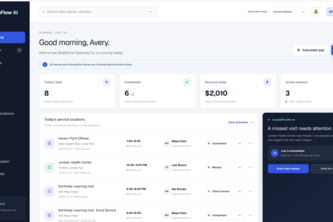
The description states that CleanFlow AI is an operations platform for cleaning businesses, designed to help owners manage schedules, clients, cleaners, service locations, communication, and daily operations from one dashboard.
It includes:
- Job scheduling
- Cleaner and client portals
- AI-assisted communication
- Notifications
- Reporting
- Operational tools
The author notes that the platform was built using Codex and GPT-5.6, which were used for development, testing, debugging, and refining workflows. The technology stack includes React, Tailwind CSS, TypeScript, Vite, and Codex/GPT-5.6.
Inference: The product is described as a software-as-a-service (SaaS) or web-based platform, but no evidence of actual deployment, user access, or live functionality is provided.
Positioning & Claim Evolution
The author positions CleanFlow AI as:
- An AI-powered operations assistant
- A tool that helps cleaning businesses track service status, adjust cleaner pay, and draft professional messages
- A platform that brings together everyday workflows into a single place
- Designed to simplify day-to-day management and improve communication
The positioning evolves from a personal problem-solving effort (based on the author’s own experience) to a potential commercial solution for cleaning business owners. The claim is that it reduces manual administrative work and improves decision-making.
Inference: The positioning reflects an intent to build a comprehensive operations platform, but there is no evidence of market validation or customer feedback beyond the author's own experience.
Target Customer & ICP
The description states that CleanFlow AI is designed for cleaning businesses, particularly those where owners manage schedules, cleaner assignments, client communication, and service changes across multiple channels (phone calls, text messages, emails, spreadsheets).
It targets:
- Business owners of cleaning companies
- Individuals managing day-to-day operations in small to medium-sized cleaning firms
The author emphasizes that the solution is based on firsthand industry experience, not assumptions.
Inference: The ICP appears to be small to mid-sized cleaning business owners who are looking for better organization and automation tools. No evidence of customer segmentation, personas, or market research beyond the author’s own role in a cleaning company.
Business Model & Pricing Evidence
There is no evidence in the description of:
- A defined pricing model
- Revenue streams
- Monetization strategy
- Customer acquisition plans
- Subscription tiers or usage-based models
The project is described as a prototype, not yet commercialized or monetized.
Inference: The business model remains undefined. It is unclear whether the product will be sold directly to customers, offered via subscription, or part of a broader suite of services.
Technical & Delivery Signals
The platform was built using:
- Codex and GPT-5.6
- React, Tailwind CSS, TypeScript, Vite
The author states that Codex was used for building, testing, debugging, and refining the application. GPT-5.6 helped shape workflows and user experience.
The project is described as a working prototype, not yet in production or deployed to users.
Inference: The use of AI tools like Codex and GPT suggests rapid prototyping capabilities, but no information is given about scalability, infrastructure, or long-term technical architecture.
Traction & Maturity Signals
The description states that CleanFlow AI was submitted to the OpenAI 2026 hackathon, indicating it exists as a prototype. It has not been deployed in production or used by customers.
There is no evidence of:
- Revenue
- Customers
- User engagement
- Product-market fit
- Beta testing or pilot programs
The author mentions that the project was built quickly using AI tools, but does not describe any iteration with real users or feedback loops.
Inference: The product is at a very early stage — likely a proof-of-concept or prototype. No traction signals are evident.
Competitive Context
There is no evidence in the description of:
- Competitors
- Market size
- Existing solutions in the cleaning operations space
- Competitive advantages or differentiation
The author does not reference any existing platforms or tools used by cleaning businesses for scheduling, communication, or operations management.
Inference: The competitive landscape is unknown. The product may be addressing an underserved niche, but this cannot be confirmed without external data.
Open Questions & Risks
- No commercial traction or revenue: The project is described only as a prototype.
- Unverified claims: All descriptions are self-reported and unverified.
- Limited evidence of customer validation: No real-world usage or feedback from users.
- Unclear monetization strategy: No indication of how the product will be sold or priced.
- Single-person team: The entire project was built by one person, raising questions about scalability and long-term development capacity.
- AI dependency: Heavy reliance on Codex and GPT-5.6 may not translate into a sustainable or scalable solution.
Inference: The risk of failure is high due to lack of real-world testing, customer feedback, and commercial viability.
Questions the description leaves open
- What specific operational challenges in cleaning businesses did you observe that led to this product idea?
- Have you tested the prototype with actual cleaning business owners or employees?
- How do you plan to monetize CleanFlow AI once it moves beyond the prototype stage?
- What is your roadmap for scaling from a single-person project to a full-fledged SaaS product?
- Are there any existing tools in the market that are similar, and how would CleanFlow AI differentiate itself?
- How do you intend to ensure data privacy and security, especially with sensitive operational information?
Overall Assessment
The description indicates that CleanFlow AI is a self-reported prototype built during a hackathon, with no evidence of traction, revenue, or customer adoption.
It is described as an idea rooted in personal experience rather than market research or validation. The author has not yet launched the product commercially or demonstrated any real-world usage.
Assessment: Not ready for investment or partnership at this stage. The project lacks commercial evidence and maturity to support a meaningful due-diligence evaluation. It requires further development, customer testing, and proof of concept before any strategic interest can be considered.
User Stories BotA demo video on every pull request
Get a demo video on every new feature
GitHub App that watches your pull requests and records a narrated, captioned demo.
Save time on demo prep and make informed decisions faster with a video walkthrough of every new feature.
Source
Submitted to the OpenAI 2026 hackathon on Devpost. Project home on Devpost. Back to the full gallery on Devpost.
This competitive analysis was produced by top-founders.com (opens in a new tab)
Generated by a language model from this project's public Devpost page — its tagline, the author's own write-up and any built-with tags listed there — as captured in August 2026. Short quotations are the author's words. It is an opinion on the idea as a business, not on the people behind it, and it reflects the description as published then. If the project has moved on, request a correction below. The analysis is not independent research and contains no verified traction, revenue or customer data.
An independent guide by KFG International LLC — not affiliated with, endorsed by, or connected to Devpost or OpenAI.