

Archive position — measured, not model output
0 likes on Devpost
2,263 of the 7,850 archived projects have more likes, and 5,587 share exactly 0 — so this project's #3,300 place in the like-ranked listing is a tie-break inside that group, not a ranking.
Projects (log scale)
Likes on Devpost. ▲ marks this project's group.
Show the figures
| Likes | Projects | Share of archive |
|---|---|---|
| 0 | 5,587 | 71.2% |
| 1 | 1,758 | 22.4% |
| 2 | 284 | 3.6% |
| 3–4 | 132 | 1.7% |
| 5–9 | 75 | 1.0% |
| 10+ | 14 | 0.2% |
 User Stories BotA demo video on every pull request
Get a demo video on every new feature
GitHub App that watches your pull requests and records a narrated, captioned demo.
Save time on demo prep and make informed decisions faster with a video walkthrough of every new feature.
Executive Summary
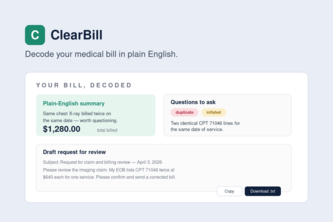
ClearBill is a self-reported tool that allows users to upload a medical bill or Explanation of Benefits (EOB) document and receive an analysis from GPT-5.6. The system flags potential billing errors, explains them in plain English, and drafts an appeal letter for submission. It was built as a hackathon project by one developer using Codex, Next.js, TypeScript, Tailwind CSS, and OpenAI’s API.
The product is described as a "billing and coding literacy tool", not medical advice. It does not store user data or require login, with the team stating that no accounts or databases are used to maintain privacy.
Key commercial due-diligence question: Is there any evidence of real-world usage or demand beyond the author's own testing? The description contains no information about revenue, customers, or adoption.
What The Product Actually Is
The description states that ClearBill:
- Takes a photo or PDF of a medical bill or EOB
- Uses GPT-5.6 to extract line items and flag potential billing errors (e.g., duplicates, overcharges)
- Explains each flagged item in plain English
- Drafts a ready-to-send appeal letter referencing specific charges
It was built using:
- Codex for scaffolding
- Next.js, TypeScript, Tailwind CSS for frontend
- OpenAI’s GPT-5.6 API via multimodal input (no OCR step)
- Three synthetic demo bills included for testing without uploading real documents
Inference: The tool appears to be a proof-of-concept prototype built in one session, not a production-ready product.
Positioning & Claim Evolution
The author claims ClearBill:
- Removes the barrier of understanding complex medical billing
- Helps people catch errors they otherwise couldn’t spot
- Is a "billing and coding literacy tool", not medical advice
- Provides actionable output: specific anomalies with explanations and draft letters
It is positioned as a way to empower individuals to dispute billing inaccuracies without needing expertise or time.
Inference: The positioning reflects an intent to democratize access to billing error detection, but the description does not indicate any prior market testing or user feedback.
Target Customer & ICP
The author states that:
- Medical bills and EOBs are full of procedure codes that most people cannot evaluate
- Billing errors like duplicate line items, upcoding, and balance billing are common
- Most people either pay the bill or give up trying to dispute it
Inference: The target customer is likely a person who receives a medical bill or EOB and wants to understand or contest charges but lacks the knowledge or time to do so.
Not evidenced: No specific customer segments, personas, or user research are mentioned.
Business Model & Pricing Evidence
The description states:
- No login required
- No data stored
- No accounts or databases used
- The tool is free to use (as presented in the hackathon submission)
There is no mention of monetization, pricing tiers, subscriptions, or paid features.
Inference: If this remains a free tool, there is no identified business model at this stage.
Technical & Delivery Signals
The author reports:
- Built in a single Codex session (~29 minutes)
- Uses GPT-5.6 directly via OpenAI API
- Multimodal input (PDF/photo) sent directly to the model
- No separate OCR step required
- Includes synthetic demo bills for testing
- Fixed rendering of line breaks in draft letters after a bug report
Inference: The tool is built with minimal infrastructure and relies heavily on AI APIs. It is not scalable or production-ready.
Traction & Maturity Signals
The description states:
- A working end-to-end flow was verified in one session
- It correctly identified a duplicate CPT 71046 charge in a $1,280 bill during testing
- No accounts, no data persistence
- Submitted to the OpenAI 2026 hackathon
Not evidenced: No revenue, customer base, usage metrics, or adoption data are provided.
Competitive Context
The description does not mention any competitors or existing solutions in this space. It does not reference:
- Other tools for analyzing medical bills
- Billing dispute platforms
- AI-powered healthcare document analysis tools
Inference: There is no evidence of competitive landscape awareness or differentiation strategy.
Open Questions & Risks
- No data persistence: The tool does not store user data, which may be a privacy feature but also limits long-term utility.
- Single developer: Only one team member is listed.
- Hackathon prototype: Built in one session; no indication of further development or testing.
- No monetization strategy: No pricing or revenue model described.
- Unverified claims: The accuracy of GPT-5.6’s error detection and letter drafting has not been independently validated.
Inference: This is a concept with limited commercial viability unless it evolves into a more robust product with traction, users, and a monetization path.
Questions the description leaves open
- What is the actual accuracy rate of GPT-5.6 in detecting billing errors?
- How many real medical bills have been processed through this system?
- Has there been any user testing or feedback beyond the author’s own use cases?
- Are there plans to integrate with public reference pricing data (e.g., Medicare fee schedules)?
- What is the long-term vision for monetization or scaling?
- How does the tool handle multi-page hospital bills, which are noted as a future enhancement?
Overall Assessment
Not evidenced: No financials, traction, or commercial performance data are available.
The project is described as a hackathon prototype built by one person using AI APIs and a minimal tech stack. It has no known users, revenue, or business model beyond its initial demonstration.
Confidence level: Low — based on self-reported evidence only, with no third-party validation or real-world usage data.
Assessment: This is an early-stage idea with potential for further development, but it lacks commercial viability indicators at this point. It would require significant investment in product development, user testing, and market validation to become a viable business.
User Stories BotA demo video on every pull request
Get a demo video on every new feature
GitHub App that watches your pull requests and records a narrated, captioned demo.
Save time on demo prep and make informed decisions faster with a video walkthrough of every new feature.
Source
Submitted to the OpenAI 2026 hackathon on Devpost. Project home on Devpost. Back to the full gallery on Devpost.
This competitive analysis was produced by top-founders.com (opens in a new tab)
Generated by a language model from this project's public Devpost page — its tagline, the author's own write-up and any built-with tags listed there — as captured in August 2026. Short quotations are the author's words. It is an opinion on the idea as a business, not on the people behind it, and it reflects the description as published then. If the project has moved on, request a correction below. The analysis is not independent research and contains no verified traction, revenue or customer data.
An independent guide by KFG International LLC — not affiliated with, endorsed by, or connected to Devpost or OpenAI.