

Archive position — measured, not model output
0 likes on Devpost
2,263 of the 7,850 archived projects have more likes, and 5,587 share exactly 0 — so this project's #3,290 place in the like-ranked listing is a tie-break inside that group, not a ranking.
Projects (log scale)
Likes on Devpost. ▲ marks this project's group.
Show the figures
| Likes | Projects | Share of archive |
|---|---|---|
| 0 | 5,587 | 71.2% |
| 1 | 1,758 | 22.4% |
| 2 | 284 | 3.6% |
| 3–4 | 132 | 1.7% |
| 5–9 | 75 | 1.0% |
| 10+ | 14 | 0.2% |
 User Stories BotA demo video on every pull request
Get a demo video on every new feature
GitHub App that watches your pull requests and records a narrated, captioned demo.
Save time on demo prep and make informed decisions faster with a video walkthrough of every new feature.
Executive Summary
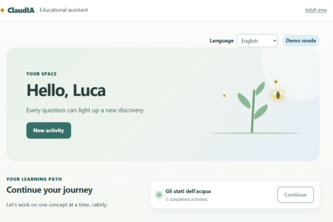
ClaudIA is a self-contained Windows application for primary-school children that claims to be an educational AI assistant with deterministic safety and pedagogical control. The author states it uses GPT-5.6 only as a language engine, while its own systems decide how to teach. It supports Italian and English, ships offline with a demo provider, and optionally integrates OpenAI via a volatile session key. The system is described as prioritizing understanding, safety, autonomy, and privacy over generic AI fluency.
What Changed: The project description shows a clear shift from general-purpose AI to an educational-first approach, where pedagogical decisions are separated from language generation. It positions itself as a child-safe, deterministic alternative to mainstream AI tutoring tools.
Most Important Open Question: Does the described architecture and functionality actually deliver on its claims of deterministic pedagogy and safety in practice? The description does not provide evidence of real-world testing or adoption.
What The Product Actually Is
The description states that ClaudIA is a bilingual educational assistant for primary-school children. It is built as a self-contained Windows application, with an offline Demo Provider, and optionally supports integration with the OpenAI Responses API via a volatile session key.
It uses GPT-5.6 only as a language engine, not for pedagogical decisions. The system includes:
- A Lesson Engine
- A Decision Engine with:
- Safety Engine
- Learning Profile + Knowledge Base
- Pedagogical Engine
- Educational Warmth Engine
- An Approved Context Builder
- A Demo Provider or OpenAI Responses API
- Schema and safety output validation
The UI is built using Razor Pages, and the application is described as a Windows x64 distribution.
Inference: The system appears to be a prototype or MVP, not a production-grade product. It is designed for offline use with deterministic behavior before any AI response generation.
Positioning & Claim Evolution
The description states that ClaudIA "decides how to teach before asking AI to explain."
It positions itself as an education-first AI assistant, contrasting with general-purpose AI tools that optimize for fluency over pedagogical quality. The author claims it prioritizes:
- Understanding
- Safety
- Autonomy
- Privacy
The system is described as not replacing adults, but supporting them by reducing cognitive load and emotional dependency.
Inference: The positioning reflects a move away from generic AI tutoring toward a more structured, child-safe, and pedagogically controlled experience. This evolution suggests an attempt to address concerns about AI in education, particularly around safety, privacy, and learning outcomes.
Target Customer & ICP
The description states that ClaudIA is designed for primary-school children. It supports Italian and English, and the UI and content are localized accordingly.
It also mentions that adults can optionally enable OpenAI for a session, suggesting a dual audience: children (primary users) and adults (supporting or supervising users).
Inference: The ICP appears to be parents, teachers, or caregivers of primary-school children, who may want a safe, structured educational tool that avoids the risks of generic AI.
Business Model & Pricing Evidence
The description does not state any business model or pricing information. It only mentions that the application is self-contained and can optionally use OpenAI via a session key.
It also states that no API keys are stored, and that the application ships with an offline Demo Provider.
Inference: There is no evidence of monetization, subscriptions, or paid features in the description. The system appears to be a prototype or proof-of-concept, not a commercial product.
Technical & Delivery Signals
The project is built using:
- .NET 8
- C#
- ASP.NET Core Razor Pages
- Kestrel
- OpenAI Responses API
- GPT-5.6
- JSON assets
- In-memory repositories
- Windows Certificate Store
- HTML, CSS, JavaScript
- XUnit
- Codex
It is described as a self-contained Windows x64 application with:
- An offline Demo Provider
- A volatile session key vault
- Schema + Safety Output Validation
- Local HTTPS integration
The architecture includes multiple deterministic engines and a clear separation between pedagogical control and language generation.
Inference: The technical stack suggests a prototype or MVP built for demonstration purposes, with strong emphasis on safety, privacy, and offline functionality. It is not described as scalable or production-ready.
Traction & Maturity Signals
The description states that this project was submitted to the OpenAI 2026 hackathon on Devpost. It includes a demo video, and mentions that it uses Codex for development support.
There is no evidence of:
- Revenue
- Customers
- Adoption
- Product usage metrics
- Market traction
The system is described as a V1 demo, with future roadmap items not yet implemented.
Inference: The project is at an early stage, likely a prototype or MVP. No evidence of real-world use or commercial traction exists.
Competitive Context
The description does not provide any information about competitors or market positioning beyond its own claims. It does not reference other educational AI tools, tutoring platforms, or AI safety initiatives in the education space.
Inference: There is no evidence of competitive analysis or awareness of existing players in the educational AI market.
Open Questions & Risks
- No real-world testing or adoption: The system is described as a demo and prototype.
- Unverified claims: The author states that GPT-5.6 is used only for language generation, but there is no evidence of how this separation is enforced in practice.
- Limited scope: It targets only primary-school children and supports only two languages.
- No commercial model: No pricing, monetization or business model is described.
- Self-reported safety mechanisms: The system claims to use deterministic engines for safety, but there is no independent verification of these claims.
Inference: The project is a self-contained prototype with strong claims about safety and pedagogy, but lacks evidence of real-world validation or scalability.
Questions the description leaves open
- How is the separation between pedagogical decisions and language generation enforced in practice?
- What are the specific educational techniques used, and how were they validated?
- Has the system been tested with actual children or educators?
- What is the plan for expanding beyond the current demo scope (e.g., more languages, curriculum areas)?
- How does the system handle edge cases or unexpected inputs from children?
- Is there any data on learning outcomes or user feedback from the demo?
- What are the plans for long-term privacy and data persistence?
Overall Assessment
The description states that ClaudIA is a self-contained Windows application built for primary-school children, with a focus on safety, pedagogy, and offline use.
It is described as a demo or prototype, submitted to a hackathon. There is no evidence of revenue, customers, or traction beyond the author’s own claims.
Inference: The project is at an early stage and not yet ready for investment or partnership. It shows strong conceptual design but lacks real-world validation, scalability, or commercial viability.
Assessment: Not evidenced as a viable investment or partnership opportunity at this time.
User Stories BotA demo video on every pull request
Get a demo video on every new feature
GitHub App that watches your pull requests and records a narrated, captioned demo.
Save time on demo prep and make informed decisions faster with a video walkthrough of every new feature.
Source
Submitted to the OpenAI 2026 hackathon on Devpost. Project home on Devpost. Back to the full gallery on Devpost.
This competitive analysis was produced by top-founders.com (opens in a new tab)
Generated by a language model from this project's public Devpost page — its tagline, the author's own write-up and any built-with tags listed there — as captured in August 2026. Short quotations are the author's words. It is an opinion on the idea as a business, not on the people behind it, and it reflects the description as published then. If the project has moved on, request a correction below. The analysis is not independent research and contains no verified traction, revenue or customer data.
An independent guide by KFG International LLC — not affiliated with, endorsed by, or connected to Devpost or OpenAI.