

Archive position — measured, not model output
0 likes on Devpost
2,263 of the 7,850 archived projects have more likes, and 5,587 share exactly 0 — so this project's #3,291 place in the like-ranked listing is a tie-break inside that group, not a ranking.
Projects (log scale)
Likes on Devpost. ▲ marks this project's group.
Show the figures
| Likes | Projects | Share of archive |
|---|---|---|
| 0 | 5,587 | 71.2% |
| 1 | 1,758 | 22.4% |
| 2 | 284 | 3.6% |
| 3–4 | 132 | 1.7% |
| 5–9 | 75 | 1.0% |
| 10+ | 14 | 0.2% |
 User Stories BotA demo video on every pull request
Get a demo video on every new feature
GitHub App that watches your pull requests and records a narrated, captioned demo.
Save time on demo prep and make informed decisions faster with a video walkthrough of every new feature.
Executive Summary
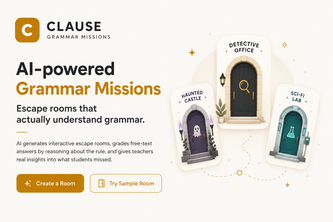
What the company appears to be: Clause — Grammar Mission is an AI-powered grammar escape room platform that generates and grades interactive puzzles for students. The product uses GPT-5.6 to create content, grade student responses, and provide hints based on specific grammar rules, aiming to give teachers insights into class struggles.
What changed: The project started as a static Google Form-based grammar escape room concept and evolved into an AI-generated, interactive platform with real-time grading and feedback capabilities. It was built in one week for the OpenAI 2026 hackathon.
Single most important open question: Does the AI grading system actually work reliably enough to be trusted by teachers in real classroom settings, given that it must distinguish between correct variations of grammar and provide meaningful feedback?
What The Product Actually Is
The description states that Clause — Grammar Mission is an AI-generated escape room designed for grammar education. It builds interactive puzzles where students type corrections instead of selecting from multiple choice options. The system uses GPT-5.6 to generate content, grade answers, and provide rule-based feedback.
The product includes:
- Generation of escape rooms with story elements and puzzle stages
- Interactive gameplay where students type corrections
- AI grading that identifies specific grammar rules
- Hint generation based on individual mistakes
- Appeal mechanism for disputed grades
- Summary reports for teachers
Evidence: The write-up describes building a React frontend with single-page architecture, backend endpoints for key functions (generate-room, grade-answer, appeal, session-summary), and use of GPT-5.6 with JSON schemas for each task.
Inference: The product appears to be a prototype or proof-of-concept built for a hackathon rather than a production-ready solution.
Positioning & Claim Evolution
The description states that the platform aims to fix the "bottleneck" in existing grammar escape rooms — the manual content creation and static grading. It positions itself as an AI-powered solution that can generate content, grade responses with reasoning, and provide insights into student learning gaps.
Evidence: The authors claim it addresses limitations of existing tools by allowing teachers to avoid writing answer keys manually and by providing more nuanced grading than exact match systems.
Inference: The positioning evolved from a simple "grammar escape room" to an AI-powered educational tool that combines gamification with adaptive assessment and teacher insights.
Target Customer & ICP
The description states that the primary users are teachers who create grammar escape rooms for students, and students who play these games. Teachers are described as wanting to understand what their class actually struggled with, while students want engaging gameplay.
Evidence: The write-up mentions teachers needing to see "plain-English summary of what the class actually struggled with" and students enjoying "fun Friday activity."
Inference: The target customer is educators in K-12 settings who use gamified learning tools. The ICP appears to be teachers seeking assessment tools that provide actionable insights beyond simple correctness.
Business Model & Pricing Evidence
Not evidenced.
The description does not mention any pricing model, revenue streams, or commercialization strategy. There is no indication of whether this will be sold as a SaaS product, used in schools, or monetized through other means.
Technical & Delivery Signals
The description states that the system was built with:
- React frontend (single page application)
- Backend endpoints for key functions
- GPT-5.6 with JSON schemas for each task
- Codex for scaffolding and endpoint work
- TypeScript, Next.js, Supabase, Turnstile, Groq
Evidence: The write-up describes splitting the product into two layers (brand layer for teachers, swappable themes for students) and using structured outputs to improve trustworthiness.
Inference: The technical approach suggests a lightweight, API-driven architecture with AI integration at key decision points. The use of Codex indicates rapid prototyping focused on human-in-the-loop design decisions.
Traction & Maturity Signals
Not evidenced.
There is no evidence of revenue, customers, user adoption, or market traction beyond the hackathon submission. The description emphasizes that this was a one-week project built for competition purposes.
Competitive Context
Not evidenced.
The description does not mention competitors, existing products in the space, or market positioning relative to other grammar education tools.
Open Questions & Risks
Risk 1: AI grading reliability - The description states that "the scariest part of the whole build is the grader" and that they had to spend time testing "deliberately annoying test cases." This suggests potential unreliability in real-world use.
Risk 2: Teacher trust - While the authors claim teachers would "actually trust this dashboard," there's no evidence of actual teacher feedback or validation beyond their own assessment.
Risk 3: Scalability concerns - The system was built for a hackathon and appears to be a prototype. The description mentions cutting down features due to time constraints, suggesting limited scope.
Risk 4: Technical limitations - The write-up notes that "grading grammar is genuinely harder than it sounds" and that the grader needed to be cautious to avoid marking correct answers wrong.
Questions the description leaves open
- What specific tests were conducted to validate the AI grading accuracy against real student responses?
- How does the system handle ambiguous grammar cases where multiple answers could be correct?
- Have you tested the appeal feature with actual teachers and students in real classroom settings?
- What is your plan for addressing accessibility issues that arose during development?
- How do you intend to scale beyond the current two puzzle types and one theme?
- What are the technical limitations of using GPT-5.6 for real-time grading in educational environments?
Overall Assessment
Not evidenced.
The description does not provide any information about funding rounds, valuation, or investment interest. The project appears to be a hackathon submission with no indication of commercial viability or market traction beyond the competition context.
User Stories BotA demo video on every pull request
Get a demo video on every new feature
GitHub App that watches your pull requests and records a narrated, captioned demo.
Save time on demo prep and make informed decisions faster with a video walkthrough of every new feature.
Source
Submitted to the OpenAI 2026 hackathon on Devpost. Project home on Devpost. Back to the full gallery on Devpost.
This competitive analysis was produced by top-founders.com (opens in a new tab)
Generated by a language model from this project's public Devpost page — its tagline, the author's own write-up and any built-with tags listed there — as captured in August 2026. Short quotations are the author's words. It is an opinion on the idea as a business, not on the people behind it, and it reflects the description as published then. If the project has moved on, request a correction below. The analysis is not independent research and contains no verified traction, revenue or customer data.
An independent guide by KFG International LLC — not affiliated with, endorsed by, or connected to Devpost or OpenAI.