

Archive position — measured, not model output
0 likes on Devpost
2,263 of the 7,850 archived projects have more likes, and 5,587 share exactly 0 — so this project's #7,217 place in the like-ranked listing is a tie-break inside that group, not a ranking.
Projects (log scale)
Likes on Devpost. ▲ marks this project's group.
Show the figures
| Likes | Projects | Share of archive |
|---|---|---|
| 0 | 5,587 | 71.2% |
| 1 | 1,758 | 22.4% |
| 2 | 284 | 3.6% |
| 3–4 | 132 | 1.7% |
| 5–9 | 75 | 1.0% |
| 10+ | 14 | 0.2% |
 User Stories BotA demo video on every pull request
Get a demo video on every new feature
GitHub App that watches your pull requests and records a narrated, captioned demo.
Save time on demo prep and make informed decisions faster with a video walkthrough of every new feature.
Executive Summary
What the company appears to be
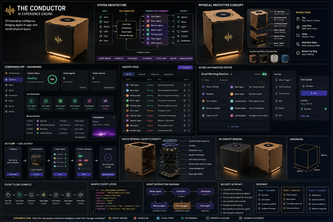
The Conductor is an open-source, event-driven framework for orchestrating cooperative AI agents. The author describes it as a "Conductor" that routes physical triggers (via a simulated UI) to specialized AI agents (the "Line Cooks") to execute tasks concurrently. It uses a Python-based architecture with asyncio and GPT-5.6 for implementation.
What changed
The project is an early-stage MVP (Version 0.1), built as part of the OpenAI 2026 hackathon. It simulates physical triggers through a Streamlit dashboard and routes events to agents using an Event Bus, with no external revenue or customer data evidenced.
Single most important open question
Is there a clear, scalable use case for multi-agent orchestration in physical or tactile environments, and does the framework have sufficient architectural maturity to support such a transition?
What The Product Actually Is
The description states:
- The Conductor is an "open, event-driven framework for orchestrating cooperative AI agents."
- It uses a "zero-latency web dashboard" built with Streamlit.
- It routes commands across an "Event Bus" to specialized agents (e.g., Memory Agent, Voice Agent, Music Agent).
- It simulates physical triggers via a UI and executes JSON "Score" logic.
- The system is built using Python, asyncio, and GPT-5.6 for code generation.
Inference The framework appears to be an experimental prototype with no external integration or production use yet. It separates orchestration from intelligence but does not demonstrate actual deployment or scalability.
Positioning & Claim Evolution
The description states:
- The project is inspired by the "Orchestra Metaphor," where a central "Conductor" delegates tasks to specialized agents.
- It aims to move beyond monolithic chat interfaces into tactile, physical AI experiences.
- The author positions it as a framework for "context-aware partners in physical space."
Inference The positioning is aspirational and rooted in the hackathon context. There is no evidence of market traction or adoption, nor any indication that this is a product for commercial use.
Target Customer & ICP
The description states:
- The author envisions a "context-aware partner in physical space."
- It targets users who want to interact with AI through tactile triggers rather than text.
Inference No specific customer segments or personas are identified. The framework is described as experimental and not yet deployed for any defined user base.
Business Model & Pricing Evidence
The description states:
- The project is open-source.
- It is an MVP built for a hackathon.
- No pricing, monetization strategy, or revenue model is mentioned.
Inference There is no evidence of a business model or pricing structure. The framework is presented as a prototype with no commercial intent.
Technical & Delivery Signals
The description states:
- Built using Python, asyncio, Streamlit, and GPT-5.6.
- Uses a 7-Layer Multi-Agent Architecture.
- Implements a zero-latency Event Bus and session-scoped memory cache.
- The system uses
asyncio.gather()for concurrent execution.
Inference The technical architecture is experimental and built with limited production-grade tools. It lacks evidence of scalability, performance testing, or integration with real hardware.
Traction & Maturity Signals
The description states:
- This is Version 0.1 MVP.
- It was built for a hackathon.
- The author mentions challenges in building an asynchronous event loop and managing state.
- No user feedback, adoption metrics, or performance data are provided.
Inference There is no evidence of traction, customer adoption, or product maturity beyond the initial prototype stage.
Competitive Context
The description states:
- It aims to move beyond monolithic chat interfaces.
- It uses a multi-agent architecture inspired by orchestration metaphors.
Inference No competitive analysis or market positioning is provided. The framework does not appear to be competing with any known commercial product, as it is in early prototype form.
Open Questions & Risks
The description states:
- It’s an MVP built for a hackathon.
- It simulates physical triggers via UI rather than real hardware.
- It uses lightweight Python dictionaries for memory instead of databases.
- The author is the sole team member.
Inference Key risks include lack of scalability, limited production readiness, and absence of real-world integration. The framework’s architecture may not support broader deployment or performance demands.
Questions the description leaves open
- What specific physical triggers or environments are you targeting for real-world deployment?
- How do you plan to scale the event-driven architecture beyond a single-user simulation?
- What is the roadmap for hardware integration, and what challenges have you encountered in that process?
- Are there any early adopters or use cases you're piloting with this framework?
- What are your plans for monetization or commercial viability beyond the prototype stage?
Overall Assessment
The description states:
- The project is an MVP built for a hackathon.
- It is open-source and experimental.
- No revenue, customers, or traction data are provided.
Inference This is an early-stage idea with no demonstrated commercial viability or product-market fit. It lacks evidence of traction, scalability, or a clear path to monetization. The framework is not ready for investment or partnership at this stage.
User Stories BotA demo video on every pull request
Get a demo video on every new feature
GitHub App that watches your pull requests and records a narrated, captioned demo.
Save time on demo prep and make informed decisions faster with a video walkthrough of every new feature.
Source
Submitted to the OpenAI 2026 hackathon on Devpost. Project home on Devpost. Back to the full gallery on Devpost.
This competitive analysis was produced by top-founders.com (opens in a new tab)
Generated by a language model from this project's public Devpost page — its tagline, the author's own write-up and any built-with tags listed there — as captured in August 2026. Short quotations are the author's words. It is an opinion on the idea as a business, not on the people behind it, and it reflects the description as published then. If the project has moved on, request a correction below. The analysis is not independent research and contains no verified traction, revenue or customer data.
An independent guide by KFG International LLC — not affiliated with, endorsed by, or connected to Devpost or OpenAI.