

Archive position — measured, not model output
1 like on Devpost
505 of the 7,850 archived projects have more likes, and 1,758 share exactly 1 — so this project's #1,330 place in the like-ranked listing is a tie-break inside that group, not a ranking.
Projects (log scale)
Likes on Devpost. ▲ marks this project's group.
Show the figures
| Likes | Projects | Share of archive |
|---|---|---|
| 0 | 5,587 | 71.2% |
| 1 | 1,758 | 22.4% |
| 2 | 284 | 3.6% |
| 3–4 | 132 | 1.7% |
| 5–9 | 75 | 1.0% |
| 10+ | 14 | 0.2% |
 User Stories BotA demo video on every pull request
Get a demo video on every new feature
GitHub App that watches your pull requests and records a narrated, captioned demo.
Save time on demo prep and make informed decisions faster with a video walkthrough of every new feature.
Executive Summary
What the company appears to be
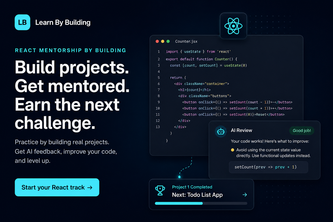
Learn By Building is a self-reported AI-powered, project-based programming education platform. The description states it is designed for learners who want to build real projects rather than consume content passively. It uses an AI mentor to provide feedback on submitted code and guides progression based on demonstrated ability.
What changed
The author describes the product as a response to what they see as a gap in current programming education—where learners watch videos or follow tutorials but struggle to apply knowledge independently. The platform aims to shift from passive consumption to active building with AI guidance.
Single most important open question
Is there evidence of traction, user adoption, or revenue that would validate the commercial viability of this model? The description contains no data on users, customers, monetization, or product-market fit beyond self-reported claims.
What The Product Actually Is
The description states:
- Learn By Building is an AI-powered, project-based learning experience for programming.
- Learners choose a technology (e.g., React) and start with small projects appropriate for their skill level.
- They build the project themselves, submit code, and receive mentor-style feedback from AI.
- The AI evaluates submitted work, explains mistakes in context, and provides hints when stuck.
- Progression is based on demonstrated ability rather than completing lessons sequentially.
Inference The product appears to be a learning platform structured around a minimal loop: Build → Get Feedback → Improve → Unlock → Build Again. It is not described as a full course or an LMS, but rather a hands-on experience focused on project completion and skill development.
Positioning & Claim Evolution
Self-reported positioning
- The platform positions itself as an alternative to passive learning methods like video tutorials or guided exercises.
- It claims to offer an AI mentor-like experience that helps learners build real projects progressively.
- The tagline is: “Learn to code by building real projects—AI-guided, hands-on, and progressively harder.”
Claim evolution
- The author frames the product as a solution to a known problem in programming education: the gap between learning concepts and applying them.
- It evolves from a hackathon prototype into a vision for replacing passive education with active, AI-assisted building.
Inference The positioning is centered on personalization and active learning. The author does not claim to be a competitor to existing platforms like freeCodeCamp or Udemy but rather a new approach to skill acquisition through project-based feedback.
Target Customer & ICP
Self-reported target customer
- Learners who want to learn programming by building real projects.
- People who have watched tutorials or completed courses but struggle to apply knowledge independently.
- Users interested in learning specific technologies (e.g., React) through hands-on practice.
ICP (Ideal Customer Profile)
- Not explicitly defined.
- The description implies a beginner-to-intermediate learner, but no segmentation is provided.
- No indication of whether the platform targets students, professionals, or hobbyists.
Inference The ICP likely includes individuals who are self-taught or transitioning into tech and want to move beyond passive learning. However, no evidence of customer personas or market research is present.
Business Model & Pricing Evidence
Self-reported business model
- Not stated.
- No mention of pricing, monetization strategy, or revenue streams.
- The description does not indicate whether the platform will be free, subscription-based, or pay-per-project.
Inference There is no evidence of a business model or pricing structure. The product is described as a prototype submitted to a hackathon and lacks any commercial context.
Technical & Delivery Signals
Self-reported technical stack
- Built with: auth.js, css, next.js, postgresql, prisma, provider-agnostic, react, tailwind, typescript, vercel, zod.
- The platform is described as using AI to evaluate code and provide feedback.
Delivery signals
- The interface is intentionally clean and focused on the current project.
- Learners receive clear goals, requirements, and optional hints before writing code.
- Progression is tied to demonstrated ability rather than time or lesson completion.
Inference The technical architecture suggests a modern web application built with React and Next.js, likely hosted on Vercel. The use of AI for feedback implies some form of code analysis or LLM integration, but no details are given about how this is implemented.
Traction & Maturity Signals
Self-reported traction
- Not evidenced.
- No mention of users, signups, retention, or usage metrics.
- The project was submitted to a hackathon and is described as a prototype.
Maturity signals
- The product is described as a minimal learning loop with core interactions: projects, hints, code submission, feedback, and progression.
- It has not yet been launched publicly or scaled beyond the hackathon context.
Inference There are no signs of traction or maturity. The platform exists only in concept and prototype form, with no evidence of user engagement or product development beyond the initial build.
Competitive Context
Self-reported competitive positioning
- The author states that most programming education is passive and wants to close that gap.
- It is positioned as an alternative to traditional courses, tutorials, and platforms like freeCodeCamp or Udemy.
No explicit competitors mentioned.
- No mention of direct or indirect competitors in the description.
- No evidence of market analysis or competitive differentiation beyond “better than passive learning.”
Inference The platform competes with passive learning tools and traditional online education platforms, but no specific competitor names or strategies are provided.
Open Questions & Risks
Key risks
- No traction or user data: The product is described only as a hackathon submission with no evidence of adoption or usage.
- Unproven AI feedback mechanism: While AI is central to the experience, there is no detail on how it evaluates code or provides feedback.
- Lack of monetization strategy: No indication of how the platform will generate revenue or sustain itself.
- Limited scope: The description focuses on a single technology (React) and does not indicate plans for expansion.
Open questions
- The product is described as a prototype with no evidence of real-world testing or iteration.
- No mention of team size beyond one member, raising questions about execution capacity.
- The platform lacks any commercial or user-facing signals, suggesting it may be early-stage or non-operational.
Questions the description leaves open
- What is the current stage of development? Is this a working prototype or a concept?
- How does the AI provide feedback? Is it based on code analysis, LLMs, or another method?
- Have you tested the platform with real users? If so, what were the results?
- What are your plans for scaling beyond React and expanding to other technologies?
- Do you have a monetization strategy in place or planned?
- How do you plan to acquire users and build a sustainable user base?
Overall Assessment
Assessment Not evidenced.
The description is entirely self-reported and unverified. There is no evidence of traction, revenue, customers, or product-market fit. The platform appears to be a hackathon prototype with no indication of commercial viability or scalability.
Confidence level Low. This analysis is based solely on the project description provided by the caller. No external data, user feedback, or performance metrics are available. Any inference or assumption about the product’s potential must be treated as speculative and not grounded in evidence.
User Stories BotA demo video on every pull request
Get a demo video on every new feature
GitHub App that watches your pull requests and records a narrated, captioned demo.
Save time on demo prep and make informed decisions faster with a video walkthrough of every new feature.
Source
Submitted to the OpenAI 2026 hackathon on Devpost. Project home on Devpost. Back to the full gallery on Devpost.
This competitive analysis was produced by top-founders.com (opens in a new tab)
Generated by a language model from this project's public Devpost page — its tagline, the author's own write-up and any built-with tags listed there — as captured in August 2026. Short quotations are the author's words. It is an opinion on the idea as a business, not on the people behind it, and it reflects the description as published then. If the project has moved on, request a correction below. The analysis is not independent research and contains no verified traction, revenue or customer data.
An independent guide by KFG International LLC — not affiliated with, endorsed by, or connected to Devpost or OpenAI.