

Archive position — measured, not model output
1 like on Devpost
505 of the 7,850 archived projects have more likes, and 1,758 share exactly 1 — so this project's #1,332 place in the like-ranked listing is a tie-break inside that group, not a ranking.
Projects (log scale)
Likes on Devpost. ▲ marks this project's group.
Show the figures
| Likes | Projects | Share of archive |
|---|---|---|
| 0 | 5,587 | 71.2% |
| 1 | 1,758 | 22.4% |
| 2 | 284 | 3.6% |
| 3–4 | 132 | 1.7% |
| 5–9 | 75 | 1.0% |
| 10+ | 14 | 0.2% |
 User Stories BotA demo video on every pull request
Get a demo video on every new feature
GitHub App that watches your pull requests and records a narrated, captioned demo.
Save time on demo prep and make informed decisions faster with a video walkthrough of every new feature.
Executive Summary
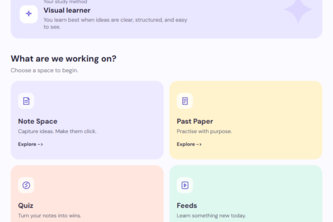
Learn-Mu is a self-reported educational platform designed as an AI-powered study companion that claims to personalize learning experiences based on individual learning styles (visual, auditory, active, reflective). The project was built by one developer as part of the OpenAI 2026 hackathon and includes features such as note-taking, past paper practice with Socratic coaching, quiz generation, and a TikTok-style educational video feed.
The author states that Learn-Mu uses GPT-5.6 for AI functionality, React + Vite for frontend, Express for backend, and integrates OpenAI APIs. It is described as a single-user application currently using local storage for data persistence.
Key commercial due-diligence read
The project lacks any evidence of revenue, customers, or traction beyond its hackathon submission. There is no indication of market validation, user adoption, or monetization strategy. The author's claims about personalization and AI capabilities are self-reported without verification.
Most important open question
Is there any evidence that the target users (students) actually want or need this type of personalized educational tool, or whether they would pay for it?
What The Product Actually Is
The description states that Learn-Mu is:
- An AI-powered study companion
- A "All in one project composing of Notes taking , past paper , Quiz , Feed(tik Tok like scrolling but educational) and News where opportunity for Student be posted"
- Designed to learn how a user learns, then personalize content around their learning style
The author describes it as:
- A note-taking space with AI summarization and explanation features
- A past paper section with Socratic AI coaching
- A quiz generator that turns notes into live multiple-choice quizzes
- A short-form video feed of educational clips (similar to TikTok)
Inference Based on the description, Learn-Mu appears to be a multi-functional educational tool built as a web application using modern frontend and backend technologies.
Positioning & Claim Evolution
The author states:
- "Every student learns differently, but most study apps treat everyone the same way"
- "Learn Mu starts by figuring out how you actually learn — visual, auditory, active, or reflective"
- "Personalizes notes, past papers, quizzes, and explanations around your learning style"
Inference The positioning appears to be a personalized learning platform that differentiates itself from generic study tools by claiming to adapt content based on individual learning preferences.
Claim vs Fact
The author claims the product personalizes content based on learning styles, but provides no evidence of this functionality being tested or validated with users.
Target Customer & ICP
The description states:
- "Every student learns differently" (generalized target)
- "Students" as the primary audience
- "Opportunity for Student be posted" in the News section
Inference The primary customer is students, but there's no specific segmentation beyond that. No mention of age groups, educational levels, or geographic markets.
Not evidenced No clear ICP (Ideal Customer Profile) defined. No evidence of market research or user personas.
Business Model & Pricing Evidence
The description states:
- No explicit pricing model
- No mention of monetization strategy
- No indication of subscription plans or freemium models
- No evidence of revenue streams
Inference The business model is unclear from the provided information. It appears to be a prototype with no commercial structure described.
Not evidenced No pricing, subscriptions, or monetization details provided.
Technical & Delivery Signals
The author states:
- Built with React + Vite (frontend)
- Built with Express (backend)
- Uses OpenAI API with GPT-5.6 for AI features
- Codex was used for scaffolding components and debugging
- Quiz generation uses strict system prompts and retry loops to ensure JSON output
- Video feed uses YouTube iframe with URL-parameter-based reload approach instead of postMessage
Inference The technical stack suggests a modern web application with AI integration. The use of Codex indicates developer efficiency tools were leveraged.
Not evidenced No evidence of scalability, performance metrics, or production deployment details.
Traction & Maturity Signals
The description states:
- Built as a hackathon project (OpenAI 2026)
- Team size: 1 person
- Uses local storage for data persistence
- "What's next" includes expanding subject coverage and building recommendation logic
Inference This is an early-stage prototype with no traction or user adoption. The author mentions future development plans but none are implemented yet.
Not evidenced No evidence of users, usage metrics, revenue, or product-market fit.
Competitive Context
The description states:
- "Most study apps treat everyone the same way"
- No mention of direct competitors
- No indication of market analysis or competitive positioning
Inference The author positions Learn-Mu as a differentiated solution to generic study tools, but doesn't identify specific competitors or market gaps.
Not evidenced No competitive landscape analysis, no competitor comparison, no market size data.
Open Questions & Risks
The description indicates:
- Single-person team (high risk for execution)
- Hackathon project with no commercial traction
- Uses local storage instead of database (limited functionality)
- Relies heavily on GPT-5.6 and OpenAI APIs (dependency risk)
- No monetization strategy or pricing model
- No evidence of user testing or feedback loops
Inference High risk due to lack of team, no traction, unclear business model, and dependency on external AI services.
Questions the description leaves open
- What specific learning style assessments are used, and how reliable are they?
- How does the product plan to validate that students actually want this type of personalized learning experience?
- What is the path to monetization beyond the current prototype?
- How will the team scale from one person to a full team?
- What evidence exists that students would pay for this service?
- How does the product handle data privacy and security concerns?
- What are the technical risks of relying on OpenAI APIs for core functionality?
Overall Assessment
Not evidenced No commercial due-diligence basis to evaluate investment or partnership potential.
The author states that Learn-Mu is a hackathon project with no revenue, customers, or traction. The description contains only self-reported claims about features and capabilities without any evidence of market validation or product-market fit.
Confidence level Very low — this is a prototype with no commercial evidence to support any investment or partnership decision.
The project appears to be an early-stage idea that has not yet demonstrated viability in the marketplace. Any potential value would depend on whether the founder can build a scalable, validated product that addresses real market needs.
User Stories BotA demo video on every pull request
Get a demo video on every new feature
GitHub App that watches your pull requests and records a narrated, captioned demo.
Save time on demo prep and make informed decisions faster with a video walkthrough of every new feature.
Source
Submitted to the OpenAI 2026 hackathon on Devpost. Project home on Devpost. Back to the full gallery on Devpost.
This competitive analysis was produced by top-founders.com (opens in a new tab)
Generated by a language model from this project's public Devpost page — its tagline, the author's own write-up and any built-with tags listed there — as captured in August 2026. Short quotations are the author's words. It is an opinion on the idea as a business, not on the people behind it, and it reflects the description as published then. If the project has moved on, request a correction below. The analysis is not independent research and contains no verified traction, revenue or customer data.
An independent guide by KFG International LLC — not affiliated with, endorsed by, or connected to Devpost or OpenAI.