

Archive position — measured, not model output
1 like on Devpost
505 of the 7,850 archived projects have more likes, and 1,758 share exactly 1 — so this project's #1,333 place in the like-ranked listing is a tie-break inside that group, not a ranking.
Projects (log scale)
Likes on Devpost. ▲ marks this project's group.
Show the figures
| Likes | Projects | Share of archive |
|---|---|---|
| 0 | 5,587 | 71.2% |
| 1 | 1,758 | 22.4% |
| 2 | 284 | 3.6% |
| 3–4 | 132 | 1.7% |
| 5–9 | 75 | 1.0% |
| 10+ | 14 | 0.2% |
 User Stories BotA demo video on every pull request
Get a demo video on every new feature
GitHub App that watches your pull requests and records a narrated, captioned demo.
Save time on demo prep and make informed decisions faster with a video walkthrough of every new feature.
Executive Summary
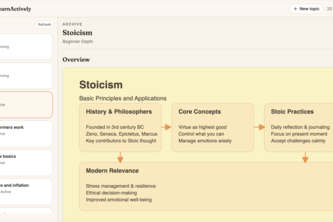
LearnActively is an AI-powered learning tool that the author describes as an “AI tutor” designed to turn conversations into active learning experiences through interactive explanations, quizzes, and retrieval practice. The product is self-reported as a structured workspace for learning topics, with features like concept roadmaps, flashcards, and activities. It was built by a team of two for the OpenAI 2026 hackathon.
The author states that LearnActively aims to move beyond passive consumption of information by encouraging learners to engage in retrieval practice and correction. The system uses an agent-based architecture with separate AI components for planning, explanations, flashcards, quizzes, and feedback. It is built using Next.js, React, TypeScript, Supabase, and other modern web technologies.
The single most important open question is: What is the actual user experience of LearnActively, and how does it differ from existing learning tools? The description lacks evidence of any real users, revenue, or adoption. It is unclear whether the tool functions as described in practice, or if it remains a prototype.
What The Product Actually Is
The description states that LearnActively is an AI tutor that turns conversations into active learning through interactive explanations, retrieval practice, and quizzes. It creates structured learning workspaces including:
- Intro content
- Cheatsheets
- Concept roadmaps
- Visual explanations
- Activities
- Flashcards
- Quizzes
The system uses separate AI agents for different tasks such as planning, explanations, flashcards, quizzes, and feedback.
It is built with:
- Frontend: Next.js, React, TypeScript, Tailwind
- Backend: Node.js, API routes
- Data storage: Drizzle, Supabase Postgres
- Visualization: ReactFlow, Mermaid
- Structured outputs: Zod
Inference: The product is described as a learning platform that integrates AI-generated content into an interactive experience. It is not a chatbot but rather a structured workspace for learning.
Positioning & Claim Evolution
The author states that LearnActively was built because most learning tools make it too easy to stay passive. The tool aims to push learners to "think, practice, retrieve, and correct mistakes while they learn."
It is positioned as:
- An AI tutor
- A structured learning workspace
- A system that encourages active engagement over passive consumption
The author also claims that the agent-based architecture makes the product easier to extend.
Inference: The positioning reflects a shift from traditional chatbot-style tools toward more structured, practice-oriented learning. However, no evidence is provided about how this differs from existing platforms or whether it has been tested in real-world use.
Target Customer & ICP
The description does not explicitly name the target customer or define an ideal customer profile (ICP). The author focuses on the learning experience and the active learning approach, but does not describe who uses it or how they would benefit.
Inference: Based on the product’s focus, the likely users are students, professionals seeking to learn new skills, or educators looking for tools that promote active recall. However, no evidence supports this claim.
Business Model & Pricing Evidence
There is no evidence in the description of a business model or pricing strategy. The project was submitted as part of a hackathon and does not include any information about monetization, subscriptions, or sales.
Inference: The tool appears to be a prototype or proof-of-concept with no commercial structure described.
Technical & Delivery Signals
The system is built using:
- Frontend: Next.js, React, TypeScript, Tailwind
- Backend: Node.js, API routes
- Database: Drizzle, Supabase Postgres
- Visualization: ReactFlow, Mermaid
- AI orchestration: Agent-based architecture with Zod for structured outputs
The author notes challenges in:
- Making the experience feel active rather than like a chatbot
- Coordinating generated artifacts and streaming them into the UI
- Balancing speed, quality, and useful practice
Inference: The technical stack is modern and well-suited to building an interactive web application. The agent-based architecture suggests scalability potential, but no evidence of performance or delivery in real-world use.
Traction & Maturity Signals
The project was submitted to the OpenAI 2026 hackathon, indicating it is a prototype or early-stage product.
There is no evidence of:
- Revenue
- Customers
- Users
- Adoption
- Product-market fit
- Any form of traction beyond its submission to a hackathon
Inference: The tool has not yet demonstrated real-world usage or commercial viability. It remains in an exploratory phase.
Competitive Context
The description does not mention any competitors or how LearnActively compares to existing tools in the AI learning space.
Inference: No competitive analysis is provided, and no evidence exists of prior market research or differentiation from other platforms.
Open Questions & Risks
- No traction or user feedback: The tool is described as a hackathon submission with no real-world usage.
- Unproven value proposition: The claim that it encourages active learning is not backed by evidence.
- Prototype nature: No indication of whether the system works reliably or at scale.
- Lack of commercialization strategy: No pricing, monetization, or go-to-market plan.
- Technical complexity without validation: The agent-based architecture may be difficult to implement and maintain without real-world testing.
Questions the description leaves open
- What specific learning outcomes have you observed from using LearnActively?
- How does the tool determine when a user has truly understood a concept?
- Have you tested the system with real users? If so, what were the results?
- How do you plan to scale beyond the current prototype?
- What is your roadmap for monetization or commercial viability?
- How do you ensure consistency and quality across different AI-generated outputs?
Overall Assessment
The description indicates that LearnActively is a prototype built for a hackathon, with no evidence of traction, revenue, or user adoption.
Assessment: Not ready for investment or partnership at this stage. The product shows potential in concept but lacks validation and commercial readiness.
Confidence Level: Low — based entirely on self-reported information with no external corroboration.
User Stories BotA demo video on every pull request
Get a demo video on every new feature
GitHub App that watches your pull requests and records a narrated, captioned demo.
Save time on demo prep and make informed decisions faster with a video walkthrough of every new feature.
Source
Submitted to the OpenAI 2026 hackathon on Devpost. Project home on Devpost. Back to the full gallery on Devpost.
This competitive analysis was produced by top-founders.com (opens in a new tab)
Generated by a language model from this project's public Devpost page — its tagline, the author's own write-up and any built-with tags listed there — as captured in August 2026. Short quotations are the author's words. It is an opinion on the idea as a business, not on the people behind it, and it reflects the description as published then. If the project has moved on, request a correction below. The analysis is not independent research and contains no verified traction, revenue or customer data.
An independent guide by KFG International LLC — not affiliated with, endorsed by, or connected to Devpost or OpenAI.