

Archive position — measured, not model output
1 like on Devpost
505 of the 7,850 archived projects have more likes, and 1,758 share exactly 1 — so this project's #1,335 place in the like-ranked listing is a tie-break inside that group, not a ranking.
Projects (log scale)
Likes on Devpost. ▲ marks this project's group.
Show the figures
| Likes | Projects | Share of archive |
|---|---|---|
| 0 | 5,587 | 71.2% |
| 1 | 1,758 | 22.4% |
| 2 | 284 | 3.6% |
| 3–4 | 132 | 1.7% |
| 5–9 | 75 | 1.0% |
| 10+ | 14 | 0.2% |
 User Stories BotA demo video on every pull request
Get a demo video on every new feature
GitHub App that watches your pull requests and records a narrated, captioned demo.
Save time on demo prep and make informed decisions faster with a video walkthrough of every new feature.
Executive Summary
What the company appears to be
LearnBridge is a self-reported AI-powered learning assistant designed for three distinct user groups: students, teachers, and elders/low-literacy learners. It offers mode-specific experiences built using GPT-5.6 via OpenAI’s API, with a frontend in HTML/CSS/JS and a Node.js backend that securely handles API keys.
What changed
The project was submitted to the OpenAI 2026 hackathon by one developer (Tejas Rathore), who describes it as a proof-of-concept or demo. It is not evidenced to have launched, scaled, or generated revenue.
Single most important open question
Is there any evidence of user adoption, feedback loops, or commercial traction beyond the author’s self-reported development?
Note: This analysis is based entirely on the self-reported description provided by the project author. No independent verification, historical data, or third-party sources are available.
What The Product Actually Is
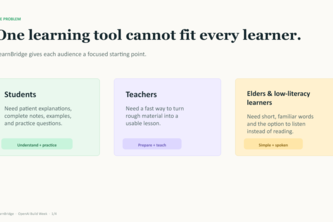
The description states that LearnBridge is an AI learning assistant with three independent modes:
- Student mode generates explanations, study notes, key terms, examples, quizzes, and mind maps.
- Teacher mode creates lesson plans including objectives, teaching notes, classroom activities, and understanding checks.
- Elder/literacy mode provides short, spoken responses using browser voice playback.
The system uses GPT-5.6 to produce structured JSON outputs for each mode. The frontend is built with HTML, CSS, JavaScript; the backend is a Node.js server that calls OpenAI’s API and keeps the key secure.
Claim: LearnBridge is an AI-powered learning assistant.
Evidence: Author's own write-up.
Claim: It supports three distinct user modes.
Evidence: Author's own write-up.
Claim: The system uses GPT-5.6 via OpenAI API.
Evidence: Author’s own write-up.
Claim: API keys are handled securely on the server.
Evidence: Author’s own write-up.
Positioning & Claim Evolution
The author positions LearnBridge as an inclusive learning assistant that adapts to different user needs—students, teachers, and elders. It is described as a tool that makes learning more accessible by tailoring content delivery methods (e.g., visual mind maps for students, spoken responses for elders).
There is no evidence of prior versions or evolution in positioning beyond this single submission.
Claim: LearnBridge aims to be inclusive across learning types.
Evidence: Author's own write-up.
Claim: The product adapts content delivery based on user type.
Evidence: Author's own write-up.
Claim: It is a proof-of-concept or demo.
Evidence: Submission context (OpenAI hackathon).
Target Customer & ICP
The author identifies three target personas:
- Students — need explanations, notes, quizzes, and mind maps.
- Teachers — require lesson planning tools including objectives, activities, and assessments.
- Elders/low-literacy learners — benefit from short sentences and voice playback.
No evidence of segmentation beyond these three personas or any data on which segment is prioritized.
Claim: Three distinct user groups are targeted.
Evidence: Author's own write-up.
Claim: No evidence of prioritization or ICP definition beyond stated personas.
Inference: Based on lack of further detail in the description.
Business Model & Pricing Evidence
There is no mention of pricing, monetization strategy, or business model. The project is described as a hackathon submission with no indication of revenue streams or customer acquisition plans.
Claim: No pricing or business model mentioned.
Evidence: Author's own write-up.
Technical & Delivery Signals
The system uses:
- Browser-based frontend (HTML/CSS/JS)
- Node.js backend
- OpenAI Responses API (GPT-5.6)
- Secure handling of API keys via server-side calls
- Voice playback using browser SpeechSynthesis API
- Fallback content when API is unavailable
- Responsive design, typography, and theme options
Codex was reportedly used for architecture, interface design, prompt engineering, and testing.
Claim: The product uses GPT-5.6 and OpenAI API.
Evidence: Author's own write-up.
Claim: API keys are not exposed to the browser.
Evidence: Author's own write-up.
Claim: Voice support is implemented via browser APIs.
Evidence: Author's own write-up.
Claim: Fallbacks exist for offline functionality.
Evidence: Author's own write-up.
Traction & Maturity Signals
There is no evidence of users, customers, or adoption beyond the author’s own development. No data on usage frequency, retention, or feedback loops are provided.
Claim: No traction or user data.
Evidence: Author's own write-up.
Claim: Not launched or commercialized.
Inference: Based on submission context and lack of evidence.
Competitive Context
The description does not mention any competitors. It is unclear whether similar tools exist in the market, nor if LearnBridge differentiates itself from existing AI learning platforms.
Claim: No competitive landscape described.
Evidence: Author's own write-up.
Claim: No differentiation strategy or positioning against competitors.
Inference: Based on lack of evidence.
Open Questions & Risks
- Single-person development team — raises questions about scalability and long-term maintenance.
- No commercial traction or user feedback — indicates no real-world validation.
- Hackathon submission — suggests this is a prototype, not a product in production.
- Use of GPT-5.6 — not publicly available; the author may be using an internal or proprietary version.
- Lack of monetization strategy — no indication of how it would generate revenue.
Claim: Single developer team.
Evidence: Author's own write-up.
Claim: No commercial traction.
Inference: Based on absence of evidence.
Claim: Prototype, not productized.
Inference: Based on hackathon submission.
Questions the description leaves open
- What is the source of GPT-5.6? Is it a public API or internal version?
- Has the system been tested with actual users from any of the three target groups?
- Are there plans to expand beyond the current three modes?
- How does the team plan to scale beyond one developer?
- What are the key assumptions about user behavior that underpin this product?
Overall Assessment
There is no evidence to support a commercial investment or partnership opportunity at this time.
Claim: No evidence of commercial viability.
Inference: Based on lack of traction, revenue, or user data.
Claim: Not ready for investment or partnership.
Inference: Based on prototype nature and absence of business model.
User Stories BotA demo video on every pull request
Get a demo video on every new feature
GitHub App that watches your pull requests and records a narrated, captioned demo.
Save time on demo prep and make informed decisions faster with a video walkthrough of every new feature.
Source
Submitted to the OpenAI 2026 hackathon on Devpost. Project home on Devpost. Back to the full gallery on Devpost.
This competitive analysis was produced by top-founders.com (opens in a new tab)
Generated by a language model from this project's public Devpost page — its tagline, the author's own write-up and any built-with tags listed there — as captured in August 2026. Short quotations are the author's words. It is an opinion on the idea as a business, not on the people behind it, and it reflects the description as published then. If the project has moved on, request a correction below. The analysis is not independent research and contains no verified traction, revenue or customer data.
An independent guide by KFG International LLC — not affiliated with, endorsed by, or connected to Devpost or OpenAI.