

Archive position — measured, not model output
0 likes on Devpost
2,263 of the 7,850 archived projects have more likes, and 5,587 share exactly 0 — so this project's #7,216 place in the like-ranked listing is a tie-break inside that group, not a ranking.
Projects (log scale)
Likes on Devpost. ▲ marks this project's group.
Show the figures
| Likes | Projects | Share of archive |
|---|---|---|
| 0 | 5,587 | 71.2% |
| 1 | 1,758 | 22.4% |
| 2 | 284 | 3.6% |
| 3–4 | 132 | 1.7% |
| 5–9 | 75 | 1.0% |
| 10+ | 14 | 0.2% |
 User Stories BotA demo video on every pull request
Get a demo video on every new feature
GitHub App that watches your pull requests and records a narrated, captioned demo.
Save time on demo prep and make informed decisions faster with a video walkthrough of every new feature.
Executive Summary
What the company appears to be
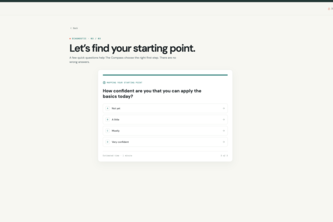
The Compass is an adaptive learning system designed to personalize educational journeys by adjusting content delivery based on learner responses, understanding, and progress. It uses AI modules to generate diagnostics, evaluate responses, detect misconceptions, and adapt learning paths in real time.
What changed
This project was submitted as a hackathon entry for the OpenAI 2026 hackathon. The author describes it as an experimental system built in two hours using Next.js, OpenAI APIs, Supabase, and related technologies. It is not yet a commercial product but represents a conceptual prototype with clear design principles around personalization, learner modeling, and transparency.
Single most important open question
Is there evidence that the author has begun building or testing any version of this system beyond the hackathon demo? If so, what traction or feedback exists from early users?
What The Product Actually Is
The description states that The Compass is an adaptive learning system. It transforms any topic into a personalized, interactive journey using AI-driven tools. Key components include:
- A diagnostic module to assess learner knowledge.
- A learner profiler that builds a structured profile based on responses.
- A curriculum planner that creates a roadmap.
- A lesson generator that delivers content via analogy-based, Socratic, or activity-based methods.
- An evaluation engine that checks factual understanding, reasoning, and application.
- A misconception detector and adaptation engine that adjusts the learning path dynamically.
The system is described as being built with Next.js, React, TypeScript, Tailwind CSS, PostgreSQL, Prisma, Supabase, OpenAI APIs, and Vercel. It uses a structured workflow: Topic → Diagnostic → Learner Profile → Roadmap → Lesson → Interaction → Evaluation → Adaptation → Next Lesson.
Evidence
- The author’s own write-up.
- Technology stack declared by the author.
Inference
- This is not a finished product but a prototype built for demonstration purposes.
- It is designed to be modular, with AI modules handling specific tasks rather than one large autonomous agent.
Positioning & Claim Evolution
The Compass positions itself as an alternative to traditional learning platforms that treat all learners the same. The author claims it adapts not only what to teach but how to teach based on individual learner behavior and understanding.
It emphasizes:
- Personalization beyond generic content delivery.
- Transparency in how learning paths change.
- A focus on learner evidence, not just AI-generated lessons.
- The ability to show two learners studying the same topic through different journeys.
Evidence
- The author’s own write-up.
- Claims about learner awareness and adaptation.
Inference
- The positioning reflects a shift from static courseware to dynamic learning systems.
- The emphasis on visible adjustments suggests an attempt to build trust in AI-driven personalization.
Target Customer & ICP
The description does not clearly identify target customers or personas. However, the author implies that the system could be used by:
- Individuals seeking self-directed learning.
- Teachers who want to understand student progress and intervene when needed.
- Organizations looking for employee training or onboarding solutions.
There is no mention of specific industries or user types beyond general learners.
Evidence
- The author mentions teachers, schools, companies, and multiple subject areas as potential future users.
- No explicit ICP defined.
Inference
- The system may appeal to educators, corporate trainers, or lifelong learners.
- It is not yet segmented into specific buyer personas.
Business Model & Pricing Evidence
There is no evidence of a business model or pricing structure in the provided description. The author does not describe how the product would be monetized or whether it will be offered as a freemium, subscription, or enterprise solution.
Evidence
- No mention of revenue streams, pricing tiers, or monetization plans.
Inference
- If this evolves into a commercial offering, it may follow SaaS models typical in edtech.
- The system could potentially target B2B (schools, companies) or B2C (individual learners).
Technical & Delivery Signals
The system is built using:
- Next.js
- React
- TypeScript
- Tailwind CSS
- PostgreSQL
- Prisma
- Supabase
- OpenAI APIs
- Vercel
It uses structured AI workflows with clearly separated responsibilities:
- Diagnostic Planner
- Learner Profiler
- Curriculum Planner
- Lesson Generator
- Response Evaluator
- Misconception Detector
- Adaptation Engine
The system maintains structured learner state and avoids random adaptation through controlled policies.
Evidence
- The author’s own write-up.
- Technology tags provided by the author.
Inference
- The architecture suggests a modular, testable system designed for scalability.
- The use of structured outputs and rubrics indicates attention to reliability and explainability.
Traction & Maturity Signals
There is no evidence of traction or adoption beyond the hackathon submission. No customers, revenue, usage metrics, or user feedback are mentioned.
Evidence
- The system was built in 2 hours for a hackathon.
- No mention of users, pilot programs, or product launches.
Inference
- This is an early-stage prototype with no commercial traction.
- The author may be exploring ideas rather than executing a launch strategy.
Competitive Context
The description does not reference existing competitors. However, the concept aligns with adaptive learning platforms and AI-powered tutoring systems such as Duolingo, Khan Academy, Coursera, or Carnegie Learning.
Evidence
- No competitor analysis or market positioning provided.
Inference
- The Compass likely competes in the edtech space where personalization is a key differentiator.
- It may face competition from AI-based learning platforms that already offer some level of adaptivity.
Open Questions & Risks
Key risks and open questions include:
- Lack of commercial traction or user data.
- No evidence of monetization strategy.
- Prototype nature implies unproven scalability or usability.
- Heavy reliance on AI for evaluation and adaptation raises concerns about consistency, bias, and explainability without real-world testing.
Evidence
- The system is described as a hackathon demo.
- No mention of user testing, feedback loops, or production deployment.
Inference
- Without real-world validation, the system may not function as intended in practice.
- The complexity of learner modeling and AI evaluation could lead to unintended consequences if not rigorously tested.
Questions the description leaves open
- Has the system been tested with actual learners beyond the hackathon demo?
- What kind of feedback have you received from users during prototyping?
- How do you plan to validate the accuracy and fairness of your AI evaluation rubrics?
- Are there any known limitations or blind spots in how the system adapts?
- What is your roadmap for transitioning from prototype to scalable product?
- Have you considered how to integrate with existing educational institutions or platforms?
- How do you intend to ensure learner privacy and data security?
- What are your thoughts on long-term sustainability and monetization?
Overall Assessment
Not evidenced.
The description provides no information about funding, valuation, team size beyond one person, or any investment history. There is also no indication of whether the founder intends to pursue a commercial venture or if there is interest from partners or investors.
Evidence
- Only one team member listed.
- No mention of funding rounds, investors, or partnerships.
Inference
- This appears to be an experimental project by a single individual.
- It may evolve into a startup or educational tool, but no signs of current investment or partnership activity are evident.
User Stories BotA demo video on every pull request
Get a demo video on every new feature
GitHub App that watches your pull requests and records a narrated, captioned demo.
Save time on demo prep and make informed decisions faster with a video walkthrough of every new feature.
Source
Submitted to the OpenAI 2026 hackathon on Devpost. Project home on Devpost. Back to the full gallery on Devpost.
This competitive analysis was produced by top-founders.com (opens in a new tab)
Generated by a language model from this project's public Devpost page — its tagline, the author's own write-up and any built-with tags listed there — as captured in August 2026. Short quotations are the author's words. It is an opinion on the idea as a business, not on the people behind it, and it reflects the description as published then. If the project has moved on, request a correction below. The analysis is not independent research and contains no verified traction, revenue or customer data.
An independent guide by KFG International LLC — not affiliated with, endorsed by, or connected to Devpost or OpenAI.