

Archive position — measured, not model output
0 likes on Devpost
2,263 of the 7,850 archived projects have more likes, and 5,587 share exactly 0 — so this project's #3,284 place in the like-ranked listing is a tie-break inside that group, not a ranking.
Projects (log scale)
Likes on Devpost. ▲ marks this project's group.
Show the figures
| Likes | Projects | Share of archive |
|---|---|---|
| 0 | 5,587 | 71.2% |
| 1 | 1,758 | 22.4% |
| 2 | 284 | 3.6% |
| 3–4 | 132 | 1.7% |
| 5–9 | 75 | 1.0% |
| 10+ | 14 | 0.2% |
 User Stories BotA demo video on every pull request
Get a demo video on every new feature
GitHub App that watches your pull requests and records a narrated, captioned demo.
Save time on demo prep and make informed decisions faster with a video walkthrough of every new feature.
Executive Summary
What the company appears to be
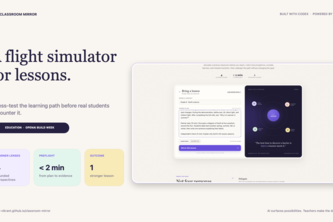
Classroom Mirror is a preflight simulator for lesson plans, using GPT-5.6 agents and evidence-grounded critique to catch hidden learning barriers before students encounter them. The product is described as an instructional review tool that helps teachers identify potential issues in their lesson plans through AI-assisted analysis.
What changed
The project evolved from an initial concept involving simulated learner personas to a system based on bounded instructional-review lenses, skeptical verification, and evidence-led findings. This redesign was driven by concerns over credibility and the desire to avoid pretending that AI can accurately predict individual student behavior.
Single most important open question — the commercial due-diligence read
Is there a viable market need for an AI-powered preflight check for lesson plans, and does the current prototype demonstrate sufficient utility or traction to warrant further investment or partnership?
What The Product Actually Is
The description states that Classroom Mirror is a tool that allows teachers to submit a lesson plan and receive feedback from GPT-5.6 agents across four instructional lenses:
- Conceptual clarity
- Academic language
- Attention and feedback
- Transfer and challenge
Each finding must cite an exact passage from the submitted lesson. A skeptical verification stage challenges these findings, labeling them as verified, qualified, or rejected.
The system uses:
- GPT-5.6 via OpenAI API
- Multi-agent architecture for parallel discovery (one root agent and three subagents)
- Skeptical verification via direct GPT-5.6 call
- Strict JSON schema outputs
- Substring validation to ensure evidence quotes are literal substrings of the lesson
It is built with:
- Next.js, React, TypeScript, Node.js
- Deterministic no-key demo for judges
- Live GPT-5.6 analysis for local testing
- Adversarial benchmark harness
Not evidenced: No mention of actual deployment, user base, or commercial usage beyond a hackathon submission.
Positioning & Claim Evolution
The description states that the project was inspired by the problem of teachers discovering ambiguity and misconception-producing examples only after a lesson is underway. The original idea involved simulated learner personas but was later redesigned to avoid pretending AI could predict individual learners.
Key claims:
- "Classroom Mirror helps teachers find the barrier before a learner does."
- "AI surfaces possibilities; teachers make the decisions."
- "Trustworthy educational AI is less about generating impressive content and more about showing evidence, exposing uncertainty, and preserving teacher agency."
Evolution:
- Started with simulated learner personas
- Shifted to bounded instructional-review lenses
- Introduced skeptical verification and grounding checks
- Emphasized teacher control over final decisions
Inference: The evolution reflects a move from a generative AI tool toward an evaluative one, focused on transparency and accountability.
Target Customer & ICP
The description states that the target user is teachers who plan lessons. It does not specify grade levels or subject areas beyond general education.
ICP inferred:
- Educators planning lesson plans
- Teachers seeking feedback on instructional design
- Likely in K–12 or higher education contexts
Not evidenced: No data on specific demographics, geographic scope, or institutional type (e.g., public vs. private schools).
Business Model & Pricing Evidence
The description does not provide any information about pricing, monetization strategy, or business model.
Not evidenced: No mention of revenue streams, subscription tiers, licensing models, or customer acquisition costs.
Technical & Delivery Signals
The system uses:
- GPT-5.6 via OpenAI API
- Multi-agent architecture with root and subagents
- Skeptical verification process
- Strict structured output (JSON schema)
- Substring validation for evidence grounding
- Built using Next.js, React, TypeScript, Node.js
Key technical features:
- Deterministic no-key demo for judges
- Live GPT-5.6 analysis for local testing
- Adversarial benchmark harness
- Contract, safety, accessibility, and production-build tests
Not evidenced: No information on scalability, infrastructure, or API usage limits.
Traction & Maturity Signals
The description states that the team:
- Built a live GPT-5.6 Sol benchmark run
- Detected all 12 planted instructional risks
- Grounded all 28 findings in exact lesson quotes
- Achieved 100% planted-risk recall
- Achieved 100% exact-quote grounding
They also mention:
- Six benchmark lessons with 12 deliberately planted failures
- Evaluation harness refuses to score deterministic demo data
- Repository includes benchmark cases and saved results for reproducibility
Not evidenced: No real-world usage, customer feedback, or adoption metrics beyond the hackathon submission.
Competitive Context
The description does not provide any information about competitors or competitive positioning.
Not evidenced: No mention of existing tools in the education AI space, nor how Classroom Mirror differentiates from them.
Open Questions & Risks
- Unproven market demand: The product is described as a hackathon submission with no evidence of real-world traction or adoption.
- Over-reliance on AI tooling: Heavy dependence on GPT-5.6 and OpenAI APIs may create dependency risks.
- Limited scope: The system is currently limited to four instructional lenses; lack of expansion plans is concerning.
- No commercial viability: No evidence of pricing, monetization, or business model.
- Self-reported performance: All performance claims are based on internal benchmarks, not external validation.
Inference: Without real-world usage or feedback, the product may not meet actual teacher needs.
Questions the description leaves open
- What specific pain points in lesson planning did you observe that led to this idea?
- How do you plan to validate whether teachers actually use and value the feedback provided?
- Are there any institutional partnerships or pilot programs with educators already underway?
- What are your plans for expanding beyond the current four instructional lenses?
- How will you ensure long-term sustainability given reliance on OpenAI APIs?
- Have you considered how to scale this beyond a hackathon prototype?
Overall Assessment
Not evidenced: No financials, funding history, or commercial traction are provided.
The project is described as a hackathon submission with no evidence of revenue, customers, or adoption beyond internal testing and benchmarking. While the concept shows promise in addressing a real problem (lesson plan review), there is insufficient evidence to support investment or partnership interest at this stage.
Confidence level: Low
The description is self-reported and unverified; it does not contain any data on market demand, user engagement, or commercial viability. The product demonstrates technical capability but lacks proof of traction or scalability.
User Stories BotA demo video on every pull request
Get a demo video on every new feature
GitHub App that watches your pull requests and records a narrated, captioned demo.
Save time on demo prep and make informed decisions faster with a video walkthrough of every new feature.
Source
Submitted to the OpenAI 2026 hackathon on Devpost. Project home on Devpost. Back to the full gallery on Devpost.
This competitive analysis was produced by top-founders.com (opens in a new tab)
Generated by a language model from this project's public Devpost page — its tagline, the author's own write-up and any built-with tags listed there — as captured in August 2026. Short quotations are the author's words. It is an opinion on the idea as a business, not on the people behind it, and it reflects the description as published then. If the project has moved on, request a correction below. The analysis is not independent research and contains no verified traction, revenue or customer data.
An independent guide by KFG International LLC — not affiliated with, endorsed by, or connected to Devpost or OpenAI.