

Archive position — measured, not model output
0 likes on Devpost
2,263 of the 7,850 archived projects have more likes, and 5,587 share exactly 0 — so this project's #3,236 place in the like-ranked listing is a tie-break inside that group, not a ranking.
Projects (log scale)
Likes on Devpost. ▲ marks this project's group.
Show the figures
| Likes | Projects | Share of archive |
|---|---|---|
| 0 | 5,587 | 71.2% |
| 1 | 1,758 | 22.4% |
| 2 | 284 | 3.6% |
| 3–4 | 132 | 1.7% |
| 5–9 | 75 | 1.0% |
| 10+ | 14 | 0.2% |
 User Stories BotA demo video on every pull request
Get a demo video on every new feature
GitHub App that watches your pull requests and records a narrated, captioned demo.
Save time on demo prep and make informed decisions faster with a video walkthrough of every new feature.
Executive Summary
What the company appears to be
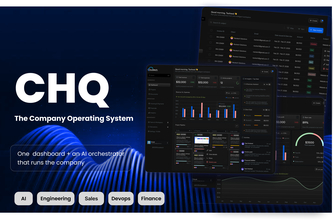
CHQ is described as an AI-native operating system for running a software company, built by one person (Taoheed Adeniji) during OpenAI Build Week 2026. It is positioned as a single-tenant, internal platform for Cloudstech, designed to automate operational toil while human-gating consequential actions.
What changed
Before the hackathon, CHQ was a finance and business-operations dashboard UI with no backend or AI system. During Build Week, it evolved into a full-stack AI operating system integrating PostgreSQL-backed data, GPT-5.6 orchestration, GitHub webhook ingestion, code review automation, infrastructure control, sales intelligence, and compliance controls.
Single most important open question
Is there any evidence of actual use beyond the author’s own development environment? The description states CHQ is intentionally not a general SaaS product or multi-tenant platform — it has exactly one organizational owner: Cloudstech. There is no indication that this system is being used by anyone else, nor does it appear to have been deployed in production outside of the author's own workflow.
What The Product Actually Is
The description states that CHQ is an AI-native operating system for running Cloudstech’s engineering delivery and business operations. It combines:
- A real PostgreSQL-backed business application.
- A bounded GPT-5.6 orchestration loop.
- Durable AI trajectories and audit history.
- Versioned skills and ephemeral engineering workers.
- Model routing, token metering, budgets, and cost controls.
- Hybrid organizational memory.
- GitHub webhook ingestion and automated code review.
- Human approval for consequential actions.
- Infrastructure monitoring and typed deployment execution.
- Scheduled business automations.
- Sales-signal discovery, scoring, and outreach drafting.
- Web, API, mobile, CLI, and server-agent surfaces.
The system is described as intentionally not a general SaaS product or multi-tenant platform. It has exactly one organizational owner: Cloudstech.
Evidence
- The author describes CHQ as an AI-native operating system.
- It integrates PostgreSQL, GPT-5.6, GitHub webhooks, and infrastructure control.
- It includes features like automated code review, deployment, sales outreach, and model cost accounting.
- It is built with technologies such as NestJS, React, Go, Docker, Redis, and PostgreSQL.
Inference The system appears to be a custom-built internal tool for one organization, not a commercial product.
Positioning & Claim Evolution
The author states that CHQ was originally a finance and business-operations dashboard UI with no backend or AI. During OpenAI Build Week, it evolved into a full-stack AI operating system.
The governing principle is:
“Automate the toil. Human-gate the consequential.”
This suggests a positioning around operational efficiency, automation, and safety — not general-purpose SaaS.
Evidence
- The product started as a UI-only dashboard.
- It transitioned into an integrated AI system over several phases (R1–R7).
- The tagline is: “The AI-native operating system for running a software company — one orchestrator that ships code, runs sales, manages finance, deploys and secures infra, with humans approving only what matters.”
Inference Positioning evolved from a UI tool to an internal AI-powered OS, but it remains self-contained and not intended for external use.
Target Customer & ICP
The description states that CHQ is intentionally not a general SaaS product or multi-tenant platform. It has exactly one organizational owner: Cloudstech.
Evidence
- “CHQ is intentionally not a general SaaS product or a multi-tenant platform.”
- “It has exactly one organizational owner: Cloudstech.”
Inference The target customer is Cloudstech itself, and the ICP is an internal engineering team or organization that wants to automate its own operations using AI.
Business Model & Pricing Evidence
There is no evidence of a business model or pricing structure in the description. The system is described as a single-tenant, internal platform for one company.
Evidence
- No mention of revenue, customers, or pricing.
- The system is described as not being a general SaaS product.
- It has exactly one organizational owner: Cloudstech.
Inference No commercial business model or pricing structure is evident. It appears to be an internal tool with no monetization strategy.
Technical & Delivery Signals
The author describes CHQ as a full-stack system built using:
- PostgreSQL, TypeScript, React, NestJS, Go, Docker, Redis, Caddy, GitHub, OpenAI APIs.
- Codex was used as an implementation collaborator during Build Week.
- The system includes migrations, typed SDKs, API controllers, authentication, authorization, and audit trails.
Evidence
- The system uses multiple technologies including PostgreSQL, NestJS, Go, Docker, Redis, and Caddy.
- It includes features like GitHub webhook ingestion, automated code review, deployment control, and model routing.
- The author used Codex to implement various components across R1–R7 phases.
- Git history shows 34 dated commits and seven merged PRs.
Inference The system is technically sophisticated and built with a focus on safety, auditability, and modularity. However, it’s not yet proven in production or at scale.
Traction & Maturity Signals
There is no evidence of traction, customers, or adoption beyond the author's own development.
Evidence
- The system is described as internal to Cloudstech.
- It was built during a hackathon (OpenAI Build Week).
- No mention of users, revenue, or customer data.
- The system is not described as being used by others or deployed outside of the author’s environment.
Inference No traction or maturity signals are evident. This is an experimental or prototype system, not yet in production use.
Competitive Context
There is no evidence of competitors mentioned in the description.
Evidence
- No mention of existing tools or platforms.
- No comparison to other AI-native operating systems or internal platforms.
Inference No competitive context is provided. The author does not reference any market or product landscape beyond their own system.
Open Questions & Risks
- Single-person development: The entire system was built by one person (Taoheed Adeniji). This raises questions about scalability, maintainability, and long-term support.
- No external use or feedback: The system is described as internal only, with no evidence of real-world usage or user feedback.
- Prototype nature: Built during a hackathon, it may not be production-ready or tested in real conditions.
- High technical complexity without validation: While the architecture is detailed, there’s no indication that it has been validated outside of the author’s own environment.
Evidence
- Only one team member (Taoheed Adeniji) built the system.
- It was built for internal use only.
- It was a hackathon project with no external validation or production deployment.
Inference The system is experimental and not validated in real-world conditions. Risks include lack of scalability, maintainability, and long-term viability.
Questions the description leaves open
- What are the actual operational needs that CHQ was designed to address?
- Has CHQ been tested or used by anyone other than the author?
- Are there any plans to open-source or commercialize CHQ?
- How does CHQ handle data privacy and security in a multi-tenant context (even if it’s currently single-tenant)?
- What are the long-term maintenance and scalability challenges for this system?
Overall Assessment
Not evidenced.
There is no evidence of revenue, customers, traction, or commercial viability beyond the author's own development. The system is described as an internal tool built during a hackathon, not intended for general use.
The description states that CHQ is intentionally not a general SaaS product or multi-tenant platform — it has exactly one organizational owner: Cloudstech.
Inference This is a prototype or experimental system with no commercial potential at this stage. It does not meet the criteria for investment or partnership unless there are plans to scale it into a product or deploy it externally, which are not evident in the description.
User Stories BotA demo video on every pull request
Get a demo video on every new feature
GitHub App that watches your pull requests and records a narrated, captioned demo.
Save time on demo prep and make informed decisions faster with a video walkthrough of every new feature.
Source
Submitted to the OpenAI 2026 hackathon on Devpost. Project home on Devpost. Back to the full gallery on Devpost.
This competitive analysis was produced by top-founders.com (opens in a new tab)
Generated by a language model from this project's public Devpost page — its tagline, the author's own write-up and any built-with tags listed there — as captured in August 2026. Short quotations are the author's words. It is an opinion on the idea as a business, not on the people behind it, and it reflects the description as published then. If the project has moved on, request a correction below. The analysis is not independent research and contains no verified traction, revenue or customer data.
An independent guide by KFG International LLC — not affiliated with, endorsed by, or connected to Devpost or OpenAI.