

Archive position — measured, not model output
1 like on Devpost
505 of the 7,850 archived projects have more likes, and 1,758 share exactly 1 — so this project's #780 place in the like-ranked listing is a tie-break inside that group, not a ranking.
Projects (log scale)
Likes on Devpost. ▲ marks this project's group.
Show the figures
| Likes | Projects | Share of archive |
|---|---|---|
| 0 | 5,587 | 71.2% |
| 1 | 1,758 | 22.4% |
| 2 | 284 | 3.6% |
| 3–4 | 132 | 1.7% |
| 5–9 | 75 | 1.0% |
| 10+ | 14 | 0.2% |
 User Stories BotA demo video on every pull request
Get a demo video on every new feature
GitHub App that watches your pull requests and records a narrated, captioned demo.
Save time on demo prep and make informed decisions faster with a video walkthrough of every new feature.
Executive Summary
Company: Chat Me AI
Self-reported basis: The description is entirely self-reported by the author, Norbert Osiemo, and unverified. No third-party corroboration exists for any claims made.
What it appears to be: A tool that allows job seekers to upload a CV and create an interactive AI profile (or “twin”) that recruiters can chat with, grounded in the information provided.
What changed: The author describes building a system that turns static CVs into dynamic, conversational profiles using AI.
Single most important open question: Is there any evidence of traction, revenue, or customer adoption beyond the single-person project?
What The Product Actually Is
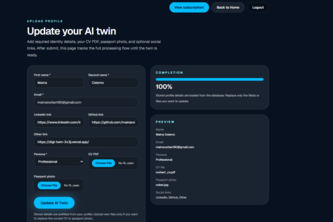
The description states that Chat Me AI allows job seekers to upload a CV, photo, social links, and choose a communication persona. It then creates a shareable profile where recruiters can chat with an AI representative grounded in that candidate’s CV.
- Product function: Converts static CVs into interactive AI profiles.
- AI behavior: Answers only from available profile information; provides clear fallbacks when the CV does not contain the answer.
- Technical components:
- Next.js/TypeScript frontend
- FastAPI backend
- PostgreSQL with pgvector
- Supabase for storage and deployment
- Core pipeline:
- Text extraction from CV
- Cleaning, chunking, embedding generation
- Retrieval of profile-specific context
- Grounded AI response generation
Note: The author describes the system as a monorepo with structured documentation (e.g., AGENTS.md, PROJECT_SPEC.md), but no evidence of actual product usage or customer feedback is provided.
Positioning & Claim Evolution
The author positions Chat Me AI as a solution to the limitations of static CVs by enabling recruiters to ask questions and understand candidates beyond a document.
- Core claim: Recruiters can chat with an AI version of a candidate, grounded in their CV.
- Evolution of positioning:
- From a hackathon project to a potential tool for improving candidate-recruiter communication.
- Emphasis on privacy, grounding, and factual accuracy.
- Narrative framing: The author frames the product as a way to make candidates easier for recruiters to understand while ensuring AI never appears more certain than the evidence in the CV.
Inference: The positioning reflects an intent to improve hiring efficiency through conversational AI, but no evidence of market validation or adoption exists.
Target Customer & ICP
The author identifies two main user roles:
- Job seekers – who upload their CV and create a public AI twin.
- Recruiters / employers – who chat with the AI twin to learn more about candidates.
- ICP (Ideal Customer Profile):
- Job seekers looking for visibility in competitive markets.
- Recruiters or hiring managers seeking faster, more interactive candidate evaluation tools.
Note: No evidence of actual customer segmentation, user interviews, or feedback from either group is provided. The ICP is inferred from the author’s description.
Business Model & Pricing Evidence
The description does not include any information about pricing, monetization, or business model.
- Monetization strategy: Not evidenced.
- Pricing structure: Not evidenced.
- Revenue model: Not evidenced.
Inference: The project is described as a personal hackathon submission with no indication of commercial intent or revenue streams.
Technical & Delivery Signals
The author describes a technical stack and development process:
- Stack used:
- Frontend: Next.js, TypeScript
- Backend: FastAPI
- Database: PostgreSQL with pgvector
- Storage: Supabase
- Development approach:
- Used Codex models (gpt-5.6-luna, gpt-5.6-terra, gpt-5.6-sol) for different tasks.
- Implemented structured documentation and project planning tools.
- Key features:
- Profile-scoped retrieval
- Deterministic routing
- AI guardrails and fallback responses
- Automated tests
Note: The technical architecture is described in detail, but there is no evidence of production deployment, scalability testing, or performance metrics.
Traction & Maturity Signals
There is no evidence of traction or maturity beyond the single-person development effort:
- Customers: Not evidenced.
- Revenue: Not evidenced.
- User engagement: Not evidenced.
- Product usage: Not evidenced.
- Maturity indicators:
- No mention of user feedback, iteration cycles, or product improvements.
- No evidence of product in production or live use.
Inference: The project is at a very early stage—likely a prototype or proof-of-concept—and lacks any signs of traction or commercial viability.
Competitive Context
The description does not mention competitors or market positioning relative to other tools.
- Competitive landscape: Not evidenced.
- Differentiation: Not evidenced.
- Market overlap: Not evidenced.
Inference: While the concept aligns with AI-powered candidate profiling and chatbots in recruitment, no competitive analysis or differentiation strategy is evident from the description.
Open Questions & Risks
Several potential risks are implied by the lack of evidence:
- No traction or adoption – The project appears to be a solo effort without any sign of real-world use.
- Unproven commercial viability – No pricing, monetization, or revenue model is described.
- Technical scalability concerns – No evidence of performance testing, production deployment, or handling large-scale usage.
- Privacy and data governance risks – Though the author mentions guardrails, no formal compliance or legal framework is described.
- Lack of user feedback or iteration – The product seems to be built in isolation without external validation.
Inference: Without evidence of traction, users, or revenue, this is a high-risk, unproven concept with limited commercial potential.
Questions the description leaves open
- What is the actual use case for recruiters? Have you tested it with real hiring managers?
- How do you plan to monetize this product? Is there any pricing model or revenue path?
- Has anyone used the tool beyond yourself? Do you have feedback from job seekers or recruiters?
- What are the limitations of the current AI grounding approach, and how do you plan to scale it?
- Are there any legal or privacy implications around allowing AI to represent individuals in a hiring context?
Overall Assessment
Not evidenced.
- No evidence of traction, revenue, or customer adoption.
- The project is described as a solo hackathon submission with no indication of commercial intent or viability.
- No data on market demand, user feedback, or product-market fit exists.
- The author’s technical approach is detailed but lacks real-world validation.
Conclusion: This is a conceptually interesting idea with strong technical execution described, but it has not demonstrated any commercial traction or viability. It is not ready for investment or partnership without further evidence of market validation and user adoption.
User Stories BotA demo video on every pull request
Get a demo video on every new feature
GitHub App that watches your pull requests and records a narrated, captioned demo.
Save time on demo prep and make informed decisions faster with a video walkthrough of every new feature.
Source
Submitted to the OpenAI 2026 hackathon on Devpost. Project home on Devpost. Back to the full gallery on Devpost.
This competitive analysis was produced by top-founders.com (opens in a new tab)
Generated by a language model from this project's public Devpost page — its tagline, the author's own write-up and any built-with tags listed there — as captured in August 2026. Short quotations are the author's words. It is an opinion on the idea as a business, not on the people behind it, and it reflects the description as published then. If the project has moved on, request a correction below. The analysis is not independent research and contains no verified traction, revenue or customer data.
An independent guide by KFG International LLC — not affiliated with, endorsed by, or connected to Devpost or OpenAI.