

Archive position — measured, not model output
0 likes on Devpost
2,263 of the 7,850 archived projects have more likes, and 5,587 share exactly 0 — so this project's #2,743 place in the like-ranked listing is a tie-break inside that group, not a ranking.
Projects (log scale)
Likes on Devpost. ▲ marks this project's group.
Show the figures
| Likes | Projects | Share of archive |
|---|---|---|
| 0 | 5,587 | 71.2% |
| 1 | 1,758 | 22.4% |
| 2 | 284 | 3.6% |
| 3–4 | 132 | 1.7% |
| 5–9 | 75 | 1.0% |
| 10+ | 14 | 0.2% |
 User Stories BotA demo video on every pull request
Get a demo video on every new feature
GitHub App that watches your pull requests and records a narrated, captioned demo.
Save time on demo prep and make informed decisions faster with a video walkthrough of every new feature.
Executive Summary
What the company appears to be: Ascend is a self-reported study tool shaped like a roguelike game, built using AI-generated prerequisite skill trees for any topic entered by the user. It uses GPT-5.6 for graph and question generation, with React and TailwindCSS for frontend.
What changed: The project was submitted as a hackathon entry to the OpenAI 2026 hackathon, indicating it is in early development or prototype stage.
Single most important open question: Is there evidence of any traction, revenue, or customer adoption beyond the author's own account?
What The Product Actually Is
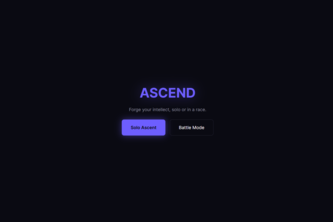
The description states that Ascend is a study tool shaped like a roguelike. It generates a live prerequisite skill tree for any topic typed in, using GPT-5.6. Users answer questions to clear nodes in the graph, with nodes locked until prerequisites are cleared. The system traces back to identify the actual shaky concept when a user fails a question. It supports solo play and battle mode where users race friends through the same generated tree.
Evidence:
- "Ascend is a study tool shaped like a roguelike"
- "Type in any topic and GPT-5.6 generates a live prerequisite skill tree for it"
- "You answer questions to clear each node. Nodes stay locked until their prerequisites are cleared"
- "If you get something wrong, Ascend traces back through the graph to find the actual concept that you find shaky"
- "You can also play it in battle mode"
Inference: The product is a gamified learning platform using AI-generated content and game mechanics.
Positioning & Claim Evolution
The author claims Ascend is a study tool shaped like a roguelike, combining gamification with AI-generated knowledge graphs. It positions itself as a way to make learning more enjoyable by turning progress into a game, similar to how Pomodoro timers or reward systems are used in other contexts.
Evidence:
- "I have always enjoyed learning new concepts, and gamifying the experience of learning helped me stay motivated long-term"
- "Combining this with my love for the game skribbl, I was inspired to create a graph-based knowledge game where you can play solo or even battle it out with friends"
Inference: The positioning evolved from personal motivation (gamification) to a product that uses AI and game mechanics to structure learning.
Target Customer & ICP
The description does not explicitly state the target customer or ideal customer profile (ICP). It implies a general audience interested in learning, particularly those who enjoy gamified experiences. The mention of battle mode suggests a social aspect that may appeal to younger users or students.
Evidence:
- "I have always enjoyed learning new concepts"
- "You can play it in battle mode. Share a room link and race a friend through the same generated tree"
Inference: The target customer likely includes students, lifelong learners, and individuals who enjoy gamified learning experiences.
Business Model & Pricing Evidence
There is no evidence of any business model or pricing structure in the description. The project is described as a hackathon submission with no mention of monetization or revenue streams.
Evidence:
- No mention of pricing, subscriptions, or monetization
- "This project was submitted to the OpenAI 2026 hackathon"
Inference: The business model remains unknown and unreported.
Technical & Delivery Signals
The author built Ascend using GPT-5.6 (via OpenAI structured outputs), React with TailwindCSS for frontend, and Codex for scaffolding and debugging. It uses dagre and ReactFlow for graph rendering and integrates AI into core gameplay rather than as a chatbot.
Evidence:
- "I built it using GPT-5.6 (via OpenAI structured outputs) for graph and question generation"
- "I used React along with tailwindCSS for the frontend"
- "I used dagre and ReactFlow for graph rendering"
- "Codex for scaffolding, feature implementation, and debugging real integration issues"
Inference: The technical stack indicates a modern web-based application with AI integration.
Traction & Maturity Signals
There is no evidence of traction or maturity beyond the author's own account. It was submitted to a hackathon and delivered within a week. No data on users, customers, or adoption is provided.
Evidence:
- "Delivering this project within a week"
- "This project was submitted to the OpenAI 2026 hackathon"
- "No revenue, customer or traction data is available beyond what they state"
Inference: The product is in early development and lacks any measurable traction or user base.
Competitive Context
The description does not provide information about competitors. It focuses on the unique features of Ascend such as AI-generated prerequisite skill trees and gamified learning, but no comparison to existing platforms is made.
Evidence:
- No mention of competitors
- "Building an AI-generated knowledge graph instead of relying on static course content"
Inference: The competitive landscape is unknown based on the provided information.
Open Questions & Risks
Key risks include:
- Lack of verified traction or revenue.
- Unclear business model and monetization strategy.
- Heavy reliance on AI (GPT-5.6) which may not be scalable or reliable.
- Prototype nature of the product, delivered in a hackathon setting.
Evidence:
- "No revenue, customer or traction data is available beyond what they state"
- "This project was submitted to the OpenAI 2026 hackathon"
- "Delivering this project within a week"
Inference: The lack of verified data and business model raises significant concerns about viability.
Questions the description leaves open
- What is the current state of the product beyond the hackathon prototype?
- Are there any plans for monetization or revenue generation?
- How does Ascend differentiate itself from existing learning platforms?
- What are the technical limitations or scalability concerns with GPT-5.6 integration?
- Is there any user feedback or testing data available?
Overall Assessment
Not evidenced.
Evidence:
- No financials, traction, or customer data
- The project is described as a hackathon submission
- No indication of investment interest or partnership potential
Inference: Without verified data on traction, revenue, or business model, it's not possible to assess investment or partnership viability.
User Stories BotA demo video on every pull request
Get a demo video on every new feature
GitHub App that watches your pull requests and records a narrated, captioned demo.
Save time on demo prep and make informed decisions faster with a video walkthrough of every new feature.
Source
Submitted to the OpenAI 2026 hackathon on Devpost. Project home on Devpost. Back to the full gallery on Devpost.
This competitive analysis was produced by top-founders.com (opens in a new tab)
Generated by a language model from this project's public Devpost page — its tagline, the author's own write-up and any built-with tags listed there — as captured in August 2026. Short quotations are the author's words. It is an opinion on the idea as a business, not on the people behind it, and it reflects the description as published then. If the project has moved on, request a correction below. The analysis is not independent research and contains no verified traction, revenue or customer data.
An independent guide by KFG International LLC — not affiliated with, endorsed by, or connected to Devpost or OpenAI.