

Archive position — measured, not model output
0 likes on Devpost
2,263 of the 7,850 archived projects have more likes, and 5,587 share exactly 0 — so this project's #6,669 place in the like-ranked listing is a tie-break inside that group, not a ranking.
Projects (log scale)
Likes on Devpost. ▲ marks this project's group.
Show the figures
| Likes | Projects | Share of archive |
|---|---|---|
| 0 | 5,587 | 71.2% |
| 1 | 1,758 | 22.4% |
| 2 | 284 | 3.6% |
| 3–4 | 132 | 1.7% |
| 5–9 | 75 | 1.0% |
| 10+ | 14 | 0.2% |
 User Stories BotA demo video on every pull request
Get a demo video on every new feature
GitHub App that watches your pull requests and records a narrated, captioned demo.
Save time on demo prep and make informed decisions faster with a video walkthrough of every new feature.
Executive Summary
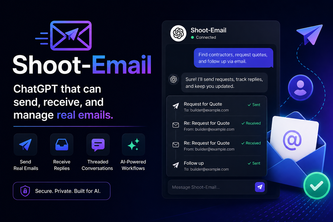
What the company appears to be: Shoot-email is a developer tool that provides an AI agent with a persistent email inbox interface, enabling it to send and receive text messages through a structured MCP (Model Communication Protocol) interface. It was submitted as part of the OpenAI 2026 hackathon.
What changed: The project description indicates this was an extension built during a hackathon period, adding functionality to a pre-existing baseline codebase. It introduces email operations designed for probabilistic callers, with features like idempotent outbound sends and explicit trust labeling for inbound messages.
The single most important open question: Is there any evidence of real-world usage or integration beyond the demo environment? The description states that the project exists in a judge sandbox environment with no local rebuild required, but does not indicate whether it has been adopted by users or integrated into production systems.
What The Product Actually Is
- The description states that Shoot-email gives ChatGPT a real email inbox
- It allows AI agents to send and receive text messages through a structured MCP interface
- The system assigns an agent a stable mailbox identity
- It exposes ten MCP tools for:
- Initializing the mailbox
- Inspecting identity and service state
- Sending text email
- Retrieving pending messages
- Reading individual messages
- Acknowledging completed work
- Inspecting processed history
- Checking outbound delivery state
- The system uses Cloudflare Email Routing, Cloudflare Workers, Neon Postgres through Hyperdrive, and PostgreSQL for storage
- It implements idempotent inbound ingestion and outbound send behavior
- The project is described as a "persistent email inbox built for AI agents"
Positioning & Claim Evolution
- The description states that current AI assistants can read connected email and help draft responses, but many workflows stop at the draft
- The product positions itself as exploring what email would look like if designed from the ground up for AI agents rather than around a human inbox interface
- It claims to make email a durable capability that an agent can operate safely, not merely a source of text it can summarize
- The project is described as being built for "LLM-first" operations with specific design principles:
- Inbox retrieval returns bounded batches with complete message text
- Retrieval never silently marks messages handled
- Inbound email is explicitly labeled as untrusted external data
- Outbound sends require caller-generated idempotency keys
- The description indicates this was a hackathon submission, suggesting it's in early development
Target Customer & ICP
- Not evidenced. The description does not specify target customers or ideal customer profiles.
- The project is described as being built for AI agents, but no specific user personas or segments are mentioned.
Business Model & Pricing Evidence
- Not evidenced. There is no information provided about pricing models, revenue streams, or business model details.
- The description indicates this was a hackathon submission with no mention of commercialization plans.
Technical & Delivery Signals
- Built with: Cloudflare, Codex, MCP, Node.js, PostgreSQL
- Uses Cloudflare Email Routing and Workers for real inbound messages
- Runs on Cloudflare Workers reaching Neon Postgres through Hyperdrive
- PostgreSQL stores users, external identities, sessions, messages, delivery state, abuse-control state, and future pgvector embeddings
- Real outbound delivery uses Cloudflare Email Sending
- Implements a CLI and MCP adapter with one Node.js service layer and versioned contract
- Has 49 automated unit and database-backed integration tests
- The system separates retrieval from acknowledgement
- Persists outbound requests before provider calls
- Returns unknown status for ambiguous provider outcomes
- Never accepts identity or mail headers as ordinary tool arguments
- Uses a restricted bearer principal for remote identity in demo environment
Traction & Maturity Signals
- Not evidenced. There is no evidence of revenue, customers, or adoption beyond the demo environment.
- The project exists in a judge sandbox environment with no local rebuild required
- The description indicates it was submitted to a hackathon and existed before the hackathon period
- No information about user growth, engagement metrics, or product usage data
Competitive Context
- Not evidenced. There is no mention of competitors or competitive landscape.
- The description does not provide any information about existing solutions in this space.
Open Questions & Risks
- The project appears to be a hackathon submission with no evidence of commercial traction
- The demo environment uses synthetic addresses and simulated outbound delivery, suggesting limited real-world testing
- No evidence of production deployment or integration with actual email providers beyond Cloudflare
- The system relies on a temporary judge bearer transport for authentication, with OAuth 2.1 planned for later milestones
- No information about scalability, security, or performance in production environments
- The project is described as existing before the hackathon but only the extension was built during it
Questions the description leaves open
- What is the timeline for moving from this demo environment to production deployment?
- How does the system handle edge cases like email provider outages or rate limiting?
- What are the specific security measures in place for handling untrusted external data?
- Are there any plans for integrating with major email providers beyond Cloudflare?
- What is the current status of OAuth 2.1 implementation for authentication?
- How does the system handle message threading and conversation continuity?
- What are the technical limitations or constraints that prevent wider adoption?
- Is there any plan to monetize this tool or integrate it into commercial products?
Overall Assessment
- Not evidenced. There is no information provided about investment status, partnership opportunities, or commercial viability.
- The project appears to be in early development stage as a hackathon submission
- No evidence of revenue generation, customer adoption, or market traction
- The description indicates this was built for a specific hackathon event with no mention of ongoing commercial development
User Stories BotA demo video on every pull request
Get a demo video on every new feature
GitHub App that watches your pull requests and records a narrated, captioned demo.
Save time on demo prep and make informed decisions faster with a video walkthrough of every new feature.
Source
Submitted to the OpenAI 2026 hackathon on Devpost. Project home on Devpost. Back to the full gallery on Devpost.
This competitive analysis was produced by top-founders.com (opens in a new tab)
Generated by a language model from this project's public Devpost page — its tagline, the author's own write-up and any built-with tags listed there — as captured in August 2026. Short quotations are the author's words. It is an opinion on the idea as a business, not on the people behind it, and it reflects the description as published then. If the project has moved on, request a correction below. The analysis is not independent research and contains no verified traction, revenue or customer data.
An independent guide by KFG International LLC — not affiliated with, endorsed by, or connected to Devpost or OpenAI.