

Archive position — measured, not model output
0 likes on Devpost
2,263 of the 7,850 archived projects have more likes, and 5,587 share exactly 0 — so this project's #4,706 place in the like-ranked listing is a tie-break inside that group, not a ranking.
Projects (log scale)
Likes on Devpost. ▲ marks this project's group.
Show the figures
| Likes | Projects | Share of archive |
|---|---|---|
| 0 | 5,587 | 71.2% |
| 1 | 1,758 | 22.4% |
| 2 | 284 | 3.6% |
| 3–4 | 132 | 1.7% |
| 5–9 | 75 | 1.0% |
| 10+ | 14 | 0.2% |
 User Stories BotA demo video on every pull request
Get a demo video on every new feature
GitHub App that watches your pull requests and records a narrated, captioned demo.
Save time on demo prep and make informed decisions faster with a video walkthrough of every new feature.
Executive Summary
What the company appears to be
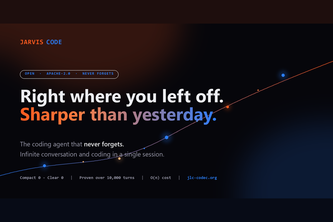
JARVIS CODE is a self-reported coding agent that claims to never forget — by archiving tool outputs byte-for-byte and enabling models to retrieve them on demand, rather than resending full context. It is described as an experimental project submitted to the OpenAI 2026 hackathon.
What changed
The description does not indicate any change from prior versions or a transition from concept to product; it presents a single, self-contained write-up of a hackathon submission.
Single most important open question
Is there evidence that this approach works at scale, or is it limited to controlled benchmarks and small experiments?
What The Product Actually Is
The description states that JARVIS CODE is a coding agent built using AI models (GPT-5.5, GPT-5.6), Node.js, TypeScript, and tools like OpenAI Codex, Ollama, and Vitest. It uses an architecture where tool outputs are archived with SHA-256 hashes and retrieved on demand instead of re-sending full context.
Inference The product appears to be a proof-of-concept or prototype, not a commercial offering. The author emphasizes that it was built for a hackathon, and no revenue, customer data, or deployment details are provided.
Positioning & Claim Evolution
The description claims JARVIS CODE is a coding agent that never forgets — a counterpoint to standard agents that "die mid-task" due to context overflow. It positions itself as solving the problem of contextual memory in long-running AI loops, using a novel archival approach.
Inference This is a self-reported positioning and not validated by external metrics or user feedback. The project is described as experimental, with no indication of commercial traction or adoption.
Target Customer & ICP
The description does not identify specific customer segments or personas. It implies the product targets developers working with AI agents in long-running coding tasks, particularly those who encounter context overflow issues.
Inference The target appears to be AI-assisted developers, especially those building complex systems like Minecraft clones or polyglot codebases, but no explicit ICP is stated.
Business Model & Pricing Evidence
No business model or pricing information is provided. The project is described as a hackathon submission with open-source code (Apache-2.0), a paper on Zenodo, and a public website — none of which suggest monetization.
Inference There is no evidence of a commercial business model or pricing strategy. The project is self-described as experimental and open-source.
Technical & Delivery Signals
The description states that JARVIS CODE uses:
- GPT-5.5 and GPT-5.6
- Node.js, TypeScript
- OpenAI Codex, Ollama, Vitest
- SHA-256-based archival of tool outputs
- Aider Polyglot benchmark (Python track) scoring 34/34
It also mentions:
- A stress test with token usage: standard agent used 73k tokens vs. JARVIS CODE at 13k
- An overflow case where a baseline agent hit 980K tokens and died, while JARVIS CODE continued
- 2,075 tests for validation
Inference The technical approach is conceptually sound, but the description does not provide evidence of production-grade delivery or scalability beyond benchmarking.
Traction & Maturity Signals
There is no evidence of traction, customers, revenue, or adoption. The project is described as a hackathon submission with open-source code and a paper, but no data on usage, performance in real-world settings, or user feedback is provided.
Inference No maturity signals are evident. It remains an experimental prototype, not a product in use.
Competitive Context
The description does not mention competitors or the broader market landscape. It focuses on solving a specific problem — context overflow in AI agents — but does not position itself against existing tools or platforms in that space.
Inference No competitive positioning is evident. The project is described as novel, but no comparison to existing solutions is made.
Open Questions & Risks
- Unproven at scale: The description admits the approach still shows re-reads and has not fully solved the quadratic cost problem.
- Experimental nature: It’s a hackathon submission with no commercial traction or product-market fit evidence.
- No validation beyond benchmarks: Performance is shown in controlled tests but not in real-world usage.
- Self-reported metrics: All performance claims are from the author's own testing, without independent verification.
Inference This is a highly speculative project, with no demonstrated ability to scale or deliver consistent results outside of controlled environments.
Questions the description leaves open
- What real-world use cases have you tested this in? Are there any production deployments?
- How does the archival approach handle large-scale codebases and multi-agent workflows?
- Can you demonstrate performance improvements beyond the benchmarks mentioned?
- Is there a plan to monetize or commercialize this technology?
- What are the limitations of the current architecture, especially around re-reads and memory management?
Overall Assessment
Not evidenced.
The project is described as a hackathon submission, with no evidence of revenue, customers, traction, or commercial viability. It presents an interesting technical idea but lacks any signal of product-market fit or scalability.
Confidence: Low.
This is a self-reported, unverified description of a prototype with no external validation or commercial data. The approach may be innovative, but it is not yet a product or business.
User Stories BotA demo video on every pull request
Get a demo video on every new feature
GitHub App that watches your pull requests and records a narrated, captioned demo.
Save time on demo prep and make informed decisions faster with a video walkthrough of every new feature.
Source
Submitted to the OpenAI 2026 hackathon on Devpost. Project home on Devpost. Back to the full gallery on Devpost.
This competitive analysis was produced by top-founders.com (opens in a new tab)
Generated by a language model from this project's public Devpost page — its tagline, the author's own write-up and any built-with tags listed there — as captured in August 2026. Short quotations are the author's words. It is an opinion on the idea as a business, not on the people behind it, and it reflects the description as published then. If the project has moved on, request a correction below. The analysis is not independent research and contains no verified traction, revenue or customer data.
An independent guide by KFG International LLC — not affiliated with, endorsed by, or connected to Devpost or OpenAI.