

Archive position — measured, not model output
0 likes on Devpost
2,263 of the 7,850 archived projects have more likes, and 5,587 share exactly 0 — so this project's #3,192 place in the like-ranked listing is a tie-break inside that group, not a ranking.
Projects (log scale)
Likes on Devpost. ▲ marks this project's group.
Show the figures
| Likes | Projects | Share of archive |
|---|---|---|
| 0 | 5,587 | 71.2% |
| 1 | 1,758 | 22.4% |
| 2 | 284 | 3.6% |
| 3–4 | 132 | 1.7% |
| 5–9 | 75 | 1.0% |
| 10+ | 14 | 0.2% |
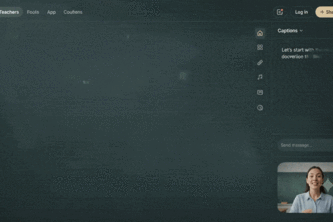
 User Stories BotA demo video on every pull request
Get a demo video on every new feature
GitHub App that watches your pull requests and records a narrated, captioned demo.
Save time on demo prep and make informed decisions faster with a video walkthrough of every new feature.
Executive Summary
What the company appears to be: Chalk is a self-reported AI-powered live teaching board for educators, built by a single developer (Ahadi Cyizere). The product enables teachers to speak while an AI (GPT-5.6) draws concept maps in real time, with gesture-based node selection and edge creation. It also generates replay videos and AI-written handouts for students.
What changed: The project is described as a self-contained hackathon submission built over six phases using structured prompts, Codex, and a decision log. It was submitted to the OpenAI 2026 hackathon.
Single most important open question: Is there any evidence of actual usage or traction beyond the author's own testing and development?
What The Product Actually Is
The description states that Chalk is a live teaching board for teachers, where:
- A teacher speaks, and GPT-5.6 listens and draws concept maps in real time.
- Nodes, labeled edges, layout, and corrections are generated from speech.
- Teachers can point at nodes using hand tracking (MediaPipe) and say “connect these two” to create edges.
- At the end of a lesson, students receive:
- A replay that rebuilds the diagram step by step.
- An AI-written handout with recap, glossary, and comprehension questions.
The core technical architecture includes:
- GPT-5.6 via OpenAI Responses API for structured outputs (add_node, add_edge, etc.)
- React Flow + elkjs for canvas rendering
- MediaPipe for hand tracking
- Web Speech API for speech input
- Remotion for demo video generation
Inference: The product is a prototype built in a hackathon setting, not a commercial offering.
Positioning & Claim Evolution
The author states that the idea was inspired by online tools where people draw in the air during meetings but notes that those tools are "dumb" — they don’t automate drawing and disappear after use. The author flipped the roles: let AI draw while human explains, and let hands point.
Claim: Chalk is a live board for teachers that draws itself using speech and gestures.
Inference: This is a self-reported positioning claim, not validated by market feedback or adoption.
Target Customer & ICP
The author states that the tool is intended for:
- Teachers, particularly in tutoring calls and remote classrooms.
- The goal is to reduce repetition in instruction where teachers must explain concepts twice — once verbally and once visually.
Inference: The target customer is a teacher or tutor using remote learning environments, but no evidence of actual customers or usage exists.
Business Model & Pricing Evidence
Not evidenced. The description does not mention any pricing model, monetization strategy, or business model.
Technical & Delivery Signals
The author reports:
- A full spec was written before coding began.
- Git history starts with SPEC.md.
- Six development phases with acceptance criteria tested by the author.
- Decision log tracked Codex vs. human decisions.
- Core contract: GPT-5.6 returns structured diagram operations.
- Speech input from Web Speech API, hand tracking via MediaPipe.
- Replay and handout generation handled by second GPT call.
Inference: The project shows strong technical execution for a prototype but lacks evidence of scalability or production deployment.
Traction & Maturity Signals
Not evidenced. There is no mention of:
- Customers
- Revenue
- Usage metrics
- Product adoption
- Market feedback
The only signal of maturity is that it was submitted to a hackathon and completed in six phases, but this does not imply traction or commercial viability.
Competitive Context
Not evidenced. No information about competitors, market size, or competitive positioning is provided.
Open Questions & Risks
- Single-person team: Only one developer (Ahadi Cyizere) built the entire product.
- Unverified claims: The description is self-reported and unverified; no third-party validation.
- No traction or revenue: No evidence of customers, usage, or monetization.
- Hackathon prototype: Likely a proof-of-concept, not a scalable product.
- High dependency on GPT-5.6: No indication of how the system would function without this model or if it’s production-ready.
Questions the description leaves open
- What is your plan for scaling beyond a single developer?
- Have you tested this with real teachers or students? If so, what feedback did you get?
- How do you intend to monetize the product?
- Are there any technical limitations of GPT-5.6 that could affect performance in real-world use?
- What are your plans for improving accuracy beyond browser-based speech recognition?
Overall Assessment
Not evidenced. There is no evidence of:
- Revenue
- Customers
- Product-market fit
- Commercial traction
- Funding or valuation
This appears to be a self-reported hackathon prototype with strong technical execution but no commercial signals.
Confidence: Low — based entirely on self-reporting and not independently verified.
User Stories BotA demo video on every pull request
Get a demo video on every new feature
GitHub App that watches your pull requests and records a narrated, captioned demo.
Save time on demo prep and make informed decisions faster with a video walkthrough of every new feature.
Source
Submitted to the OpenAI 2026 hackathon on Devpost. Project home on Devpost. Back to the full gallery on Devpost.
This competitive analysis was produced by top-founders.com (opens in a new tab)
Generated by a language model from this project's public Devpost page — its tagline, the author's own write-up and any built-with tags listed there — as captured in August 2026. Short quotations are the author's words. It is an opinion on the idea as a business, not on the people behind it, and it reflects the description as published then. If the project has moved on, request a correction below. The analysis is not independent research and contains no verified traction, revenue or customer data.
An independent guide by KFG International LLC — not affiliated with, endorsed by, or connected to Devpost or OpenAI.