

Archive position — measured, not model output
0 likes on Devpost
2,263 of the 7,850 archived projects have more likes, and 5,587 share exactly 0 — so this project's #3,163 place in the like-ranked listing is a tie-break inside that group, not a ranking.
Projects (log scale)
Likes on Devpost. ▲ marks this project's group.
Show the figures
| Likes | Projects | Share of archive |
|---|---|---|
| 0 | 5,587 | 71.2% |
| 1 | 1,758 | 22.4% |
| 2 | 284 | 3.6% |
| 3–4 | 132 | 1.7% |
| 5–9 | 75 | 1.0% |
| 10+ | 14 | 0.2% |
 User Stories BotA demo video on every pull request
Get a demo video on every new feature
GitHub App that watches your pull requests and records a narrated, captioned demo.
Save time on demo prep and make informed decisions faster with a video walkthrough of every new feature.
Executive Summary
What the company appears to be
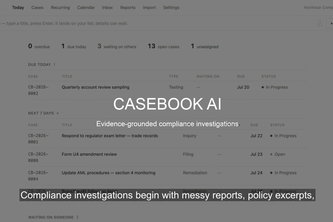
Casebook AI is a local-first, compliance-focused case management tool that integrates AI assistance into regulated investigations. The author states it is built as a portable Go application with an embedded UI and SQLite database. It uses GPT-5.6-sol for structured AI output in support of human decision-making, with strict controls to ensure auditability, provenance, and human oversight.
What changed
The project was initially a local case-management tool for small compliance teams. During OpenAI Build Week, it was extended with an AI workflow that addresses the most difficult part of an investigation—generating structured, sourced summaries without replacing human judgment. The extension includes safeguards like exact-quote grounding and explicit user submission.
Single most important open question
Is there a market need for this specific type of AI-assisted compliance case management, or is it a niche solution that may not scale beyond the author’s own use case?
What The Product Actually Is
The description states:
- Casebook AI is a local-first application built in Go with an embedded HTML/CSS/JavaScript interface and SQLite database.
- It supports compliance investigations, where users paste reports, policies, and evidence into a case.
- An AI model (GPT-5.6-sol) generates a structured brief including allegations, timeline, policy matches, gaps, risk flags, and recommended actions.
- Each factual claim includes a source quote that is independently verified against the submitted text.
- The system enforces human review of all AI-generated items; no silent edits or final determinations are made by the model.
- All decisions and actions are appended to an audit trail and can be tracked in checklist format.
This is a structured, human-controlled AI workflow tool for regulated environments, not a general-purpose AI assistant or document summarizer.
Positioning & Claim Evolution
The description states:
- The product was originally built as a local case-management tool for small compliance teams.
- It was extended during OpenAI Build Week to include AI assistance that focuses on the hardest part of an investigation—generating structured, sourced summaries without pretending the model is the decision-maker.
- The author emphasizes that the AI output is operational, not decorative: accepted actions become trackable work items.
- The core value proposition is human control and auditability, not automation or speed.
Inference The positioning has evolved from a simple local tool to a human-in-the-loop AI workflow tailored for compliance environments, with an emphasis on trust, transparency, and defensibility.
Target Customer & ICP
The description states:
- The product is designed for small compliance teams, who are likely working in regulated industries such as finance, healthcare, or legal.
- It supports compliance investigations that involve messy data, deadlines, and need for audit trails.
- The author notes that the tool was built for a specific use case: “a reviewer may receive a report, policy passages, email excerpts, a partial system export, and a deadline.”
Inference The ICP likely includes compliance officers, legal investigators, or auditors in regulated industries who need to manage complex, evidence-based investigations with strict provenance requirements.
Business Model & Pricing Evidence
Not evidenced.
The description does not mention any pricing model, monetization strategy, or business model. It only describes the tool’s functionality and design principles.
Technical & Delivery Signals
The description states:
- The application is built in Go, with embedded HTML/CSS/JavaScript UI and a local SQLite database.
- It uses the OpenAI Responses API with GPT-5.6-sol, strict JSON Schema output, and input limits.
- Safeguards include:
- Explicit user submission notice
store: false- Input limits and SHA-256 packet fingerprinting
- Per-user hashed safety identifier
- Exact-quote grounding post-generation
- Owner/coverer permission checks
- Immutable, idempotent review decisions
- Append-only provenance events
- A deterministic synthetic fixture allows testing without an API key.
Inference The tool is designed with privacy and auditability as core principles. It uses a local-first architecture, which suggests it may be suitable for environments where data sovereignty is critical.
Traction & Maturity Signals
Not evidenced.
There is no mention of customers, revenue, usage metrics, or adoption data. The description only details the tool’s design and functionality.
Competitive Context
Not evidenced.
The description does not reference any competitors or market landscape. It does not describe how Casebook AI compares to existing tools in compliance case management or AI-assisted investigation platforms.
Open Questions & Risks
- Single-person team: The project is built by one person (1/10th of a typical M&A due diligence team).
- No traction or customers: No evidence of revenue, users, or adoption beyond the author’s own use case.
- Niche application: The tool is tailored for compliance investigations in regulated environments—this may limit its scalability or market size.
- AI model dependency: Reliance on GPT-5.6-sol and OpenAI API introduces risk of API availability, cost, or model changes.
- Local-first architecture: While privacy-focused, this may limit enterprise adoption unless a cloud version is planned.
Questions the description leaves open
- What specific compliance industries or use cases are you targeting?
- How do you plan to scale beyond a single developer and local-first architecture?
- Are there any existing customers or pilot users of the tool?
- What is your roadmap for enterprise features like authentication, TLS, role-based access control, and encryption?
- How do you intend to monetize this product, if at all?
- What are the technical challenges in moving from a local-first model to a cloud-hosted version?
- Are there any regulatory or compliance concerns around AI use in your target domain that could affect adoption?
Overall Assessment
Not evidenced.
There is no information on valuation, funding rounds, or investment interest. The description does not indicate whether the project is seeking investment or partnership.
Confidence level Low. This is a self-reported, unverified description of a tool built by one person for a niche use case. No evidence of traction, revenue, or market validation exists. The product shows strong design principles around privacy and auditability but lacks commercial signals.
User Stories BotA demo video on every pull request
Get a demo video on every new feature
GitHub App that watches your pull requests and records a narrated, captioned demo.
Save time on demo prep and make informed decisions faster with a video walkthrough of every new feature.
Source
Submitted to the OpenAI 2026 hackathon on Devpost. Project home on Devpost. Back to the full gallery on Devpost.
This competitive analysis was produced by top-founders.com (opens in a new tab)
Generated by a language model from this project's public Devpost page — its tagline, the author's own write-up and any built-with tags listed there — as captured in August 2026. Short quotations are the author's words. It is an opinion on the idea as a business, not on the people behind it, and it reflects the description as published then. If the project has moved on, request a correction below. The analysis is not independent research and contains no verified traction, revenue or customer data.
An independent guide by KFG International LLC — not affiliated with, endorsed by, or connected to Devpost or OpenAI.