

Archive position — measured, not model output
0 likes on Devpost
2,263 of the 7,850 archived projects have more likes, and 5,587 share exactly 0 — so this project's #3,165 place in the like-ranked listing is a tie-break inside that group, not a ranking.
Projects (log scale)
Likes on Devpost. ▲ marks this project's group.
Show the figures
| Likes | Projects | Share of archive |
|---|---|---|
| 0 | 5,587 | 71.2% |
| 1 | 1,758 | 22.4% |
| 2 | 284 | 3.6% |
| 3–4 | 132 | 1.7% |
| 5–9 | 75 | 1.0% |
| 10+ | 14 | 0.2% |
 User Stories BotA demo video on every pull request
Get a demo video on every new feature
GitHub App that watches your pull requests and records a narrated, captioned demo.
Save time on demo prep and make informed decisions faster with a video walkthrough of every new feature.
Executive Summary
What the company appears to be
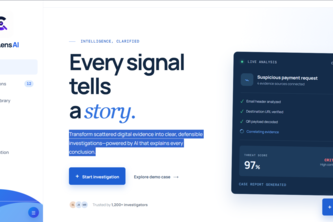
CaseLens AI is a self-reported AI-powered tool for managing digital evidence in investigations, with an emphasis on clarity and defensibility. It is presented as a solution that uses AI to explain conclusions drawn from scattered digital data.
What changed
The project was submitted to the OpenAI 2026 hackathon, indicating it is early-stage or experimental. No prior traction, revenue, or customer evidence is provided.
Single most important open question
Is there any indication of a viable market need for this product, or has the team merely described an idea without demonstrating demand?
Analysis basis
The entire analysis is based on the self-reported project description supplied by the caller. No external verification or historical data are available. All claims are unverified and must be treated as stated by the author.
What The Product Actually Is
The description states that CaseLens AI “transforms scattered digital evidence into clear, defensible investigations—powered by AI that explains every conclusion.” This suggests a product focused on processing and organizing digital evidence using artificial intelligence to produce structured, explainable outputs for investigative purposes.
However, the project is described as a hackathon submission (submitted to the OpenAI 2026 hackathon), which implies it may be in an early prototype or conceptual phase. There is no evidence of a functioning product, user interface, or technical implementation beyond the declared tech stack.
Evidence
- The author states: “Transform scattered digital evidence into clear, defensible investigations—powered by AI that explains every conclusion.”
- The project was submitted to a hackathon, suggesting early-stage development.
- Declared tech stack includes codex, css3, flask, html5, javascript, supabase.
Not evidenced
- No functional product or working prototype is described.
- No evidence of actual use cases or customer feedback.
Positioning & Claim Evolution
The tagline and description position CaseLens AI as a tool that helps investigators make sense of digital evidence using AI. The emphasis on “defensible” and “explains every conclusion” suggests a focus on transparency, accountability, and legal or forensic utility.
There is no indication of prior positioning or evolution in claims beyond the single self-reported statement from the hackathon submission.
Evidence
- Tagline: “Transform scattered digital evidence into clear, defensible investigations—powered by AI that explains every conclusion.”
- The project was submitted to a hackathon, implying it is an idea or early-stage prototype.
Inferred
- The product may be targeting legal, forensic, or compliance teams who need structured analysis of digital data.
Not evidenced
- No prior versions or claim evolution documented.
- No evidence of market positioning or competitive differentiation beyond the tagline.
Target Customer & ICP
The description does not identify a specific customer segment or ideal customer profile (ICP). The focus on “digital evidence” and “investigations” suggests potential use in legal, law enforcement, compliance, or forensic domains. However, no explicit target audience is named.
Evidence
- The author states: “Transform scattered digital evidence into clear, defensible investigations.”
Inferred
- Likely targets users who work with digital data in investigative or legal contexts.
Not evidenced
- No customer personas, use cases, or market segments identified.
- No indication of whether the team has spoken to potential customers or validated demand.
Business Model & Pricing Evidence
There is no evidence of a business model or pricing structure described by the author. The project is presented as a hackathon submission with no mention of monetization, licensing, or customer acquisition strategies.
Evidence
- No mention of revenue, pricing, or monetization strategy.
Not evidenced
- No indication of how the product would be sold or who would pay for it.
- No evidence of a go-to-market plan or sales model.
Technical & Delivery Signals
The project is declared to have been built using: codex, css3, flask, html5, javascript, supabase. These technologies suggest a web-based application with backend support and possibly AI integration (via codex). However, the description does not indicate how or if these tools are used in practice.
Evidence
- Declared tech stack: codex, css3, flask, html5, javascript, supabase.
Not evidenced
- No evidence of actual delivery, architecture, or technical performance.
- No indication of AI integration beyond the use of codex.
Traction & Maturity Signals
There is no evidence of traction, adoption, or maturity. The project is described as a hackathon submission and has no evidence of users, revenue, partnerships, or growth metrics.
Evidence
- Submitted to OpenAI 2026 hackathon.
- Team size: 1.
Not evidenced
- No customers, usage data, or product traction.
- No evidence of a product in development or production.
Competitive Context
No competitive landscape is described. The author does not mention existing tools or platforms that address similar problems, nor does the project description provide any indication of how CaseLens AI compares to others in the market.
Evidence
- No mention of competitors or market positioning.
Not evidenced
- No evidence of a competitive analysis or differentiation strategy.
- No indication of whether similar tools already exist.
Open Questions & Risks
Key risks and open questions include:
- Early-stage prototype: The project is described as a hackathon submission, suggesting it may be unproven or experimental.
- Single founder: With only one team member, the ability to scale or execute is uncertain.
- Lack of traction or validation: No evidence of customers, revenue, or product adoption.
- Unverified claims: The description lacks any demonstration of functionality or results.
Inferred
- The lack of a clear business model and pricing structure raises questions about monetization.
- The absence of a competitive analysis suggests the team may not have validated market demand.
Questions the description leaves open
- What specific use cases are you targeting, and how do you know there is demand for this?
- How does your AI explain conclusions? Is it rule-based, machine learning-driven, or a hybrid approach?
- Have you spoken to potential customers or legal professionals who might use this tool?
- What is the plan for scaling beyond a hackathon prototype?
- Are there any existing tools in this space that you are aware of, and how do you differentiate from them?
Overall Assessment
At this stage, CaseLens AI appears to be an early-stage idea or prototype submitted as part of a hackathon. There is no evidence of traction, revenue, customer validation, or a clear business model. The project lacks sufficient information to assess its viability for investment or partnership.
Inferred
- This may be a promising concept with potential, but it requires further development and market validation before any strategic move can be made.
Not evidenced
- No evidence of product-market fit, customer traction, or financials.
- No indication of whether the team has progressed beyond the prototype stage.
User Stories BotA demo video on every pull request
Get a demo video on every new feature
GitHub App that watches your pull requests and records a narrated, captioned demo.
Save time on demo prep and make informed decisions faster with a video walkthrough of every new feature.
Source
Submitted to the OpenAI 2026 hackathon on Devpost. Project home on Devpost. Back to the full gallery on Devpost.
This competitive analysis was produced by top-founders.com (opens in a new tab)
Generated by a language model from this project's public Devpost page — its tagline and any built-with tags listed there, since the author published no write-up — as captured in August 2026. Short quotations are the author's words. It is an opinion on the idea as a business, not on the people behind it, and it reflects the description as published then. If the project has moved on, request a correction below. The analysis is not independent research and contains no verified traction, revenue or customer data.
An independent guide by KFG International LLC — not affiliated with, endorsed by, or connected to Devpost or OpenAI.