

Archive position — measured, not model output
0 likes on Devpost
2,263 of the 7,850 archived projects have more likes, and 5,587 share exactly 0 — so this project's #3,153 place in the like-ranked listing is a tie-break inside that group, not a ranking.
Projects (log scale)
Likes on Devpost. ▲ marks this project's group.
Show the figures
| Likes | Projects | Share of archive |
|---|---|---|
| 0 | 5,587 | 71.2% |
| 1 | 1,758 | 22.4% |
| 2 | 284 | 3.6% |
| 3–4 | 132 | 1.7% |
| 5–9 | 75 | 1.0% |
| 10+ | 14 | 0.2% |
 User Stories BotA demo video on every pull request
Get a demo video on every new feature
GitHub App that watches your pull requests and records a narrated, captioned demo.
Save time on demo prep and make informed decisions faster with a video walkthrough of every new feature.
Executive Summary
Company: Carrie Notes
Self-reported basis: The description provided by the author — unverified, self-reported, and without any independent corroboration.
Commercial due-diligence read: This is a hackathon project that claims to solve information handover challenges in pet care through AI-powered structured profiles and chat-based Q&A. It is not evidenced to have traction, revenue, customers or adoption. The author states the product works end-to-end but does not provide evidence of usage or impact beyond personal testing.
Key open question: Is there any evidence that caregivers actually use this system in real-world handovers, or that pet owners adopt it at scale?
What The Product Actually Is
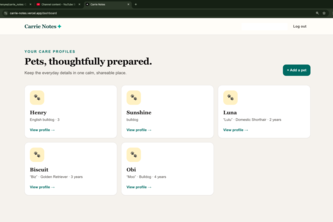
The description states that Carrie Notes is a tool for pet owners to create structured care profiles for their pets. These profiles can be built via forms, plain text, or voice notes and are automatically converted into structured fields using AI. The system allows caregivers to access these profiles through a shareable link without needing an account or app install. Caregivers can ask questions directly in the interface, and the system answers them by referencing only information provided by the owner, citing its source.
The system uses:
- Next.js 14 with TypeScript and Tailwind
- Supabase for backend (Postgres, Auth, Storage, pgvector)
- OpenAI models including gpt-4o-mini-transcribe, text-embedding-3-small, and gpt-4.1-mini
It is built to support anonymous access via a narrowly scoped security function keyed on an unguessable token.
Inference: The product appears to be a proof-of-concept or MVP for a digital care handover system, not yet validated in production use.
Positioning & Claim Evolution
The author positions Carrie Notes as solving a problem in pet care handovers — where caregivers must recreate information from scratch due to scattered communication. It claims to reduce stress and errors by centralizing structured data and enabling AI-powered Q&A.
Claim: The system automates the process of converting unstructured input into structured fields, and answers questions based on that data.
Inference: This is a self-described positioning for a niche use case (pet care handover), not yet validated in market or with users beyond the creator.
Target Customer & ICP
The description states that the product targets pet owners who need to hand over care responsibilities to others — such as family members, friends, or professional caregivers. The system is designed for caregivers who do not require an account or app installation to access information.
Inference: The target customer segment is likely pet owners with temporary or recurring caregiving needs, but no evidence of actual customers or user segments is provided.
Business Model & Pricing Evidence
There is no mention of pricing, monetization, or business model in the description. The project appears to be a hackathon submission without any indication of how it would generate revenue or scale.
Not evidenced: No information on pricing, subscriptions, or monetization strategy.
Technical & Delivery Signals
The system uses:
- Next.js 14 (App Router)
- Supabase for backend services
- OpenAI models for NLP tasks including transcription, embedding, and chat grounding
- pgvector for vector similarity search
- Security via Postgres functions with unguessable tokens to control access
Inference: The technical stack suggests a modern full-stack SaaS-like architecture built with AI tools. However, the delivery is limited to a hackathon prototype.
Traction & Maturity Signals
The author states that they personally use the system and tested retrieval quality empirically. They also mention that they have started using it, but no data on adoption, retention, or usage metrics are provided.
Not evidenced: No evidence of users, customers, or real-world usage beyond personal testing.
Competitive Context
There is no mention of competitors in the description. The author does not reference existing solutions for pet care handover or structured information sharing.
Not evidenced: No competitive landscape or differentiation analysis.
Open Questions & Risks
- Unproven market demand: No evidence of customer traction or real-world usage.
- Limited scope: The system is built for one caregiver per profile, with no multi-user support yet.
- AI reliability concerns: The author notes that the AI chat was unreliable initially and required tuning to improve grounding.
- Security model: While designed to be secure, it relies on a narrowly scoped access token mechanism — not a full authentication system.
- Hackathon origin: The product is a hackathon submission with no indication of long-term development or commercial viability.
Questions the description leaves open
- What is the actual problem you're solving, and how many pet owners have expressed interest in this solution?
- Have you tested the system with real caregivers or pet owners beyond personal use?
- How do you plan to scale beyond one caregiver per profile?
- Is there a plan for monetization or pricing?
- What are the key technical challenges that remain unresolved before production deployment?
Overall Assessment
Not evidenced: No data on revenue, customers, traction, or scalability exists in the description.
This is a self-reported hackathon project with no evidence of commercial viability, adoption, or market validation. The author describes a working prototype but does not provide any data to support claims about real-world usage or business potential.
Confidence level: Low — based entirely on self-reporting and limited demonstration.
User Stories BotA demo video on every pull request
Get a demo video on every new feature
GitHub App that watches your pull requests and records a narrated, captioned demo.
Save time on demo prep and make informed decisions faster with a video walkthrough of every new feature.
Source
Submitted to the OpenAI 2026 hackathon on Devpost. Project home on Devpost. Back to the full gallery on Devpost.
This competitive analysis was produced by top-founders.com (opens in a new tab)
Generated by a language model from this project's public Devpost page — its tagline, the author's own write-up and any built-with tags listed there — as captured in August 2026. Short quotations are the author's words. It is an opinion on the idea as a business, not on the people behind it, and it reflects the description as published then. If the project has moved on, request a correction below. The analysis is not independent research and contains no verified traction, revenue or customer data.
An independent guide by KFG International LLC — not affiliated with, endorsed by, or connected to Devpost or OpenAI.