

Archive position — measured, not model output
0 likes on Devpost
2,263 of the 7,850 archived projects have more likes, and 5,587 share exactly 0 — so this project's #3,154 place in the like-ranked listing is a tie-break inside that group, not a ranking.
Projects (log scale)
Likes on Devpost. ▲ marks this project's group.
Show the figures
| Likes | Projects | Share of archive |
|---|---|---|
| 0 | 5,587 | 71.2% |
| 1 | 1,758 | 22.4% |
| 2 | 284 | 3.6% |
| 3–4 | 132 | 1.7% |
| 5–9 | 75 | 1.0% |
| 10+ | 14 | 0.2% |
 User Stories BotA demo video on every pull request
Get a demo video on every new feature
GitHub App that watches your pull requests and records a narrated, captioned demo.
Save time on demo prep and make informed decisions faster with a video walkthrough of every new feature.
Executive Summary
What the company appears to be
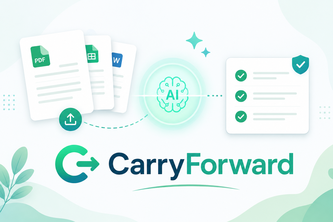
CarryForward is a self-reported AI-powered document readiness-checking tool designed to help users identify mismatches, conflicts, missing information, or unclear data in documents before submitting them for applications (e.g., university admissions, scholarships). It allows users to define what requirements are needed, upload relevant documents, and receive a structured output showing whether each requirement is matched, conflicting, missing, or unclear. The tool uses AI for extracting visible facts from uploaded files and applies rule-based logic to compare those facts against user-defined requirements.
What changed
This is a self-reported project submitted as part of the OpenAI 2026 hackathon. It was built by a team of three students over a limited timeframe, with no evidence of prior traction or commercial deployment. The authors describe it as a working prototype that could be integrated into real-world systems but do not claim any revenue, customers, or adoption.
Single most important open question
Is there sufficient evidence in the self-reported description to support confidence in CarryForward’s ability to scale beyond a hackathon-level prototype and deliver consistent value at scale?
Note: This analysis is based entirely on the self-reported project description provided by the authors. No third-party verification, historical data, or independent sources are available.
What The Product Actually Is
The description states that CarryForward:
- Is an AI-powered tool for checking document readiness before submission.
- Allows users to specify what requirements are needed (e.g., name, date of birth).
- Accepts PDF, PNG, or JPEG uploads.
- Uses Gemini 2.5 Flash to extract visible facts from documents.
- Applies rule-based logic in TypeScript to determine if the extracted data matches, conflicts, is missing, or is unclear relative to user-defined requirements.
- Provides a Plan B and editable email template for next steps.
It also states that:
- It does not verify document authenticity.
- It does not make eligibility or admission decisions.
- It separates AI extraction from comparison logic to ensure consistency and clarity for users.
Inference: The product is described as a web-based readiness-checking tool, not an identity verification or decision-making platform. Its core function appears to be fact-matching across documents using AI + deterministic rules.
Positioning & Claim Evolution
The authors state:
- CarryForward was inspired by practical problems in rural areas of Pakistan where small paperwork errors cause significant delays and stress.
- It aims to help users find issues before submission, rather than after rejection or delay.
- The tool is positioned as a readiness-checker for applications like university admissions or scholarships.
Inference: The positioning evolved from addressing a local problem (paperwork mismatches in developing countries) to a broader use case of document validation prior to application submission. However, the description does not indicate any shift toward targeting global markets or enterprise clients.
Target Customer & ICP
The description states:
- The tool is intended for individuals applying to universities, scholarships, or other formal processes.
- It targets people in developing countries (specifically Pakistan) who face document-related issues due to spelling mismatches or incomplete paperwork.
- Users define what the application requires and upload their own documents.
Inference: The ICP appears to be individual applicants with limited access to support systems, particularly those dealing with bureaucratic processes that require strict documentation. No evidence of institutional or enterprise adoption is presented.
Business Model & Pricing Evidence
The description does not contain any information about:
- Revenue streams
- Pricing models
- Monetization strategy
- Subscription plans or usage fees
Not evidenced: There is no indication of how the tool would generate revenue or be monetized in a commercial context.
Technical & Delivery Signals
The authors state:
- Built with React, TypeScript, Vite, and Cloudflare Workers.
- Uses Gemini 2.5 Flash for document extraction.
- Employs Codex and GPT-5.6 during development (not used at runtime).
- Implements private R2 storage for temporary files.
- Uses Zod for data validation.
- Includes error handling for file types, network failures, and invalid content.
Inference: The technical stack suggests a modern web application with backend API routes, AI integration, and basic security practices. However, no evidence of production-grade infrastructure or scalability is provided.
Traction & Maturity Signals
The description states:
- The project was built by second-semester students.
- It is described as a working prototype that could be integrated into real systems.
- No mention of users, customers, revenue, or product usage metrics.
- The team tested the tool with fictional records and demo videos.
Not evidenced: There is no evidence of traction, user base, or market validation beyond internal testing and a hackathon submission.
Competitive Context
The description does not include:
- Information about competitors
- Market analysis
- Prior art or similar tools in the space
Not evidenced: No competitive landscape or differentiation from existing solutions is described.
Open Questions & Risks
Key risks identified from the self-reported description:
- Lack of commercial traction or adoption — no evidence of users, customers, or revenue.
- Limited scope and language support — currently only supports English documents.
- Dependency on AI model selection and cost awareness — the team mentions challenges with model choice and token usage.
- No clear path to monetization or scaling — no indication of how the tool would be commercialized.
- Prototype-level maturity — built by students, not a mature product or company.
Inference: The project is at an early stage and lacks evidence of viability as a scalable business model or product.
Questions the description leaves open
- What specific document types or application domains are you targeting beyond English documents?
- How do you plan to handle multilingual support and regional variations in document formats?
- Have you tested the tool with real users outside of your own team or hackathon environment?
- Is there a roadmap for integrating with universities, scholarship platforms, or online portals?
- What are the key assumptions about user behavior and adoption that underpin your product design?
- How do you intend to manage costs associated with AI APIs and backend infrastructure at scale?
- Are there any legal or compliance considerations around handling personal documents in your system?
Overall Assessment
The description indicates that CarryForward is a self-reported hackathon project built by students, not yet proven in production or market. It has no demonstrated traction, revenue, or customer base.
Assessment: Not suitable for investment or partnership at this stage. The tool shows potential as a proof-of-concept but lacks evidence of scalability, commercial viability, or real-world usage. Further due diligence would require demonstration of actual user engagement, technical robustness, and business model clarity.
User Stories BotA demo video on every pull request
Get a demo video on every new feature
GitHub App that watches your pull requests and records a narrated, captioned demo.
Save time on demo prep and make informed decisions faster with a video walkthrough of every new feature.
Source
Submitted to the OpenAI 2026 hackathon on Devpost. Project home on Devpost. Back to the full gallery on Devpost.
This competitive analysis was produced by top-founders.com (opens in a new tab)
Generated by a language model from this project's public Devpost page — its tagline, the author's own write-up and any built-with tags listed there — as captured in August 2026. Short quotations are the author's words. It is an opinion on the idea as a business, not on the people behind it, and it reflects the description as published then. If the project has moved on, request a correction below. The analysis is not independent research and contains no verified traction, revenue or customer data.
An independent guide by KFG International LLC — not affiliated with, endorsed by, or connected to Devpost or OpenAI.