

Archive position — measured, not model output
0 likes on Devpost
2,263 of the 7,850 archived projects have more likes, and 5,587 share exactly 0 — so this project's #7,080 place in the like-ranked listing is a tie-break inside that group, not a ranking.
Projects (log scale)
Likes on Devpost. ▲ marks this project's group.
Show the figures
| Likes | Projects | Share of archive |
|---|---|---|
| 0 | 5,587 | 71.2% |
| 1 | 1,758 | 22.4% |
| 2 | 284 | 3.6% |
| 3–4 | 132 | 1.7% |
| 5–9 | 75 | 1.0% |
| 10+ | 14 | 0.2% |
 User Stories BotA demo video on every pull request
Get a demo video on every new feature
GitHub App that watches your pull requests and records a narrated, captioned demo.
Save time on demo prep and make informed decisions faster with a video walkthrough of every new feature.
Executive Summary
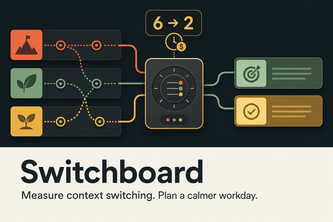
What the company appears to be: Switchboard is a self-reported read-only command center for people operating across several ventures. The author describes it as an application that records deliberate venture transitions, estimates re-orientation costs, and helps redesign a fragmented day.
What changed: The project was submitted to the OpenAI 2026 hackathon. It includes a fictional workday fixture with reproducible results (6 venture switches, 2 cold entries, 74 estimated minutes) and is built using Next.js, React, TypeScript, and GPT-5.6 via Codex.
Single most important open question: Is there any evidence of real-world usage or adoption beyond the fictional demo? The description states no revenue, customers, or traction data are available beyond what the author reports.
What The Product Actually Is
The description states that Switchboard is a read-only command center for people operating across several ventures. It includes:
- An in-memory switch session
- Structured venture re-entry briefings
- A validated cross-venture priority merge
- A lower-switch venture-block planner
- Daily closeout narration
- An inspectable measurement explanation
- A fixed fictional judge workday requiring no account or credentials
The product is described as a deterministic planning model, not a scientific claim about productivity loss. It uses AI to propose complete venture orders but does not supply the success metric.
Evidence: The author's own write-up describes these features in detail.
Positioning & Claim Evolution
The project’s tagline is: “Measure cross-venture context switching, explain the cost, and plan a calmer workday.”
The description states that the product was built as part of an OpenAI 2026 hackathon submission. It includes:
- A fictional workday fixture with reproducible results
- Use of GPT-5.6 via Codex for building the project
- Emphasis on deterministic behavior and transparency in AI use
There is no evidence of prior positioning or evolution beyond this single submission.
Evidence: Self-reported by the author; no external claims or historical context provided.
Target Customer & ICP
The description states that Switchboard targets people operating across several ventures. It does not define a specific customer segment or ideal customer profile (ICP) beyond this general use case.
Evidence: The author describes the target as "people operating across several ventures" but provides no further segmentation or persona details.
Business Model & Pricing Evidence
There is no evidence of any business model or pricing structure in the description. The project is presented as a hackathon submission with no indication of monetization, subscriptions, or paid features.
Evidence: Not evidenced.
Technical & Delivery Signals
The product is built using:
- Next.js 16 and React 19
- TypeScript
- Zod for validation
- OpenAI Responses API
- Vercel deployment
- Codex used in development
It includes:
- Deterministic measurement spine
- AI-assisted flows that return mock data when no API key is present
- Server routes supporting briefing, ranking, planning, and closeout narration
- Shared Read-Only Guarantee (no task completion, messaging, scheduling, deletion, or venture-data mutation)
- Public repository with tests, fixtures, and documentation
Evidence: The author describes the technical stack and architecture in detail.
Traction & Maturity Signals
There is no evidence of traction, revenue, customers, or adoption beyond the fictional demo. The project is described as a hackathon submission with no indication of real-world usage or product-market fit.
Evidence: Not evidenced.
Competitive Context
The description does not mention any competitors or competitive landscape. It focuses only on the internal design and functionality of Switchboard.
Evidence: Not evidenced.
Open Questions & Risks
- The project is a hackathon submission with no evidence of real-world usage.
- No revenue, customers, or traction data are reported.
- The product is described as read-only, limiting its potential for growth or monetization.
- The use of mock data in the demo may obscure whether the AI components function properly in live scenarios.
Inference: These points are drawn from the lack of evidence and the nature of a hackathon project.
Questions the description leaves open
- What is the intended path to market for this product beyond the hackathon?
- Are there any plans to move beyond the read-only model or add user persistence?
- How would you validate that the assumptions used in estimating switch costs align with real-world productivity loss?
- Is there any plan to integrate actual user feedback or data into the estimator?
- What are the next steps for product development, and how do they align with potential customer needs?
Overall Assessment
The project is a self-reported hackathon submission with no evidence of traction, revenue, or customer adoption. It is described as read-only and deterministic in nature, with no indication of monetization or scalability.
Confidence: Low — based entirely on the author’s own description, which lacks any independent verification or data on usage or performance.
Assessment: Not ready for investment or partnership consideration without further evidence of product-market fit, traction, or a clear path to commercial viability.
User Stories BotA demo video on every pull request
Get a demo video on every new feature
GitHub App that watches your pull requests and records a narrated, captioned demo.
Save time on demo prep and make informed decisions faster with a video walkthrough of every new feature.
Source
Submitted to the OpenAI 2026 hackathon on Devpost. Project home on Devpost. Back to the full gallery on Devpost.
This competitive analysis was produced by top-founders.com (opens in a new tab)
Generated by a language model from this project's public Devpost page — its tagline, the author's own write-up and any built-with tags listed there — as captured in August 2026. Short quotations are the author's words. It is an opinion on the idea as a business, not on the people behind it, and it reflects the description as published then. If the project has moved on, request a correction below. The analysis is not independent research and contains no verified traction, revenue or customer data.
An independent guide by KFG International LLC — not affiliated with, endorsed by, or connected to Devpost or OpenAI.